
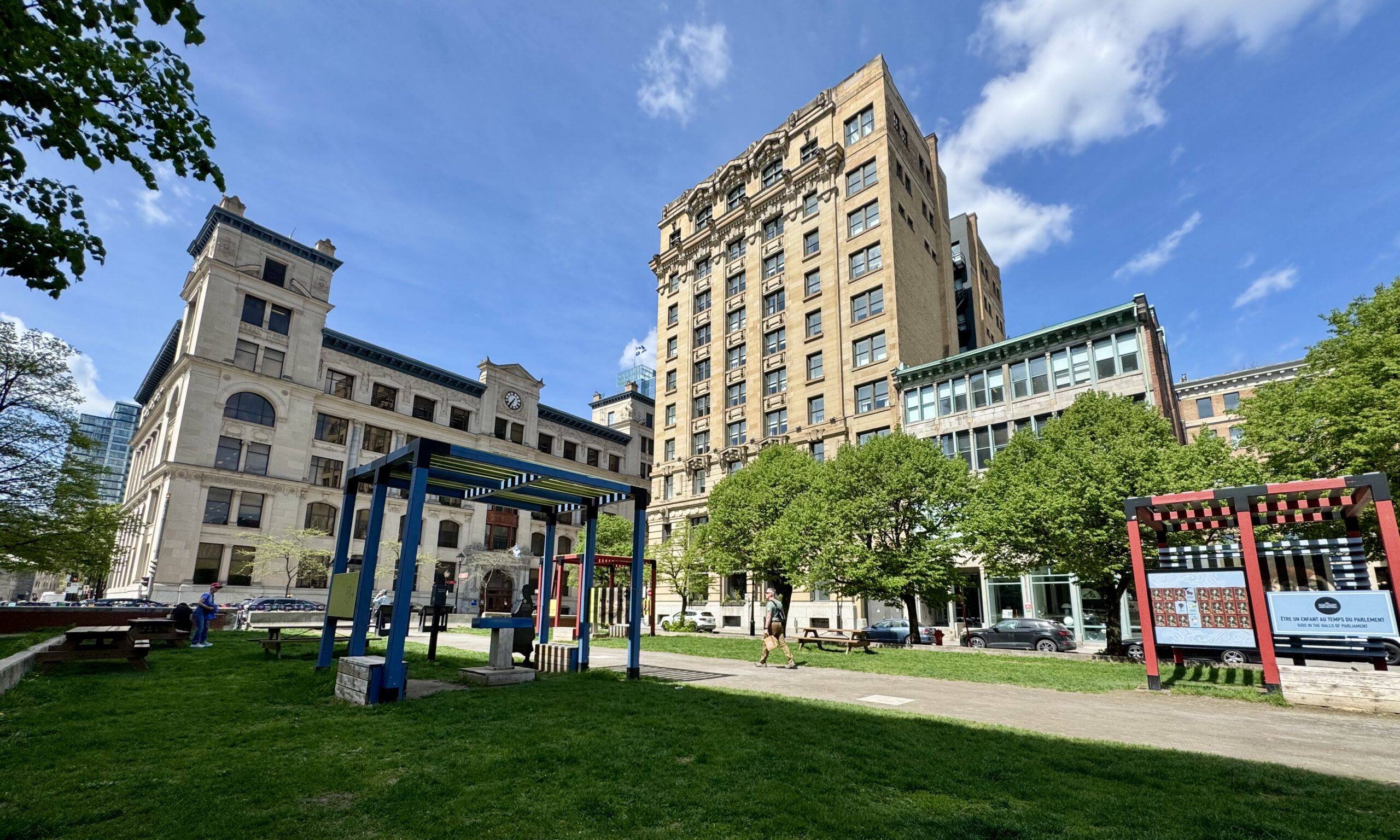
May 20th, 10 AM. Twenty-three degrees and the wind is moving through the field in a way that keeps changing its mind. I’m sitting near the old Customs House, just off rue McGill, in what is now a wide green space ringed with historical plaques. This is where the first Parliament of the Province of Canada convened in 1844. The building burned in 1849. A mob set it on fire the night Governor General Elgin signed the Rebellion Losses Bill. The plaques are careful about this.
I came here without a book, which almost never happens. I’d nearly finished the nonfiction I’d been reading and realized it on the walk over, so I stopped at a nearby bookstore, bilingual, Francophone in its orientation. I wanted fiction for once. Something more porous, less argumentative. I asked if they had anything by Black Québécois authors in French.
The question on the face.
What followed was Dany Laferrière, of course, and then a migration story. When I said migration wasn’t the direction I was looking for, the category shifted without either of us naming the shift: non-Black Palestinian and Colombian authors. I clarified. Black francophone fiction, I said, broadening it, not requiring Québec specifically. That didn’t help either. The broader frame returned the same result.
Each time I offered more information about what I was actually asking for, something tightened in the person’s jaw. At some point I watched her notice the same gap I’d been watching from the beginning. That must have done something to her. Being seen not to know by the person you couldn’t locate.
The reflex is what I keep returning to. If I had walked in and asked for Québec literature with no further specification, I suspect the shelf would have looked different. The reflex showed it. If every Black Québec story is for you a story about arriving, you cannot imagine Black people as having always already been here. And if your frame for not-white is general enough that Palestinian and Colombian and Black are interchangeable categories, then Blackness isn’t what you’re reaching for. It’s a placeholder. It’s difference, undifferentiated, available to be filled with whatever the shelf has to offer.
The presence precedes the Haitian immigration narrative by centuries. Black people were enslaved in Nouvelle-France. In this city. In the predecessors of these buildings. The Parliament whose ground I’m sitting on held its first session while that history was still recent and living in specific bodies. Charlène Lusikila and I traced some of this a few years ago, in a paper about why the intercultural frame in social work keeps failing Black Montrealers: treating Blackness as something that arrived, rather than something the city was organized against from the beginning.
There are no plaques for that. The city decided what to mark. The decision is ongoing.
Near the end of the conversation, the person pulled out a book by Rebecca Makonnen. Transracial adoptee, they said, with a slight shift in register, as though this were a different route to the same destination, more legible somehow. And I’ve been sitting with that grammar ever since. Laferrière gets to be called Québécois now. He’s Haitian, too, and I’m not taking anything away from what that means. But notice what had to happen first. The migrant who earns recognition through what the community decides is exemplary. The adoptee. Each route requires prior authorization from the same structure that just spent ten minutes finding me migration stories when I asked for Québec literature.
I could claim Québécois. The claim would be legitimate. I’ve been here long enough, loved this place through several versions of itself and several versions of myself. What resists in me when I reach for that word is not uncertainty about who I am. It is the specific difficulty of loving a society that keeps showing you the conditions attached to its love. Loving it anyway. Both of those things are true and they don’t resolve each other and I’ve stopped asking them to.
All I wanted was literature.
The field is quiet. A few tourists reading the plaques with the careful attention of people who arrived this morning and will leave by evening. The St. Lawrence is so close to here, obscured by the Customs House to my left, the one that has been deciding what moves through it since 1838. The new book is in my bag, barely opened, bought because it was the least fraught option available.
The city put a park here. The grass is doing its patient work over the ground where the Parliament burned and the river keeps moving past all of it, indifferent and uninterrupted. The wind is still changing its mind.
I might return the book.
Leave a Reply