
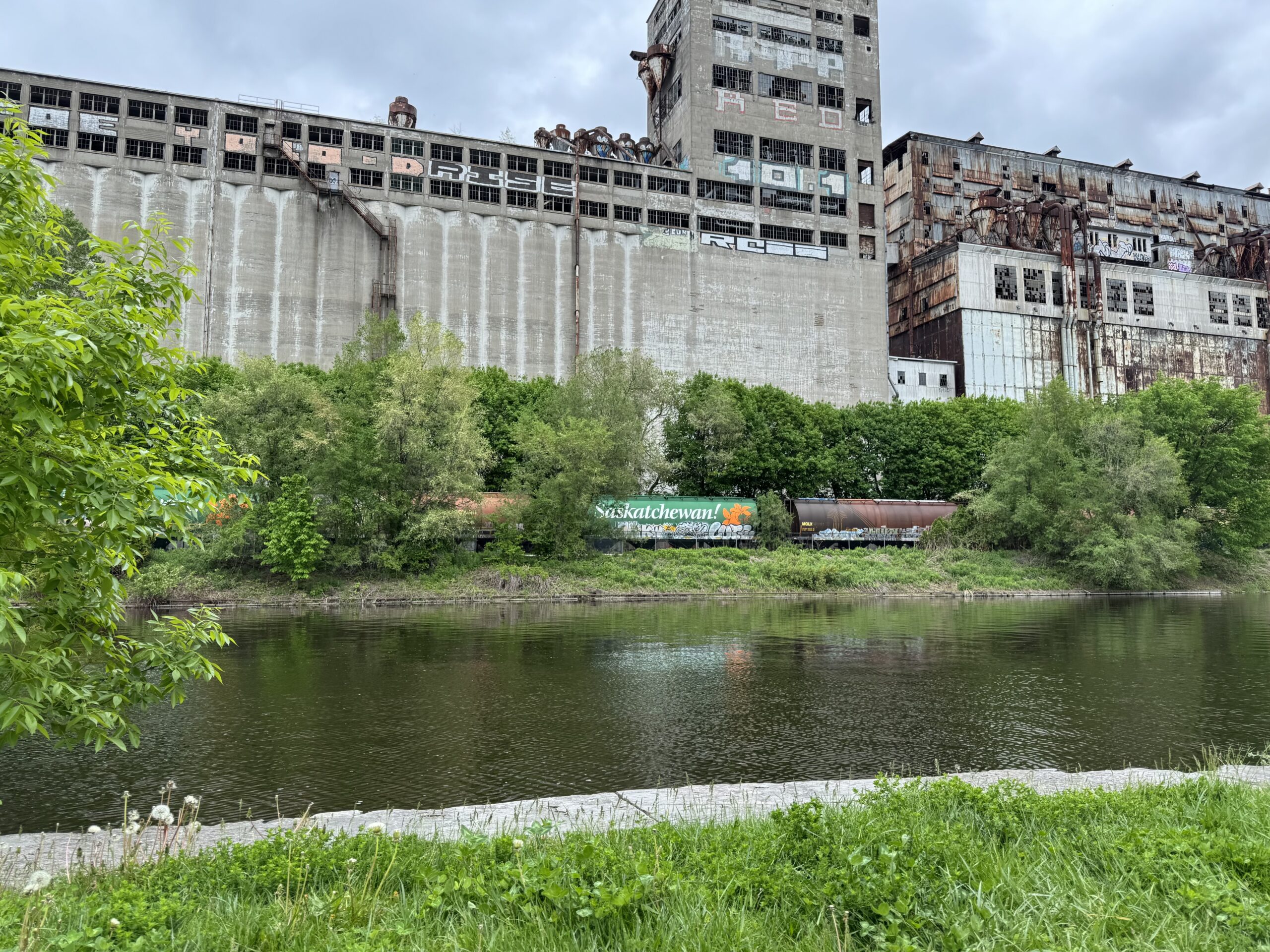
The train came through while I was still settling into the grass, while the ground was still negotiating with my weight. Slow, rounded cars on the tracks between the canal bank and the silo, heading toward the harbour. I could read the side of one as it passed. Saskatchewan! with the exclamation point. Green paint, the province’s name in a typeface that expects enthusiasm. The train slowed. Stopped.
I’d come from my coffee shop. The usual people, the particular warmth of a Thursday morning in a place that has become a place, where someone knows to ask what you’ve been reading. Someone asked what I’d recommend and I said All About Love by bell hooks without having to think about it. Then I walked here, to this thin strip of grass between the canal and the river, Lock No. 1 just down from where I’ve settled, the Daniel McAllister moored somewhere behind me. I didn’t decide to come. The body has been here enough times to know the way.
The grass is long and undisturbed around me, dandelions in every stage, some still yellow, some gone to seed, the white puffs of them catching what little light the grey sky is offering. Gulls overhead. The canal moving the way still water moves, everything happening at the surface, nothing disclosed about what’s underneath.
The car is across the water, directly in front of Silo No. 5. The silo is nearly half a kilometer of corrugated metal and concrete cylinders, the last structure of its kind in the country, built to receive grain shipped by rail from the prairies and export it by sea to Europe. Its scale is wrong against the sky in the way that only very old industrial things are wrong, too large to be decorative, too ruined to be functional, present in the way that monuments are present even when no one intended a monument. The tracks run directly into the building. Tags on its walls reach floors that require real commitment to reach, people going to extreme lengths to mark presence on something the city hasn’t decided what to do with, evidence of unauthorized arrival at heights that shouldn’t be accessible. The car sits below all of it, still announcing itself, grain from treaty land at the door of a building that stopped opening thirty years ago.
I don’t know what to do with any of this. I keep looking.
Leanne Betasamosake Simpson writes that the first thing a snowflake does when it lands is form bonds with its neighbors. A snowflake lands and immediately begins joining. Slow deformation. She calls it sintering: communal transformation, bonds with staying power. Fractal. What we do on a small scale is how we exist at the large scale.
I’ve been coming to this water since winter. Sintering. Forming bonds at this bank through repetition that accumulated across a season, a snowpack building without announcement. When I started coming here the canal was grey and iced-over, the willows bare, the bank a different kind of undisturbed. The willows have leafed out since then. The dandelions have gone through their whole cycle and started again. I finished Theory of Water a few days ago and recognized something I had already been doing, the practice visible in retrospect the way a path through grass is visible only after it’s been walked enough times. Simpson gave me the word after the knowing had already happened.
The grass holds the shape of me. The sky is doing what it’s been doing all morning. Across the water the silo stands in its wrongness against the clouds, the same wrongness it had in February when I first sat across from it, and I am a different kind of settled than I was then, bonded to this bank through the accumulation of mornings, through every time the body led and the mind followed after.
There’s a water strider near the edge of the canal, just below where I’m sitting. It moves in short quick jumps, and where it lands it leaves a small circular ripple that moves outward and flattens before the next one arrives. The ripple moves through water going somewhere: canal to river to St. Lawrence to Atlantic. The strider doesn’t know. It leaves its mark anyway.
Simpson writes that her ancestors spoke to their ancestors through the sound of rushing water, and that locks close off those channels of communication. Lock No. 1 is just down from me, the Lachine Canal cutting through Kanien’kehá:ke territory since the 1820s to make this stretch of the river legible to colonial commerce, to move grain and goods eastward toward the sea. The locks try to control what the water does, but it always finds its way past the container, moving through the gates regardless. The sound is still there.
The water moves east. The St. Lawrence runs to the Atlantic. I look at the surface of the canal, the way it holds the grey of the sky without giving it back, dark green-brown and nearly opaque, the colour of something that keeps rather than reflects. You cannot see the bottom. You cannot see what the water is holding. This is what the water always looks like from here, from the mouth of things, where the canal opens into river opens into sea. I have been looking at this surface since February and it has never once disclosed what is underneath.
Christina Sharpe writes about residence time, the oceanographic measure of how long an element stays in the water. Sodium has a residence time of 260 million years. Sharpe thinks this alongside those Africans thrown, dumped, jumped overboard during the Middle Passage. She is not speaking in metaphor. The chemistry of seawater holds what entered it. The dead did not go somewhere else. They have a residence time. They are in the water still, in what Sharpe calls the wake, which is the path behind a ship, which is a keeping watch with the dead, which is a coming to consciousness all at once. Alexis Pauline Gumbs has listened for them in that water, attended to what it carries, what it will not release. Simpson has learned from them both, has brought this knowledge to this river, to this territory, to me sitting at the mouth of the canal on a grey Thursday morning in May not knowing what I am sitting beside until I do.
Every drop of water on this planet is all the water that has ever been here. The canal is fed by the St. Lawrence. The St. Lawrence opens to the Atlantic. The Atlantic received my ancestors, which means the Atlantic holds them still. There is no distance in this. I am not drawing a line between here and there. I am sitting at the mouth of the canal, at the threshold where the water I have been looking at since winter opens into the water that has never stopped being a grave, and they are not two different bodies of water. The surface in front of me is the same surface. The opacity I have been looking at all morning, the water that holds the sky without giving it back, is holding other things too, has always been holding them, will hold them for longer than I can think about without losing my footing. 260 million years. The dead are not in the past. They are in the residence time, which means they are here, which means the water I have been sintering beside, forming my small bonds, accumulating my mornings, is the same water that received them and did not let go.
The water strider leaves its mark. The ripple moves through what is, and has always been, full.
Down at the lock, people are fishing. Unhurried, present, the particular stillness of people who have been at the water long enough to stop waiting for something to happen. The sound of water moving through the gates, which Simpson’s ancestors might have known as something else entirely.
This has always been a meeting place. Long before the canal was cut and the locks built and the silo raised, this convergence of water gathered people because the water itself required it. Confluence produces meeting the way certain conditions produce certain weathers, because a place where waters join is a place where everything moving along those waters eventually arrives. You don’t choose a meeting place so much as find yourself already in one.
I arrived here through repetition without deciding to. The water required it.
The sound at the lock. The people still fishing. The silo enormous and still across the water, the tracks below it empty now.
At the end of this month I hand in the dissertation. Then the defense. Then it leaves my hands and becomes whatever it becomes in other people’s hands. I have been building this argument for years, and the months at this water were part of that, the body arriving here before the mind had a name for why. I’m standing at a confluence, the way this canal opens into the St. Lawrence opens into whatever is further east, the water moving past the point where you can follow it. You don’t choose what comes next so much as find yourself already in it.
At some point while I was sitting here the Saskatchewan! car moved on. I got a photo before it did, from where I was in the grass, but the train has continued toward the harbour or somewhere further east. The silo is still there. The tracks are still there. The locks, the people fishing, the sound of water moving through the gates. The dandelion puffs lifting off one by one into the grey air.
The car said what it said and kept moving. I get up from the grass and go.
Leave a Reply