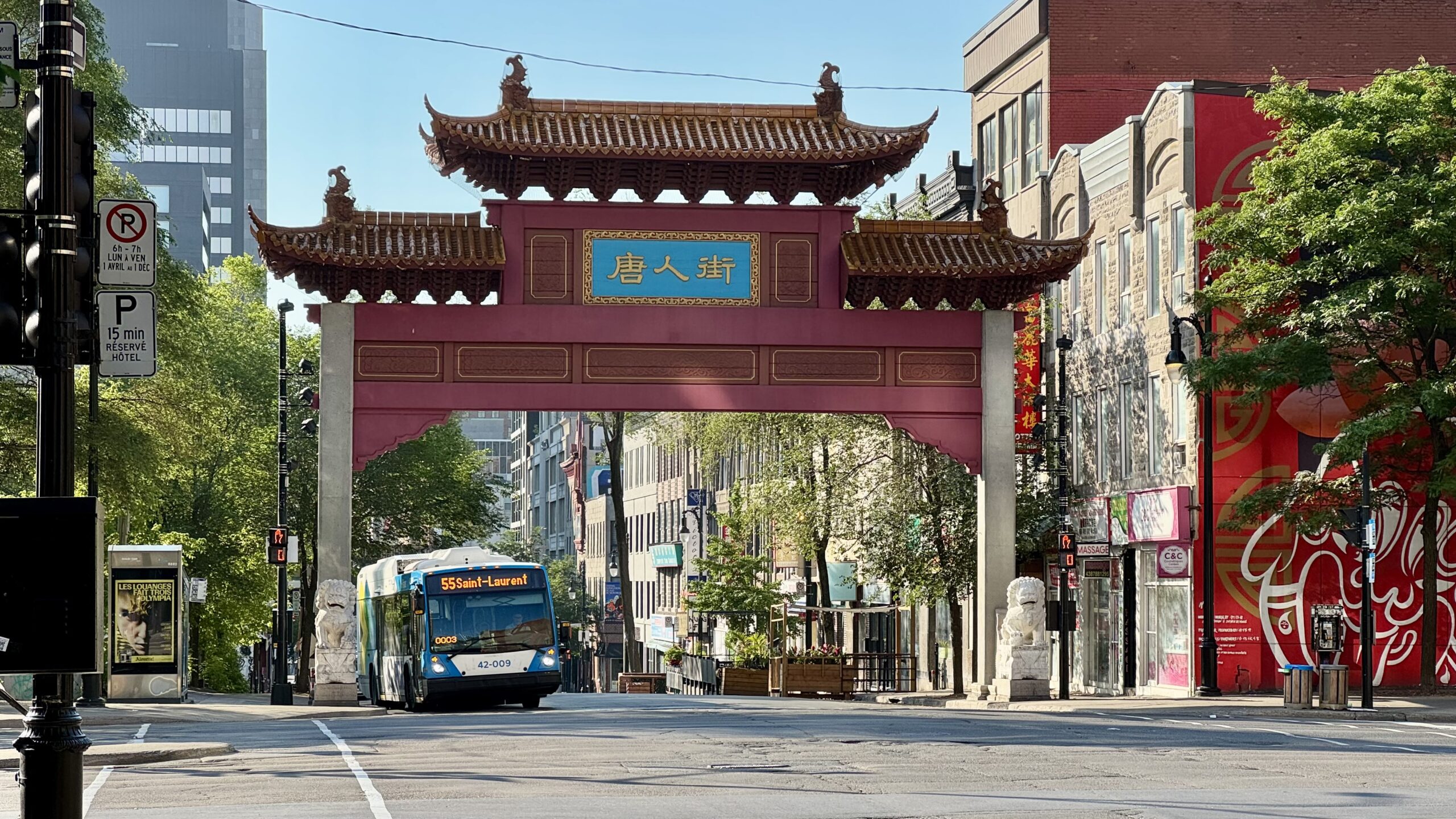
July 8. Sunny. I pass under the Chinatown gate a little after seven, heading down Saint-Laurent toward the water. This is one of a few routes I take most mornings, meandering through the Quartier des Spectacles some days, down along René-Lévesque others, but they tend to end the same way, at the river.
I couldn’t sleep, which is why I’ve been up since six thirty or so. The sun was barely up. Construction vehicles made their slow way down the cobblestones on Sainte-Catherine, and crews were taking down the stages from the jazz festival and the Francos, packing up the tents that covered the VIP areas, loading the barricades noisily onto a flatbed truck. On a festival night at nine, the whole city presses into that square and the stages look like they were always meant to be there. This morning they were planks and cable, and the people touching them were thinking about their shift, their coffee, the hour. The square was built to be watched. Nobody was watching it under this morning light, and it went about its other life.
There is something about being in a space at a moment when its occupation isn’t its principal concern. The streets get louder around this time. People hurry through the métro stations toward work or school. I was the only one wandering, and I was wandering because last night the framed picture on the wall beside my bed flew off the wall when I adjusted the curtains. I was tired. I opened them without much attention and the frame came down and broke. This happened in the same weeks I’d been telling people my dissertation is finished. I handed it in at the beginning of June. It’s out of my hands. It’s also waiting for a defence date, and a position I want to apply for needs that defence done by mid-August. I no longer know if that’s possible. Finished is a word I have been using the way the festivals use their stages. It holds the square together for the night. In the morning there are planks.
I keep thinking about the ball last week. If a stage can come down overnight because a festival ends, a community can be taken apart just as fast by a policy that decides who gets to stay. Some people I love from the scene here were forced back to Europe, largely because of what immigration policy in this province has become. They were hired to come back for a week, to give workshops, to be celebrated. The room was love and joy and it was exactly what I needed. What stays with me is the shape of it. A community looked at an absence that policy had made and decided it wouldn’t stand, at least for a short time. People coordinated resources and made calls and booked flights so that a thing that’d been taken apart could be put back together in front of everyone. I’ve watched this city dismantle a lot. I’d forgotten how deliberately it can also rebuild.
Ten years ago I moved here from Ottawa. Ten years before that I left home at fifteen, out of a childhood I’ll leave folded for now, except to say that leaving was how I survived it. Now I am 36, and the itch has been building for over a year, stretched across my body and my writing both, the same restlessness surfacing in what I make as much as in what I feel. For the past year I have been telling myself the story that the city is drawing something out of me and the drawing points toward departure. But I’ve started to notice the arithmetic. Every ten years or so my body announces that it is time to go, and every ten years I have believed the announcement was about the place. Leaving has always been my first answer, formed long before any of the questions I have since applied it to. It’s possible that safety lives in this city. It’s possible that Tiohtià:ke holds what I’ve been looking for, and that the itch is an old reflex arriving on time. If I leave, I want it to be because something specific needs to be better somewhere else. I want departure to be a decision I make with my whole attention, the opposite of how I opened the curtains.
So I keep going past the gate, down to the edge, where I have been taking my coffee most mornings. I sit in the shade with a book or my laptop and look out over Habitat 67, watch the river move in its slow waves against the docks, hear the hulls knock against them, the water carrying a mineral cold up off its surface even in July. See the Tower of the Port of Montréal on the far side. The river keeps its own schedule. It was moving before the festival infrastructure went up and it will be moving after, and it was moving before me, and my people crossed water I will never fully account for. This is where I go back to the ancestors, the ones the trade took, the ones the water carried and didn’t carry back. When I sit there long enough, the question of leaving gets quieter. The water makes the question wait, the way the square waits under morning light for whatever it’ll become next.
I don’t know what to do with all of this yet. I know there’s value in it. I know I’m not finished, and for once I’m saying that word carefully.
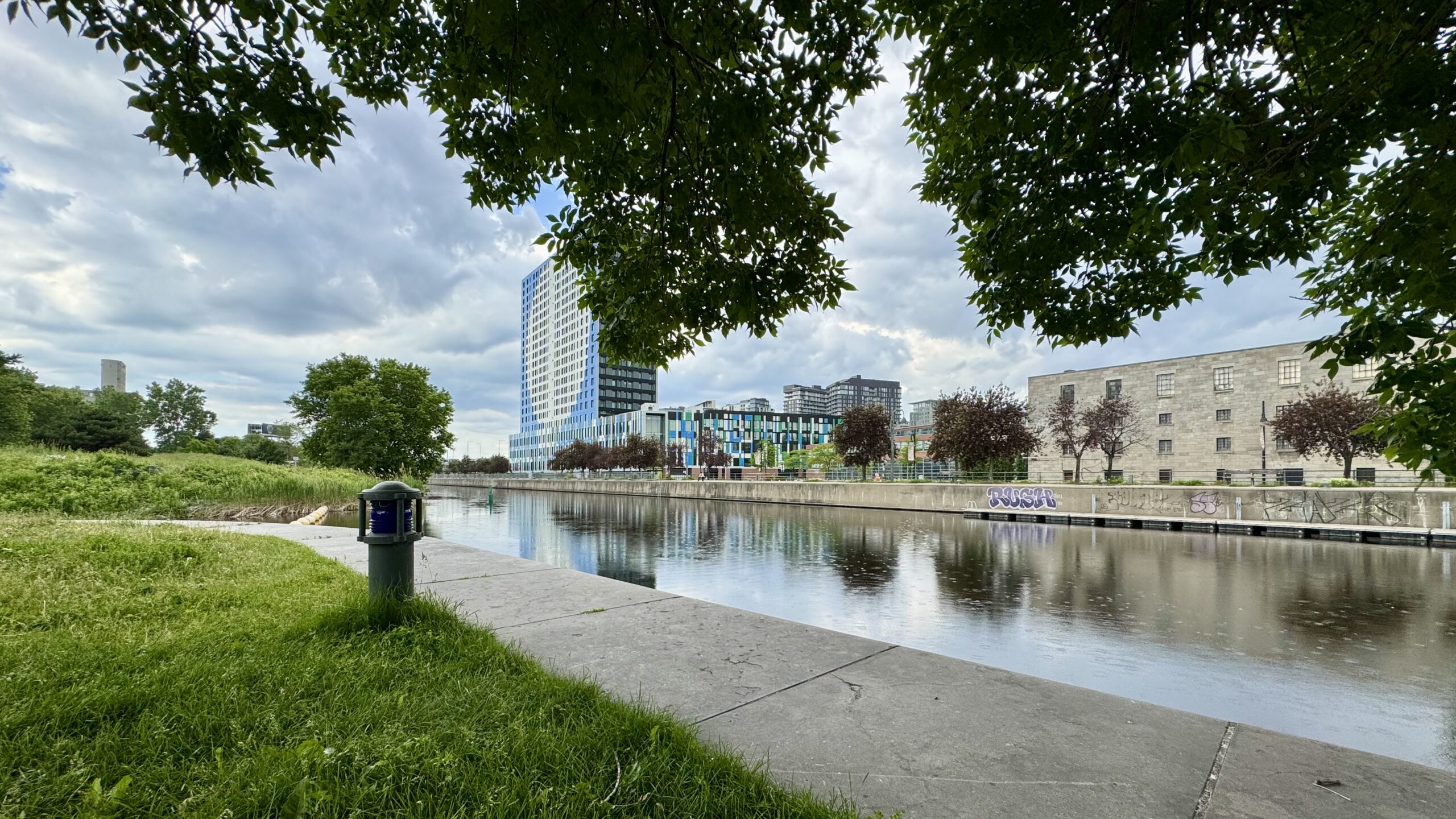
Eight-thirty and I’ve been awake since six. The body has been doing this since I sent the dissertation in: waking itself before I decide to wake, some obscure bodily alarm I didn’t set going off in the dark. I ended up at a coffee shop I’d never tried before–less by choice and moreso because all my usual spots are all still closed–an oat milk moka slowly going cold in my hand. I don’t fully know why I came to sit here, under this ash tree at the edge of the Lachine Canal, except that the body has been leading and the mind has been following.
The bike path is busy even now, this early. Commuters, runners, a construction worker setting out cones thirty meters from where I’m sitting. Birds are picking crumbs off the stone edge of the canal, and I can see an RTL bus from Longueuil crossing the Mill Street bridge above my right shoulder, moving through without stopping.
The story broke a few days ago: officers from Station 39 in Montréal-Nord had been stopping Black men and men of Arab origin at rates that required formal explanation, issuing tickets on the basis of ethnicity, making racist remarks inside a unit culture that circulated them as ordinary. The investigation had started in March, already underway before anyone outside the unit knew to ask. Then, in the coverage, a detail: some of them had been ripping off locs during police interventions and keeping the pieces as trophies.
Trophies.
What I notice is which part of this incident dominated the headlines. The stops, the tickets, and the remarks are the texture of daily life for people in that neighbourhood: the unremarkable climate of being under a specific kind of management. It took the “trophies” to produce the press conference, the mayor calling it disturbing, the police chief holding the room with his own face as evidence that the institution has changed. Frank B. Wilderson writes that anti-Black violence circulates as atmosphere, the condition against which civil society confirms its own moral coherence. Scandals like this, almost predictable in their recurrence, are necessary precisely because the atmosphere is not. The trophy takes the heat so the remarks and the tickets and stops don’t have to. Then the reform response arrives on cue: body cameras, reassignments, oversight, the machinery that allows the atmosphere to be named without being changed.
This logic doesn’t stop at the institution. A progressive journalist in this city who has covered SPVM violence for years and has built a sizeable following opened their Station 39 video with: “The SPVM is scalping people.” The image is vivid, which is the point, which is also the problem. Anti-Black violence is passing through a progressive media network as affective content, producing moral feeling in audiences who will likely never be stopped in Montréal-Nord on a humid Tuesday evening. The feeling confirms alignment: it circulates, metabolizes into outrage, and then the next story accumulates. I want to be clear about this: none of this requires bad faith. Civil society built the execution scaffold, and we mount it before we decide to. This is what Wilderson means by background affect: the Black body in pain as the ground condition that civil society, including its critics, requires in order to feel itself.
Vincent Woodard writes about the consumption of Black bodies as inherited logic: the taking and keeping of the souvenir. Locs accumulate over months and years, the hair carrying its own time, and cutting them during an intervention is taking that time alongside the dignity and the agency and the flesh. What the officer does with the trophy and what the viewer does with the progressive journalist’s video share a structure. In both cases, the Black body is made available to someone who is not subject to it, received and held briefly, used to produce something — possession, feeling, the confirmation of one’s moral position — and then the Black body remains where it was: in Montréal-Nord, subject to the next ticket, the next racist remark, the next unjustified stop. The trophy is the version that made the condition legible. The underlying assumption was already there before the scissors, before the camera, in every interaction that didn’t make anyone’s feed.
Saidiya Hartman says gratuitous violence doesn’t require justification. It enacts a prior condition. The analysis is not a shield against it. I have been studying this for four years. The dissertation on my committee’s desks right now is over a hundred pages about how communities care for themselves when institutions won’t, and I am sitting here under this ash tree at eight-thirty in the morning with a chest that weighs more than it did yesterday. The knowing doesn’t stop the landing.
A duck comes down the canal with a few others trailing. The water here is built, cut through Kanien’kehá:ka territory in the 1820s to make commerce legible, to route water according to a particular purpose, to bend it to the capitalist’s will. There is still life in it. Their attempts at control failed, as they always do. Water finds a way.
Christina Sharpe writes about residence time, the measure of how long an element stays in water. Sodium for 260 million years. The water doesn’t release what entered it. This canal connects to the St. Lawrence connects to the Atlantic, and the Atlantic received—and the Atlantic holds. Holds the bodies, holds the names that were never written down, holds the ones whose lives were rendered unremarkable long before the Station 39 officers kept their trophies. The surface in front of me has always been holding something it won’t disclose, and I have been sitting beside it long enough that I stopped checking.
I was starting to gather myself to go when I realized it was raining. Had been raining for a little while, actually. There was no forecast for it, so I hadn’t brought an umbrella. The ash tree had been holding it off without asking—the canopy dense enough to keep me dry—while the canal surface in front of me was already pocked with it, thousands of small entries. I hadn’t noticed because I was protected. I don’t know how long I’d been sitting inside this weather I couldn’t feel.
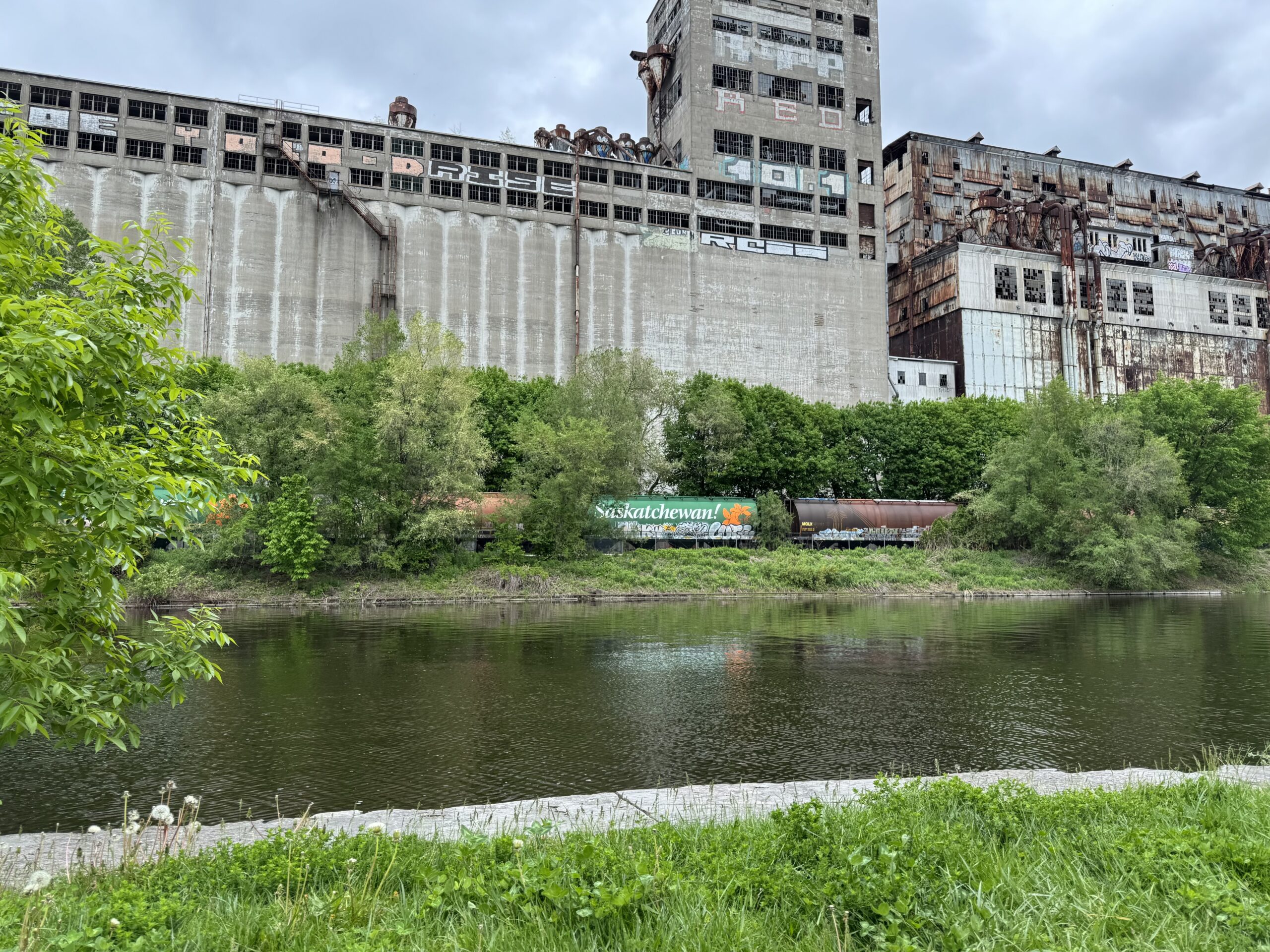
The train came through while I was still settling into the grass, while the ground was still negotiating with my weight. Slow, rounded cars on the tracks between the canal bank and the silo, heading toward the harbour. I could read the side of one as it passed. Saskatchewan! with the exclamation point. Green paint, the province’s name in a typeface that expects enthusiasm. The train slowed. Stopped.
I’d come from my coffee shop. The usual people, the particular warmth of a Thursday morning in a place that has become a place, where someone knows to ask what you’ve been reading. Someone asked what I’d recommend and I said All About Love by bell hooks without having to think about it. Then I walked here, to this thin strip of grass between the canal and the river, Lock No. 1 just down from where I’ve settled, the Daniel McAllister moored somewhere behind me. I didn’t decide to come. The body has been here enough times to know the way.
The grass is long and undisturbed around me, dandelions in every stage, some still yellow, some gone to seed, the white puffs of them catching what little light the grey sky is offering. Gulls overhead. The canal moving the way still water moves, everything happening at the surface, nothing disclosed about what’s underneath.
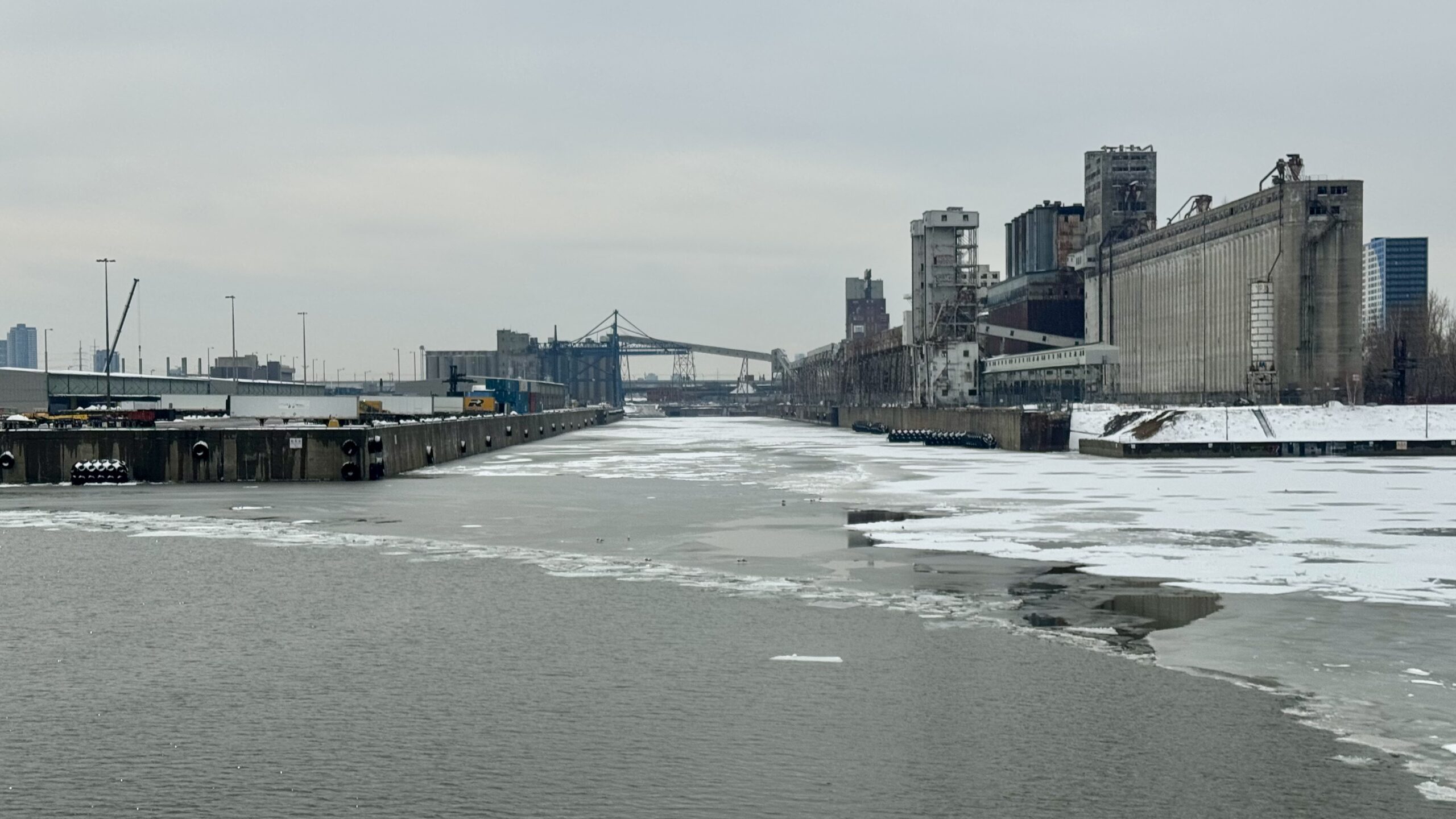
The car is across the water, directly in front of Silo No. 5. The silo is nearly half a kilometer of corrugated metal and concrete cylinders, the last structure of its kind in the country, built to receive grain shipped by rail from the prairies and export it by sea to Europe. Its scale is wrong against the sky in the way that only very old industrial things are wrong, too large to be decorative, too ruined to be functional, present in the way that monuments are present even when no one intended a monument. The tracks run directly into the building. Tags on its walls reach floors that require real commitment to reach, people going to extreme lengths to mark presence on something the city hasn’t decided what to do with, evidence of unauthorized arrival at heights that shouldn’t be accessible. The car sits below all of it, still announcing itself, grain from treaty land at the door of a building that stopped opening thirty years ago.
I don’t know what to do with any of this. I keep looking.
Leanne Betasamosake Simpson writes that the first thing a snowflake does when it lands is form bonds with its neighbors. A snowflake lands and immediately begins joining. Slow deformation. She calls it sintering: communal transformation, bonds with staying power. Fractal. What we do on a small scale is how we exist at the large scale.
I’ve been coming to this water since winter. Sintering. Forming bonds at this bank through repetition that accumulated across a season, a snowpack building without announcement. When I started coming here the canal was grey and iced-over, the willows bare, the bank a different kind of undisturbed. The willows have leafed out since then. The dandelions have gone through their whole cycle and started again. I finished Theory of Water a few days ago and recognized something I had already been doing, the practice visible in retrospect the way a path through grass is visible only after it’s been walked enough times. Simpson gave me the word after the knowing had already happened.
The grass holds the shape of me. The sky is doing what it’s been doing all morning. Across the water the silo stands in its wrongness against the clouds, the same wrongness it had in February when I first sat across from it, and I am a different kind of settled than I was then, bonded to this bank through the accumulation of mornings, through every time the body led and the mind followed after.
There’s a water strider near the edge of the canal, just below where I’m sitting. It moves in short quick jumps, and where it lands it leaves a small circular ripple that moves outward and flattens before the next one arrives. The ripple moves through water going somewhere: canal to river to St. Lawrence to Atlantic. The strider doesn’t know. It leaves its mark anyway.
Simpson writes that her ancestors spoke to their ancestors through the sound of rushing water, and that locks close off those channels of communication. Lock No. 1 is just down from me, the Lachine Canal cutting through Kanien’kehá:ke territory since the 1820s to make this stretch of the river legible to colonial commerce, to move grain and goods eastward toward the sea. The locks try to control what the water does, but it always finds its way past the container, moving through the gates regardless. The sound is still there.
The water moves east. The St. Lawrence runs to the Atlantic. I look at the surface of the canal, the way it holds the grey of the sky without giving it back, dark green-brown and nearly opaque, the colour of something that keeps rather than reflects. You cannot see the bottom. You cannot see what the water is holding. This is what the water always looks like from here, from the mouth of things, where the canal opens into river opens into sea. I have been looking at this surface since February and it has never once disclosed what is underneath.
Christina Sharpe writes about residence time, the oceanographic measure of how long an element stays in the water. Sodium has a residence time of 260 million years. Sharpe thinks this alongside those Africans thrown, dumped, jumped overboard during the Middle Passage. She is not speaking in metaphor. The chemistry of seawater holds what entered it. The dead did not go somewhere else. They have a residence time. They are in the water still, in what Sharpe calls the wake, which is the path behind a ship, which is a keeping watch with the dead, which is a coming to consciousness all at once. Alexis Pauline Gumbs has listened for them in that water, attended to what it carries, what it will not release. Simpson has learned from them both, has brought this knowledge to this river, to this territory, to me sitting at the mouth of the canal on a grey Thursday morning in May not knowing what I am sitting beside until I do.
Every drop of water on this planet is all the water that has ever been here. The canal is fed by the St. Lawrence. The St. Lawrence opens to the Atlantic. The Atlantic received my ancestors, which means the Atlantic holds them still. There is no distance in this. I am not drawing a line between here and there. I am sitting at the mouth of the canal, at the threshold where the water I have been looking at since winter opens into the water that has never stopped being a grave, and they are not two different bodies of water. The surface in front of me is the same surface. The opacity I have been looking at all morning, the water that holds the sky without giving it back, is holding other things too, has always been holding them, will hold them for longer than I can think about without losing my footing. 260 million years. The dead are not in the past. They are in the residence time, which means they are here, which means the water I have been sintering beside, forming my small bonds, accumulating my mornings, is the same water that received them and did not let go.
The water strider leaves its mark. The ripple moves through what is, and has always been, full.
Down at the lock, people are fishing. Unhurried, present, the particular stillness of people who have been at the water long enough to stop waiting for something to happen. The sound of water moving through the gates, which Simpson’s ancestors might have known as something else entirely.
This has always been a meeting place. Long before the canal was cut and the locks built and the silo raised, this convergence of water gathered people because the water itself required it. Confluence produces meeting the way certain conditions produce certain weathers, because a place where waters join is a place where everything moving along those waters eventually arrives. You don’t choose a meeting place so much as find yourself already in one.
I arrived here through repetition without deciding to. The water required it.
The sound at the lock. The people still fishing. The silo enormous and still across the water, the tracks below it empty now.
At the end of this month I hand in the dissertation. Then the defense. Then it leaves my hands and becomes whatever it becomes in other people’s hands. I have been building this argument for years, and the months at this water were part of that, the body arriving here before the mind had a name for why. I’m standing at a confluence, the way this canal opens into the St. Lawrence opens into whatever is further east, the water moving past the point where you can follow it. You don’t choose what comes next so much as find yourself already in it.
At some point while I was sitting here the Saskatchewan! car moved on. I got a photo before it did, from where I was in the grass, but the train has continued toward the harbour or somewhere further east. The silo is still there. The tracks are still there. The locks, the people fishing, the sound of water moving through the gates. The dandelion puffs lifting off one by one into the grey air.
The car said what it said and kept moving. I get up from the grass and go.
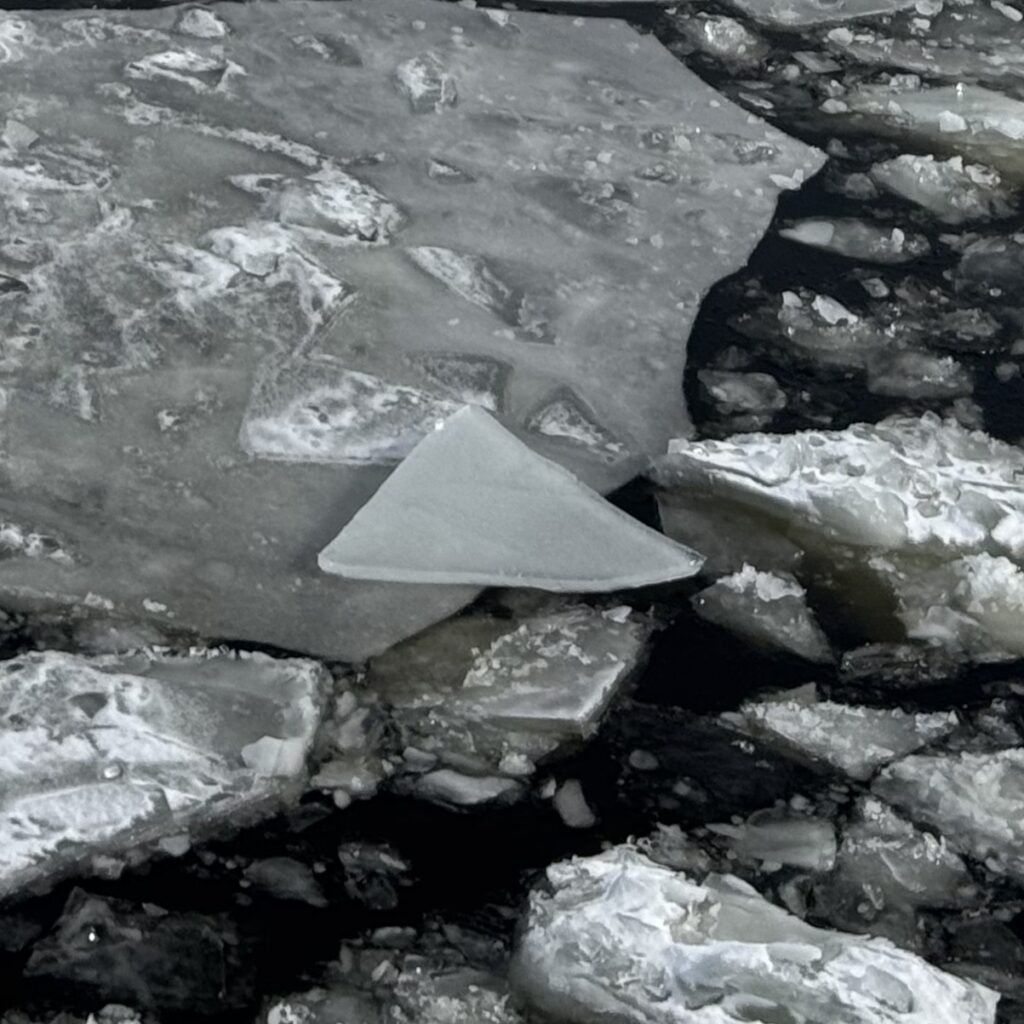
I notice this before I’ve settled fully onto the bench, the oat milk moka still warm between my hands, the pines along the boardwalk doing their slow work in the wind. Habitat 67 sits in my peripheral vision the way it always does. The Jacques-Cartier Bridge. The amusement park still closed for the season, rides standing idle behind the fence. This is the same bench, the same eastward orientation I keep returning to without quite deciding to. The Grand Quai in late April looks like a different river than the one I’ve been sitting with all winter, and in some ways it is. What I’m looking at now is water that has finished its holding. The ice that was here, the particular piece I wrote about once, the one that had taken the shape of a perfect triangle and pointed east the day I submitted my application, is gone. The river took it. That’s what rivers do across a season, with what they’re given.
I came back because the body knew to, before the rest of me had a reason.
Yesterday the city was warm.
I had finished a book on a terrasse on rue Saint-Paul, the last page coming the way last pages do when you’ve been living inside something long enough — not with surprise but with a recognition that the shape had completed itself. I sat with the last sentence for a moment before closing it, the way you sit with the last note of something before the room starts being a room again. Espresso. A crepe. The sun was doing what it had no business doing in the last days of April and rue Saint-Paul was receiving it without question, the old stone of the buildings holding the warmth differently than the glass towers do, softer, like the city remembering an older version of itself. People moved slowly. Faces turned up. I had nowhere to be and the body knew it and settled accordingly, shoulders dropping to a place they haven’t reached in months, the jaw unclenching, the particular luxury of a Tuesday that belongs entirely to itself.
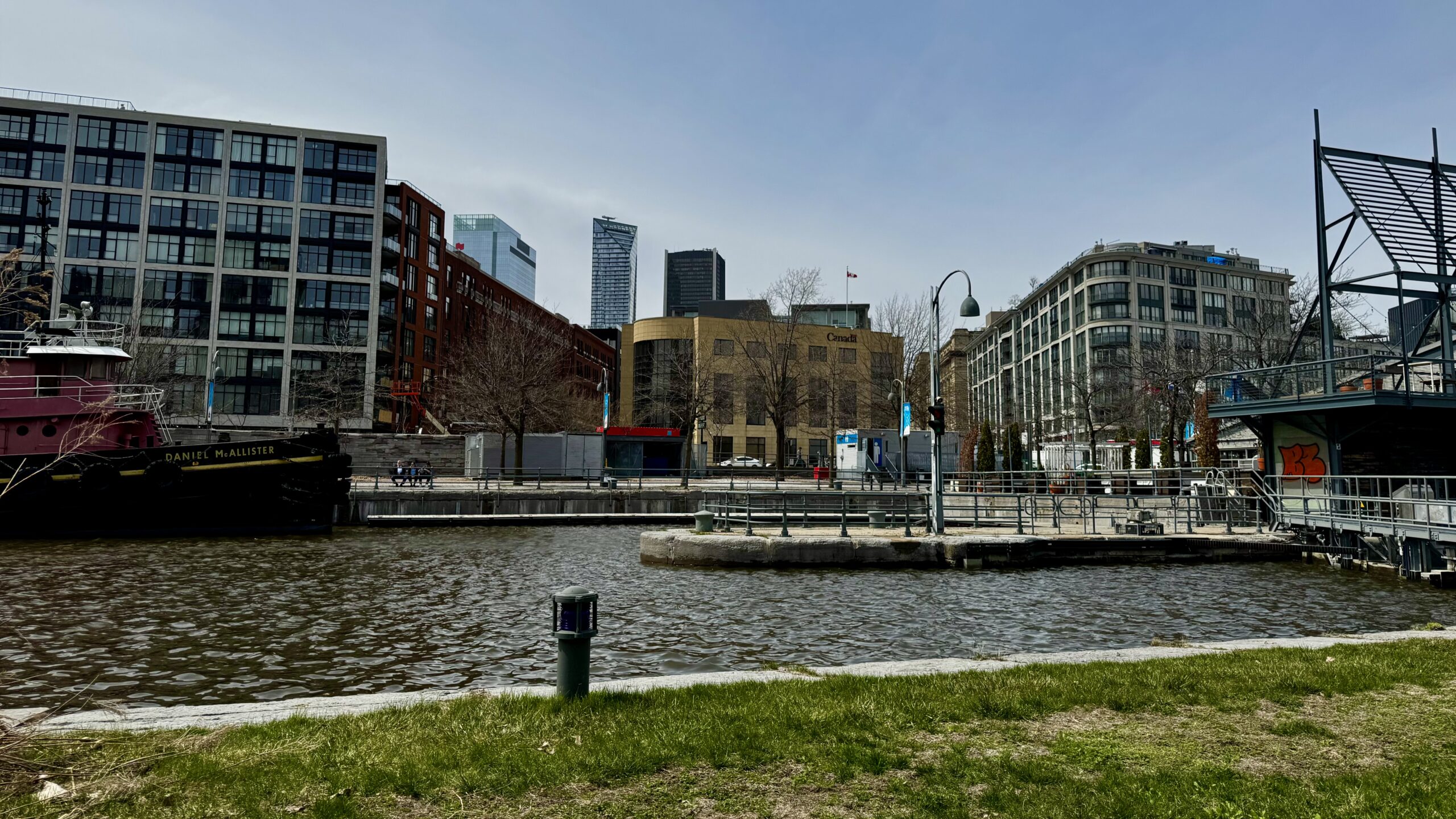
I walked to the Lachine Canal after. The streets through the old port were still carrying the warmth, the light coming off the cobblestones at the angle it only reaches in spring, low and honeyed, the kind of light that makes the familiar look briefly precious. The Daniel McAllister was sitting in the locks the way it always sits, red and massive and indifferent to what the afternoon was doing around it. I found a patch of grass near the water, soft from the recent thaw, and lay down with my backpack as a pillow and let the sun press into my face and chest and the fronts of my hands. The body settled into the ground. The canal moved beside me with the particular quietness of still-cold water in a warm month. Somewhere across the water a bird was doing something persistent. I closed my eyes.
The body was already somewhere it recognized. Water, the eastward pull, the quality of attention that arrives in me when I’ve been near this city’s waterways long enough to stop performing being near them. I didn’t know I had brought anything. I thought I was lying in the sun on a warm day with a finished book and nowhere to be. The email came into that. I stared at the water for a long time after. Not thinking. Not yet. The canal kept moving the way it had been moving before the email arrived, indifferent to the reordering that had just occurred inside my chest. The sun was still doing what it had been doing. The Daniel McAllister hadn’t moved. I lay there with the phone face down on the grass beside me and let the body do what it needed to do with the information before I asked it to do anything else.
Not even an interview.
I knew it before I opened the email. Had known something was coming since morning in the way you know certain things through the body before they arrive as language — a low settling, a particular quality of stillness that isn’t peace. I had been waiting eight weeks. The waiting had lived in my shoulders, in the bracing I’ve been writing about for months, the compression that doesn’t shift with rest or movement. And then the day had been so good. The book finished, the sun, the terrasse, the city briefly being the version of itself that makes you forget you know better. I think now that the body had been preparing the whole time, had been carrying the knowledge forward through the morning and into the afternoon, had found the water and lain down beside it because it knew what was coming and wanted to be somewhere it could receive it.
Four days before this, I was at a ball.
The editor of a collection on queering research methods was in the city — they had already read the chapter I submitted, the one that takes ballroom as its methodological site, had held the manuscript in their hands and followed the argument through — and it happened, the way things sometimes happen in this work, that there was a function that weekend. Le National was filling up as they arrived, the air carrying that particular charge a ballroom space holds before the first category is called, sweat and cologne and anticipation and the low thrum of a sound system that knows what it’s there for. This is my place. The place where my body remembers things about itself it forgets in other rooms.
The commentator was electric that night. It’s the girls I see, it’s the girls I know, it’s the girls I LOVE! — the chant landing and lifting and landing again, the whole room carrying it forward without being asked, the way a room becomes a body when the conditions are right. For Bizarre and Face the effects came out, light and smoke and the particular theatre of a category that understands spectacle as argument, and the walkers moved through it like they had built the universe the effects were gesturing toward, because they had. Then the commentator called for the DJ to cut the beat. Someone deserved their flowers. The praise came slowly and specifically, the way real recognition does when it isn’t performed but meant. I turned to them and said: imagine what a moment like that does for your self image.
They were watching the room the way you watch something you’ve read about but hadn’t yet felt in the body. And I was watching them watch it, and I was also just there, inside the thing my chapter is about, the thing I have been trying to describe in academic language for years, and for a few unrepeatable hours the distance between the researcher and the researched was not a methodological problem I was managing but simply gone. They saw the work in its own element. Saw what the work knows that the chapter can only point toward.
The hiring committee reviewed my file and moved on without making contact.
These are not the same kind of not-being-chosen and my body knows the difference. It also knows the longer record. The tissue that received the email yesterday has received other decisions, earlier ones, ones that arrived before I had language for what it meant to be assessed and found not quite right for the available position. The committee doesn’t know that. The file doesn’t carry it. But the body holds the full archive anyway, and what lands on it now lands on everything already stored there — every room that looked at what I was and made its calculation, every process that moved forward without me, every form of not-being-selected that taught me, before I had words for any of it, that my belonging somewhere was conditional on someone else’s decision. The hiring committee is not the first institution to review my file and conclude I wasn’t what they were looking for. The body has been here before.
What I know is that my work circulates. It reaches into rooms before I do. The professor who was hired for the anti-colonial social work position I applied for once asked me to lecture in one of their courses, on anti-Blackness, because of the strength of what I had built. The editor came to the ball. The work is not invisible. What it is, is illegible to the institutions that would need to legibly credential it in order to shelter it. There is a difference between being seen and being chosen, and I have been living inside that difference long enough to name its specific texture — the way it sits in the chest distinct from ordinary disappointment, distinct from failure. This is not failure. It is something more precise and in some ways more exhausting than failure, because it requires knowing the value of what you’re holding while watching the institution decide it doesn’t know what to do with you.
I have to pay my bills. I don’t have a job. In a few months the PhD will be finished and the structure it provided — the funding, the timeline, the container — will be gone, and the practice is already closed, and the position didn’t come, and I am sitting at the bottom of every scaffold at once. I know the work has value because I have watched it have value, repeatedly, in rooms that received it on its own terms. I am also scared in a way that doesn’t care what I know.
A triangular piece of ice, pointing eastward, on the surface of the Saint Lawrence in late February.
I came back to the Grand Quai this morning because this is where I picked it up.
Eight weeks ago there was ice here. A piece that had taken the shape of a perfect triangle, pointing east, and I had stood at this water and let that mean something on the day I submitted the application. I know what I felt standing here, the particular quality of a sign you don’t go looking for, the way the body receives it before the mind has decided whether to believe in that kind of thing. I let it mean something. I carried it forward through eight weeks of waiting, through the compression and the bracing and the not-knowing, and I brought the weight of it with me to the canal yesterday and it was still there when the email arrived.
The ice is gone now. The river took it back sometime in the weeks I was waiting, dissolved it into current the way it dissolves everything it’s given across a season. I’m looking at open water. The same eastward orientation, the same bench, Habitat 67 still on the opposite shore, the boardwalk’s pines still swaying slowly in the wind. The place hasn’t changed. What it was holding is gone.
I’ve been watching this stretch of water long enough to know what it looks like when it’s finished holding something. This is what it looks like.
So I put it down.
Not the work. Not the knowing. Not the particular exhaustion of being this person in this work at this moment. Those travel with me. What I’m putting down is the version of the future I had been carrying in my chest since January: the particular mornings I had been imagining, the quality of quiet in a small town, the body that might exist there, less braced, more available to itself. The version of myself that had a title and a campus and a room where the work could happen on its own terms. I had given that version a lot of grace. I had let it become specific. I had let myself want it.
The ancestors came from the direction this water runs. The shard of ice that pointed east is already out there somewhere, dissolved into the Atlantic, returned to the water that carried my people. I’m not the first one to sit at this river and give something to the current. I won’t be the last.
The trucks are still beeping in the distance. The pines are doing their slow work in the wind. Habitat 67 and Île-Sainte-Hélène and the Jacques-Cartier Bridge still sit in my peripheral vision, the amusement park still closed, the rides standing idle. The oat milk moka has gone cold in my hands. The sky is the particular grey of a day that isn’t going to change its mind.
I’m still here. I’m still undone. The water already knows what to do with what I’ve brought it.
The ice is sweating. Moisture gathering at the surface, at the precise line where the ice meets the water it’s in the process of becoming. I’m watching it from the bench on the pier, the same bench, the same eastward orientation I keep returning to without quite deciding to. Gulls have settled at that line and they don’t move. They know something about thresholds. They sit exactly where the transformation is occurring and they stay.
The St. Lawrence in late March. The ice still holds toward the middle, grey-white and flat. At the edges it’s releasing, the surface doing its slow work, and the water that was held all winter is beginning to find its way back into current. I’ve been sitting here long enough to watch it happen. I haven’t moved either.
There’s a specific quality of attention this place produces in me. I come here when the body has been holding too much and needs to set it down somewhere that can receive it without asking what it is. The body keeps returning to this exact spot, this exact orientation, facing east, the city at its back, and at some point the repetition itself becomes information.
I put the city at my back when I sat down. I know what’s there. I know this city the way you know something you’ve loved through several versions of itself and several versions of yourself — its pace, its particular generosity, the specific texture of its contradictions, the way care gets built here inside difficulty. I’ve walked these streets through enough seasons to have accumulated a real knowledge of this place. That’s most of what I know about how to survive.
The most enslaved people in what is now called Canada lived here. In these streets. In these buildings’ predecessors. They moved through this geography, were bought and sold in it, built what became the city now sitting behind my left shoulder. Montréal, Québec City, the towns along this river — the institution put down roots here, made its records here, established itself in French and in English and in the silences between the two. The history is documented and specific and present. It’s in the soil the city was built on. It’s in the financial foundations of institutions that are still standing. The place holds this whether I acknowledge it or not. What I try to do is be someone who doesn’t pretend otherwise while I’m standing here — who doesn’t let the beauty of the water or the particular way the light falls on the ice in March do the work of making the ground feel neutral.
Follow the St. Lawrence east and you reach the Atlantic. The Atlantic is the route of the trade. The trade is the origin of my lineage. The river in front of me, moving in the direction it has always moved, is carrying water toward the ocean that carried my ancestors. The body standing at the edge of this pier and the current visible at the edge of this ice are not separate things. There’s a line from here to there that is literal — longitude, current, the specific direction water moves when the land finally releases it into the sea. I keep facing east. I keep coming back to this exact orientation. The body keeps choosing it. The eastward pull runs deeper than this lifetime’s accumulation of difficult days and necessary walks. The ancestors are in the direction the water goes. Facing east, here, at this river, is a form of relation.
Ancestral presence feels like a quality of attention, a pressure in the chest that arrives when you’re standing somewhere that holds more than it shows, a recognition that moves through the body before the mind has assembled the full sentence. I’ve felt it here before. I feel it today. Something in the body responds to this geography in a way it doesn’t respond to other geographies, and I’ve learned to follow that response without demanding it become more legible than it is. I’m not the first Black person to stand at this water. I’m not the first to face east from a shore on this river and feel the weight of what the water knows. There’s an accumulation in a place like this — of the people who came before, of what they survived and didn’t survive, of the specific grief of those who were brought here and those who were born here into conditions not of their making. That accumulation sits in the body alongside everything else, indistinguishable sometimes from ordinary grief, sometimes from the particular tiredness of carrying one’s own history through a world that keeps asking you to set it down. I stay with it. I’ve stopped asking it to become more coherent than it is. Some knowledge arrives in sensation and lives there, and the staying is the practice.
The gulls haven’t moved from the line where the ice sweats. I keep returning to what they seem to understand about that specific location — the threshold between states, the place where one thing is becoming another and the process is incomplete and you can see both at once if you look closely enough. The grief of knowing what the water knows is structural. It predates you and will outlast you. It lives in the body as inheritance rather than as event. The grief of standing at a river that runs toward the place your people were taken from, in a city built in part by their labour and their captivity, in a body that carries the record of all of it — that grief has no clean edges. It doesn’t arrive in a single moment and it doesn’t resolve in one either. It moves the way the ice moves. A slow release at the surface, the held thing finding its way back to motion, not all at once but gradually, at the line between what was solid and what is becoming current again. The holding is structural, which means the release is too: slow, incremental, happening at the edge where the conditions finally allow it. This is one of the few places where the grief the body carries and the geography underfoot are in direct relation. Where the river is already doing the work of holding the history, because it runs through the same history on its way to the sea.
There’s a practice in returning. Each time the body is slightly different — more tired, or more clear, or carrying a different weight — and the place receives that version without distinction. What accumulates is a relational knowledge, built through repeated presence, through being changed by a place over time and being willing to notice the change. I know this stretch of the St. Lawrence in winter. I know what the ice looks like at different stages of forming and releasing. I know the quality of the cold here and how the wind comes off the water and where the light lands in the late afternoon. That knowledge was built through return, and it means something that it was built at this geography. The body knew to come here today. It knew the turn toward the water before the thought to turn had fully articulated itself. This is what happens when a practice has been sustained long enough that the body has internalized its logic. The walks have their own intelligence. The route has its own memory. And underneath that memory, older routes: the ancestors returning to water, finding their way to shorelines for their own reasons, carrying their own knowledge of what the water holds. Some of those routes were interrupted. Some were destroyed deliberately, the paths erased along with the people who made them, the knowledge scattered in the violence of what was done. The practice of return is partly an attempt to hold what was held, to keep a thread from breaking entirely, to maintain a relation to geography that was never supposed to be maintained. I have this river. This body. This bench facing east. I’ve stopped waiting for more before taking it seriously.
The ice is still sweating when I finally stand up. The gulls have shifted slightly but they haven’t left the line. The water at the edge is darker now than when I arrived, more current visible, the release progressing through the afternoon. I stand there for a moment before turning back toward the city, facing east with the cold on my face, feeling the specific quality of attention this place produces and letting it finish what it was doing before I interrupt it with movement. The river will keep doing this after I’m gone from the pier. The ice will keep its slow release toward the edges, the sweating at the line, the water finding its way back into current. The St. Lawrence will keep running east the way it has always run, carrying whatever the city gives it, moving toward the Atlantic with the patience of something that has been doing this longer than anyone alive can remember. The ocean it runs into will keep holding the history it holds. The salt will stay salt.
At the end of everything, it all returns to that. The ocean that carried my ancestors. The river that runs into it. The body standing here, made of water and what water holds, at the edge of a geography that is mine and not mine, claimed and unclaimed, loved and not yet finished being grieved. The ice sweating slowly back into motion. The gulls at the threshold. The city at my back, built on what it was built on, holding what it holds.
The water already knows all of it. I come here to remember that I do too.