
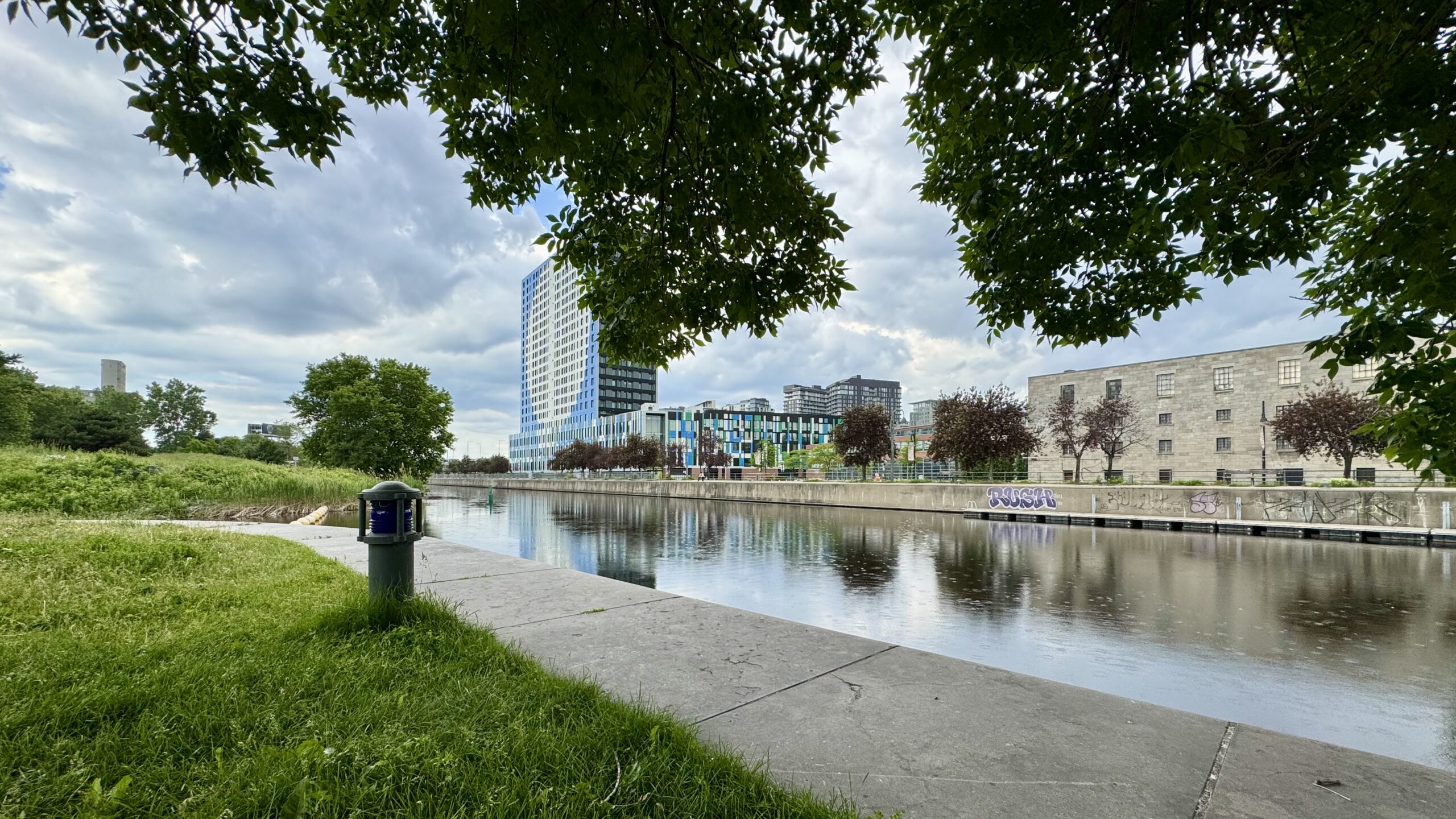
Eight-thirty and I’ve been awake since six. The body has been doing this since I sent the dissertation in: waking itself before I decide to wake, some obscure bodily alarm I didn’t set going off in the dark. I ended up at a coffee shop I’d never tried before–less by choice and moreso because all my usual spots are all still closed–an oat milk moka slowly going cold in my hand. I don’t fully know why I came to sit here, under this ash tree at the edge of the Lachine Canal, except that the body has been leading and the mind has been following.
The bike path is busy even now, this early. Commuters, runners, a construction worker setting out cones thirty meters from where I’m sitting. Birds are picking crumbs off the stone edge of the canal, and I can see an RTL bus from Longueuil crossing the Mill Street bridge above my right shoulder, moving through without stopping.
The story broke a few days ago: officers from Station 39 in Montréal-Nord had been stopping Black men and men of Arab origin at rates that required formal explanation, issuing tickets on the basis of ethnicity, making racist remarks inside a unit culture that circulated them as ordinary. The investigation had started in March, already underway before anyone outside the unit knew to ask. Then, in the coverage, a detail: some of them had been ripping off locs during police interventions and keeping the pieces as trophies.
Trophies.
What I notice is which part of this incident dominated the headlines. The stops, the tickets, and the remarks are the texture of daily life for people in that neighbourhood: the unremarkable climate of being under a specific kind of management. It took the “trophies” to produce the press conference, the mayor calling it disturbing, the police chief holding the room with his own face as evidence that the institution has changed. Frank B. Wilderson writes that anti-Black violence circulates as atmosphere, the condition against which civil society confirms its own moral coherence. Scandals like this, almost predictable in their recurrence, are necessary precisely because the atmosphere is not. The trophy takes the heat so the remarks and the tickets and stops don’t have to. Then the reform response arrives on cue: body cameras, reassignments, oversight, the machinery that allows the atmosphere to be named without being changed.
This logic doesn’t stop at the institution. A progressive journalist in this city who has covered SPVM violence for years and has built a sizeable following opened their Station 39 video with: “The SPVM is scalping people.” The image is vivid, which is the point, which is also the problem. Anti-Black violence is passing through a progressive media network as affective content, producing moral feeling in audiences who will likely never be stopped in Montréal-Nord on a humid Tuesday evening. The feeling confirms alignment: it circulates, metabolizes into outrage, and then the next story accumulates. I want to be clear about this: none of this requires bad faith. Civil society built the execution scaffold, and we mount it before we decide to. This is what Wilderson means by background affect: the Black body in pain as the ground condition that civil society, including its critics, requires in order to feel itself.
Vincent Woodard writes about the consumption of Black bodies as inherited logic: the taking and keeping of the souvenir. Locs accumulate over months and years, the hair carrying its own time, and cutting them during an intervention is taking that time alongside the dignity and the agency and the flesh. What the officer does with the trophy and what the viewer does with the progressive journalist’s video share a structure. In both cases, the Black body is made available to someone who is not subject to it, received and held briefly, used to produce something — possession, feeling, the confirmation of one’s moral position — and then the Black body remains where it was: in Montréal-Nord, subject to the next ticket, the next racist remark, the next unjustified stop. The trophy is the version that made the condition legible. The underlying assumption was already there before the scissors, before the camera, in every interaction that didn’t make anyone’s feed.
Saidiya Hartman says gratuitous violence doesn’t require justification. It enacts a prior condition. The analysis is not a shield against it. I have been studying this for four years. The dissertation on my committee’s desks right now is over a hundred pages about how communities care for themselves when institutions won’t, and I am sitting here under this ash tree at eight-thirty in the morning with a chest that weighs more than it did yesterday. The knowing doesn’t stop the landing.
A duck comes down the canal with a few others trailing. The water here is built, cut through Kanien’kehá:ka territory in the 1820s to make commerce legible, to route water according to a particular purpose, to bend it to the capitalist’s will. There is still life in it. Their attempts at control failed, as they always do. Water finds a way.
Christina Sharpe writes about residence time, the measure of how long an element stays in water. Sodium for 260 million years. The water doesn’t release what entered it. This canal connects to the St. Lawrence connects to the Atlantic, and the Atlantic received—and the Atlantic holds. Holds the bodies, holds the names that were never written down, holds the ones whose lives were rendered unremarkable long before the Station 39 officers kept their trophies. The surface in front of me has always been holding something it won’t disclose, and I have been sitting beside it long enough that I stopped checking.
I was starting to gather myself to go when I realized it was raining. Had been raining for a little while, actually. There was no forecast for it, so I hadn’t brought an umbrella. The ash tree had been holding it off without asking—the canopy dense enough to keep me dry—while the canal surface in front of me was already pocked with it, thousands of small entries. I hadn’t noticed because I was protected. I don’t know how long I’d been sitting inside this weather I couldn’t feel.
Leave a Reply