
Tag: Abolition

  • Les inscriptions sont fermées pour le moment

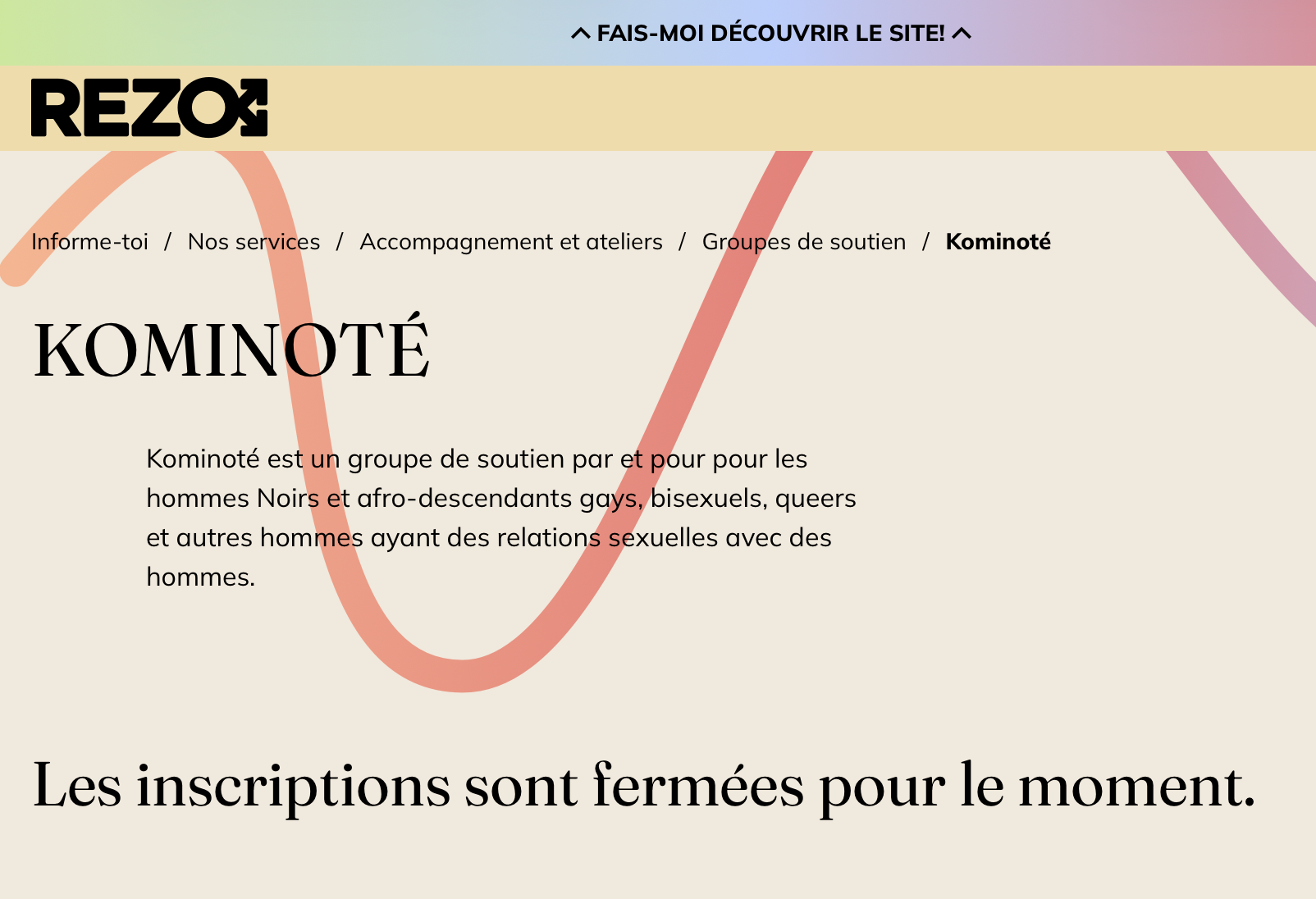
    Les inscriptions sont fermées pour le moment

    The conversation is over. My friend and I are sitting in the particular stillness that follows something hard, the kind where the next thing hasn’t become possible yet. I know how to be here. I’ve learned, over years of this kind of work, how to stay inside difficulty without flinching toward resolution, and that knowing didn’t go anywhere when I closed my practice. That was partly the point. The practice closed so that this could happen differently, in the register of friendship rather than the session note, the billing code, the annual registration, the showing up that doesn’t require an intake form.

    Which means I also know what comes next. I know how to locate a resource, how to identify which organizations are genuinely adapted and which ones will make someone feel worse for having tried. For this friend, this need, I reach for RÉZO, Montréal’s primary sexual health organization for GBQ men, before I’ve finished the thought. The body already moving toward the answer while the mind is still formulating the question. Something that becomes reflex when you’ve been inside a community long enough, when you’ve given enough of yourself to a particular ecosystem of care to know where things live inside it.

    I open the site. The navigation has changed. The page has moved, nested now under a sub-sub-section I have to locate before I can locate what I came for. I find it.

    Les inscriptions sont fermées pour le moment.

    My body receives this before I do. Something settles low in the chest: not sharp, the specific weight of something already known arriving as confirmation. The body has a grammar for this particular texture of disappointment, has developed it over years and in relation to this specific institution. I stay on the page longer than I need to. Dates à venir. I close the tab.

    My friend is still there in the way people stay with you after a difficult conversation. Still needing something. I sit with the quality of not having it to give, which is different from not knowing it existed, different from not having tried.

    I’ve known RÉZO since 2017. That summer, I was an outreach worker for their sex worker program, young, newly arrived in this kind of work, learning what it meant to move through communities the state had abandoned and then appointed institutions to monitor. The work itself was real. I was doing harm reduction with people who had built their own forms of survival inside that precarity, and something in me recognized that, was drawn toward it, was learning from it. That part I kept.

    There was a supervisor. His relationship to Black men’s bodies was legible to me that summer before I had full structural language for it. The institution had chosen not to have language for it either, which is its own kind of position. What surrounds that kind of behaviour inside a professional context is often more instructive than the behaviour itself. The silences. The way certain things circulate without being named, without anyone being required to account for them. The particular atmosphere of an organization that’s decided its progressive commitments are self-evident and therefore require no examination. I was a young Black worker inside that atmosphere, doing real work, learning two things simultaneously: what genuine care looked like when it reached people the state had abandoned, and what an institution looked like when it housed harm without naming it. You learn things from what an organization doesn’t say. I filed that knowledge somewhere and kept working.

    Training, supervised hours, three provincial registrations, insurance, continuing education requirements, documentation, all of it building toward a practice and toward a growing clarity about what the credential required in exchange for the legitimacy it conferred. It asked me to convert genuine care into something auditable, to route what happened between me and the people who trusted me through frameworks designed to make it legible to institutions rather than useful to people. I stayed inside that structure long enough to do real work and also long enough to understand what it was costing. I closed the practice deliberately in order to hold this differently. In the register of community, of friendship, of care that doesn’t require the state’s recognition to be real. I believed the infrastructure for that kind of work existed. That belief is what I was carrying when I opened the tab.


    In 2020 RÉZO hired me to lead a community needs assessment. The question was precise: why were Black queer and trans people structurally absent from the organization’s users, and what would it actually take to change that. I consulted 38 people, 21 in individual interviews and 17 through an online survey, with trans and non-binary participants deliberately over-recruited because the existing research on Black MSM health had excluded them as a matter of course. The consultation ran mid-COVID, which meant planned group discussions were cancelled, interviews moved to screens, and anonymity was compromised for participants who weren’t out because payment required a name attached to a cheque. These constraints are named openly in the report because that kind of transparency is part of what makes a document trustworthy rather than authoritative.

    What the community described was specific. They talked about walking into RÉZO and feeling immediately that the space had been built around someone else, that the staff’s frame of reference didn’t include the particular ways anti-Blackness and homophobia operated together in their lives, that being Black and queer in Montréal’s LGBTQ+ spaces meant being hyperlegible in some registers and invisible in others. They described the sexual fetishization of Black men as a documented harm operating not at the margins of those spaces but at their centre. They described needing something built from the ground up around their actual experience, not retrofitted from programming that had been designed around a different community’s needs entirely.

    The report that came from that process wasn’t a set of suggestions. It required a Board composition of minimum 33% racialized members including at least one Black person and at least one Indigenous person. It required anonymous CVs as standard hiring practice. It required mandatory anti-racism training built into onboarding for all staff and volunteers, with documentation, on a schedule the organization would be held to rather than one it could determine for itself. It required a dedicated support group animated by and for Black community members. A public awareness campaign against the sexual fetishization of Black men inside LGBTQ+ spaces, because the community had named that fetishization specifically and the report took them seriously. The specificity was deliberate. The consultation had been thorough. The report matched it.

    The document landed. RÉZO received it, the document they’d hired me to produce, and called it “un point-tournant dans l’histoire de notre organisme.” The report is still linked on the Kominote page. Still available to download. The organization’s own words about what this moment represented are still on the record, attached to the page of a program that’s no longer running, below a banner that reads: Les inscriptions sont fermées pour le moment.

    Kominote launched in 2021. Discussion groups, individual consultations, thematic workshops covering sexual health, discrimination, mental health, the specific experience of navigating LGBTQ+ spaces that hadn’t been built with Black queer people in mind. An awareness campaign against the sexual fetishization of Black men. RÉZO had asked what the community needed and they’d said, and then they’d come when something genuinely responsive was offered. The community showed up. Twelve people across twenty-five sessions in the program’s second year. Individual consultations running in parallel. People moving from one-on-one support into the group because the group was what they’d been looking for. They didn’t need to be convinced.

    Then political appetite shifted. Funding dried up. RÉZO’s own 2024-2025 annual report opens by acknowledging a reduction of sexual health funding. This is real. RÉZO has undergone significant restructuring in recent years, losing substantial staffing capacity across multiple intervention teams. People lost their jobs. Programs lost capacity. Communities lost services that had been built over years. The organization has been navigating a genuine crisis, not a managed inconvenience, and that context belongs in any honest account of what happened next. It does not, however, determine where the cuts landed. That determination is institutional. The funding landscape is genuinely difficult, and it does not explain what happened next. The Chemsex/PnP project expanded during this same period. It received more than 267 hours of individual accompaniment in 2024-2025, two support groups, multiple staff, detailed coverage across several pages of the annual report. Convive, the Spanish-language group for Hispanic GBQ men, is described in the same document as essential and thriving, 182 members, 12 meetings. Funding pressure is distributed unevenly and the distribution is legible if you read the annual reports alongside the Kominote page. Neither the 2023-2024 nor the 2024-2025 report mentions Kominote. Two consecutive years of institutional silence. In that same 2022-2023 report, the last one to mention Kominote, Chemsex/PnP appears for the first time: a new program still in development, four meetings held.

    The page stays up. The report stays linked. Les inscriptions sont fermées pour le moment. Dates à venir. The organization keeps the political currency produced by the consultation, the report, the community’s attendance, and sheds the obligation that currency was supposed to carry. This isn’t neglect and it isn’t bureaucratic failure. Neglect would be passive. What this is, is the active maintenance of a progressive reputation built on work the institution is no longer doing, for a community that came to everything Kominote offered and was not sustained. The box is ticked. The community member looking for a group session finds a banner. RÉZO gets to keep the turning point. The community gets dates à venir.

    The summer of 2017 is where this grammar comes from. Not a case being built but a way of reading being learned, through the body, before the language caught up. Black presence instrumentalized to produce legitimacy, to signal progressiveness, to access funding, and then the institution withdrawing once the currency has been extracted, leaving the community that produced it without the infrastructure their presence was used to justify. The needs assessment the institution commissioned and praised and didn’t implement. The program the community filled and the institution didn’t sustain. This isn’t a pattern of failure. This is a pattern of extraction, and it’s been operating at RÉZO for as long as I’ve known the organization.


    HoT and Kominote were built under the same federal project funding, the first phase of the Avancer alliance, which ran from 2018 to 2022. HoT followed a needs assessment, produced a guide for trans men and transmasculine people having relationships with men, and became a program. The community it was built for came to it. Kominote did the same. Federal project funding is always time-limited. When that first phase ended, both programs hit the same cliff and RÉZO had to decide what to sustain.

    The 2024-2025 annual report describes HoT as being in its fourth cohort, nine people enrolled, with plans to rebuild the group for 2025-2026. Its registrations are also currently fermées pour le moment. The difference is that HoT exists in the report: named, accounted for, assigned a future. Kominote doesn’t appear in either the 2023-2024 or the 2024-2025 annual report. Not to note a pause. Not to signal a rebuild. Not once. Two programs, the same funding origin, the same cliff, the same direction of travel while Chemsex/PnP expanded, while Convive grew, while the annual report filled pages with statistics about what the organization chose to sustain. A community’s needs don’t contract because a program’s enrollment does. The pattern isn’t about one program or one community. It’s about which communities RÉZO decided, in practice rather than in stated values, to keep building toward when the federal money ran out.

    Architectural decisions are decisions. Convive has its own dedicated portal in RÉZO’s primary navigation, built into the site at the same architectural level as the main sections. The site exists in three languages, structured partly around this portal. Where something lives in a navigation structure communicates institutional priority as clearly as anything in an annual report. Kominote sits under a sub-sub-page of the services section, below a banner that by now you know.

    This isn’t a critique of Convive or the community it serves. The contrast isn’t between those communities. It’s between what the institution decided to sustain and what it decided not to, and what that pattern communicates about where Black queer people actually sit in RÉZO’s hierarchy of commitments, as opposed to its stated one.


    In 2022 I presented Kominote’s findings at SMASH. Black queer and trans community members had said what they needed, I had documented it, and I brought it to the conference of the organization that had commissioned the work and called it a turning point. That’s the before.

    SMASH 2025. A presenter had used photographs of Black people throughout their slides on sex work and health access without once analyzing what being Black meant for the people in those images, for the statistics being presented, for the disproportionate rates of criminalization and healthcare exclusion the data was already showing. I asked, in the room, why racialization had been absent from a presentation that had used Black bodies as its visual evidence. The answer was that there hadn’t been time to get into everything. I said that was a choice, and that the choice didn’t align with the use of those images. The presenter, a white woman, became upset. A white man well known in the space went to her and said, “en tout cas y’était ben énervé,” offering her comfort by reducing what I had said to a matter of my affect. Not the presentation. Not the question. My affect. A Black trans friend who had been at the conference with me heard it and told me. I addressed him directly and in public. What followed was the organizers moving to calm me down — not to address the comment, not to address what any of it meant in a space organized, ostensibly, around the health and dignity of the communities whose images had just been used as backdrop. The angry Black body was the disruption. Everything that had produced the anger was not.

    RÉZO didn’t address what happened in any way the community would recognize as meaningful. Nothing reached the people who had been in that room. Nothing suggested the institution understood what the afternoon had revealed about the space it had built.

    SMASH 2026. No sessions on Black people. Multiple sessions on chemsex and PnP, across different framings and angles. The conference that couldn’t hold a question about anti-Blackness in 2025 found no place for Black-specific health content in the following year’s program. The 2026 program is the institution’s answer to the 2025 question, more complete than anything said in the aftermath of that afternoon, more honest about institutional priority than any statement of values on the website.

    I’ve been carrying what I know about this institution since a summer in 2017. The specific and accumulated kind of knowledge that builds when a body is right about something before the mind has language for it, that builds through years of acquiring the language only to watch it change nothing. I know what it means when an institution commissions a report, calls it a turning point, and files the turning point. I know what it means when a community fills a program and the program isn’t sustained. The body kept the record across all of it. So did I. The difference between those two things has gotten smaller over the years.

    My friend is still there. Still in the particular aftermath of a hard conversation, still needing something that should exist, that did exist, that was built specifically for them and for people like them by a process that asked the community what it needed and received an answer and turned that answer into a program and called the whole thing a turning point in the organization’s history. The report that produced Kominote is still on RÉZO’s website. Still linked from the page with the closed registrations. Still available to download. It describes, in the organization’s own commissioned language, exactly what RÉZO was asked to become and exactly what it hasn’t become. The turning point is still there. The program it turned toward is not.I don’t know what my friend will find when they look for support next. I know what I found when I looked for them. The report and the page are both still there, sitting on the same server, attached to the same organization, available to anyone who knows where to look. The evidence isn’t mine. It belongs to RÉZO. They hired me to write it, they praised it, they linked it, and they left it there, attached to the absence it was supposed to prevent. That is the record. It doesn’t require my anger to be legible. It is legible on its own.

    Fediverse Reactions
  • What the Credential Requires

    What the Credential Requires

    The process is specific. A recognized bachelor’s or master’s in social work. More than 350 hours of supervised fieldwork. Registration with a provincial regulatory body. Annual renewal. Professional liability insurance. Continuing education requirements that must be documented and submitted on schedules the regulatory bodies determine. In most provinces, certain activities are reserved exclusively for licensed practitioners, creating legal perimeters around forms of assessment and intervention that can only be practised by those the provincial order has recognized. The details differ by jurisdiction. The logic is the same across all of them.

    The stated mandate of professional regulatory bodies is the protection of the public. The mechanism for that protection is the control of professional practice. Those two things are presented as the same project.

    They are not the same project.

    To require that care be delivered through a licensed practitioner is to require that it be delivered through a person the institution has recognized, trained, insured, and made accountable to the institution’s own standards. The supervised fieldwork hours are not hours of learning how to be in relation with people. They are hours during which the institution evaluates whether the candidate’s practice can be named in its terms. Regulatory bodies define supervision as a formal, continuous process of reflection that integrates the values of the profession. The profession’s values. Not the community’s. Not the client’s. Registration is not a recognition of competence. It is an entry into a register. The register is a list of people whose practice can be found, audited, disciplined, and withdrawn.

    This is not bureaucracy failing to do what it promised. This is bureaucracy doing exactly what it was built to do.

    To require that care be standardized, documented, and reproducible is to require that it be made available on institutional terms. The institution sets those terms in relation to its own interests, which are not the same as the interests of the people most likely to need care. The session note is not a record of what happened between two people. It is a translation of that encounter into language an insurer can evaluate, a court can subpoena, and a regulatory body can review in the event of a complaint. Every translation involves loss. The losses here are not random. What falls out of the session note is precisely what made the session matter: the quality of the silence, the shift that happened that neither person could have predicted, the particular texture of someone’s survival. What remains is the presenting problem, the intervention modality, the plan. The care gets documented. The care does not survive the documentation intact.

    This conversion is the point. The credential is not incidental to it. The credential is the mechanism through which it happens.

    Licensed practitioners gain access to something specific: legitimacy within systems that were not built for the people most likely to need care. The ability to bill insurers. To work within institutions. To produce assessments that carry weight with courts, hospitals, employers, child protection services. That weight is deputized. It flows from the same institutions whose ongoing function includes the surveillance, regulation, and management of the communities those assessments are most often used against. To enter those institutions as a credentialed participant is to enter on their terms. The terms of participation are established before anyone arrives, regardless of what they intended when they applied.

    People still choose this. The choice is made, and the harms that follow from it belong to the people who enact them. The structure does not absorb individual accountability. What the structure does is make certain harms legible and defensible. It provides frameworks within which things can be done to clients that would, outside the professional context, be recognizable as violation. It provides language that converts those violations into documentation of professional practice. It provides discipline processes better designed to protect institutional authority than the person who was harmed. The credential is not incidental to this protection. It is how the protection works.

    The work that happened in this practice was real. Something moved between people in those rooms that was not reducible to the structure surrounding it. The quality of attention that accumulates in sustained therapeutic work, the particular thing that becomes possible when someone knows they will not have to start over next week, when the person across from them has been paying attention long enough to notice what has shifted and what has not. That is real in the way that relation is real. It happened, and the fact that it happened inside a structure organized to convert it into auditable service does not unmake it.

    What it does is make the contradiction sharp enough to become impossible to continue carrying.

    The practice is closing because continuing it would mean continuing to agree, in practice if not in belief, to what the credential requires. To keep routing genuine care through a structure whose function is to make it legible on institutional terms. To keep producing documentation that serves systems organized against the people sitting across from this desk.

    The care does not close with it. The obligation that came from being trusted with people’s survival does not dissolve when the annual registrations do. What those who were in those rooms carried here mattered, and it was received as mattering, fully, outside any framework the regulatory bodies provided for receiving it. That does not change. What ends is the agreement to deliver care through a mechanism that extracts something from it on the way, that requires it to pass through institutional translation before it can count as real.

    That extraction was always happening. This is what it cost.
  • Time, Held

    Time, Held

    Time arrives before anything happens. It shows up early, settles in, rearranges the day around itself. You learn it through how the body prepares. Through the way the chest stays slightly lifted, like it’s waiting for a tap on the shoulder. Through how often the jaw tightens when the phone lights up. Through the reflex to count days without meaning to.

    Empire works through this kind of time. It lets it sink in slowly. It gives people enough room to adapt, enough repetition to make endurance look like a personal trait. Lives stretch around renewal dates and review periods. Everything keeps moving, but nothing quite lands. You learn how to hold your life lightly, how to keep your belongings minimal, how to stay ready to shift without being told to move.

    People live for years inside extensions. Inside temporary permissions. Inside measures that circulate without ever settling into something solid. Life fills the space anyway. Dinners get made. School lunches get packed. Work schedules get memorized. Love keeps happening. All of it unfolds on ground that never fully firms up. You learn to distribute your weight. You learn where not to lean too hard.

    Joy still arrives, but it comes with an internal clock already running. You feel it tick while you’re laughing. While you’re planning. While you’re letting yourself believe something might hold. Celebration becomes careful. Plans stay provisional. Even rest carries a low hum of alertness, as if the body doesn’t quite trust that it can go all the way down.

    This kind of time wears people without leaving marks you can point to. It teaches the body to stay available. Sleep thins out. Attention fragments. You start measuring life in cycles you didn’t choose. Renewal cycles. Processing cycles. Waiting cycles. Each one asks for patience. Each one takes a little more capacity with it.

    Policy relies on this. Fatigue funnels what feels possible. When energy gets spent managing uncertainty, very little remains for anything else. The week becomes the unit of survival. The future starts to feel abstract. You make decisions based on what requires the least explanation, the least exposure, the least risk of being noticed.

    Urgency moves unevenly through this system. Some situations stop everything. Others stretch on quietly, absorbing days, months, years. Loss waits its turn. Harm gets filed, deferred, assigned a new expected timeline. You feel the delay in how long it takes to breathe normally again, in how quickly hope retracts when it gets too loud.

    The language surrounding all of this stays calm. Dates appear. Updates get promised. Progress gets implied. These words move smoothly through official channels. They sound steady. They invite trust. They ask for composure. They ask people to keep showing that they can handle it.

    And still, time gets made elsewhere. In kitchens where stories don’t arrive in order. On dance floors where the body follows sensation instead of sequence. In care networks that move when someone needs something, not when a form clears. Memory bends time. Touch compresses it. Grief stretches it. None of this asks to be scheduled.

    These practices don’t wait for recognition. They happen because life keeps insisting. Because care has its own tempo. Because people stay with each other even when everything else feels provisional. These rhythms don’t resolve the waiting, but they interrupt its authority.

    Empire manages time by distributing it unevenly. By deciding who gets to arrive and who must remain in motion. Who is allowed to settle and who must stay ready. Who is worn down slowly enough that it looks procedural. Paying attention to time means noticing how power moves quietly, through calendars, deadlines, queues, and the long spaces in between.

    There isn’t a clean ending to this. Time under empire leaves residue. It stays in the muscles. It shows up in how cautiously people plan, in how often joy gets delayed, in how carefully hope is rationed. Naming that doesn’t make it disappear. But it does bring the clock into the room. It lets the weight be felt together.

    And sometimes, that shared awareness is where movement begins.

  • Structures of Warmth and Violence

    Structures of Warmth and Violence

    The sun is warm on my face at the port, and I don’t trust it.
    Midwinter light has no business feeling this gentle.
    The river is frozen hard enough to refuse reflection, to hold its surface without depth.
    Ice tightens everything into place.
    And still, the sun presses against my skin, insistent, intimate, as if it has selected me for a comfort it has not offered the water.

    The warmth settles along my cheekbone, my forehead, the bridge of my nose.
    It feels careful.
    Conditional.
    The kind of warmth that arrives without consequence.

    Below me, the St. Lawrence stays sealed.
    Nothing loosens.
    Nothing yields.

    The body receives what the structure does not.

    I stand longer than I need to. The warmth encourages this. It invites cooperation. I find myself adjusting my posture to keep it where it is, then stopping mid-movement. The river does not respond. Frozen water thickens time, holds things mid-instruction.

    The river has lived many lives. Long before it was drawn into colonial routes, it moved according to rhythms that did not answer to ledger or law. Those rhythms were narrowed, redirected, pressed into service.

    The river was not born into circulation, but it was made to sustain it. Even frozen, that demand remains legible. I feel it in the way the streets pull away from the water, organized and expectant.

    Montréal learned early how to organize violence without spectacle.
    Enslavement here did not require plantations.
    It required houses.
    Parishes.
    Courtrooms.
    Contracts folded small enough to disappear into pockets.

    The river anchored this order without needing to carry every body directly. It stabilized the circulation that made enslavement repeatable inland. Wealth accumulated. Authority settled. Black life moved through kitchens, sacristies, wills, and back rooms—measured, assigned, transferred at the scale of the household.

    I leave the port and begin walking. The sun follows in fragments now, slipping between buildings, touching my face, then withdrawing. My hands stay numb inside my gloves. My feet register the cold through stone and pavement.

    As the river slips out of sight, it does not recede. Its work continues elsewhere—through inheritance records, baptismal registers, domestic routines. Violence did not need the port to remain present. It lived closer than that.

    Warmth keeps insisting. My thoughts turn to fire.

    In 1734, fire tore through Montréal and forced exposure. It moved through homes and businesses, through the interiors where enslaved Black and Indigenous people laboured without legal standing. The fire did not invent violence. It illuminated what the city already contained.

    Marie-Joseph Angélique was accused of setting that fire.
    The archive does not offer certainty.
    It offers procedure.

    She was enslaved.
    She was imprisoned.
    She was interrogated.
    She was tortured.
    She was sentenced.
    She was hanged.

    Fire moved quickly.
    Judgement did, too.

    Walking now, the sun returns as the street opens. It warms my face without softening anything else. I let it stay. Heat has always been read carefully here—allowed when it behaves, named dangerous when it does not.

    The records remain.
    The scaffold remains in description.
    The crowd remains as fact.

    In New France, the work of execution was frequently assigned to enslaved Black men. Settlers refused the role. The state solved the problem by purchasing someone into it. One of them, Mathieu Léveillé, was held in bondage and forced to perform executions for years. The archive places him as the one who likely carried out Angélique’s hanging. It tells us something else, too: that the colony routinely conscripted Black life to enact its most visible violence.

    This fact does not resolve anything.
    It deepens the fracture.

    The executioner’s body was also owned, unfree, positioned to absorb the consequence of an order that required intimacy rather than distance. The rope passed through Black hands—rough hemp against skin just as unfree—because the colony needed it to.

    Angélique’s execution did not interrupt slavery in Montréal.
    It clarified the terms.
    It demonstrated consequence.
    It absorbed the fire into governance.

    Ice forms differently than fire spreads.
    Slowly.
    Quietly.
    Layer by layer.

    By the time I drift back up to Vieux-Montréal, the river is elsewhere, but its cold has stayed with me. I turn towards Place d’Armes without ceremony. The square does not announce itself as a site of death. It behaves like stone and space. People pass through. Traffic moves nearby.

    This is likely where Angélique was hanged.

    This knowledge reaches the body first. The chest tightens. The jaw sets. There is no shift in the square to mark this recognition. The sun touches my face once more, briefly, as if insisting on its neutrality. Nearby, a busker’s rendition of “My Heart Will Go On” bounces off the buildings, unembarrassed, continuous. The warmth does not belong to the place. It belongs to the moment, and the moment does not care where it happens.

    Execution is cold work.
    So is administration.
    So is forgetting.

    I keep walking.

    The warmth thins. Cold resumes its full instruction. 

    By the time I reach home, the sun feels distant, almost unreal. But it stays the way certain facts stay—undeniable, insufficient, instructive. The river remains sealed. The square remains where it is. The archive remains incomplete and operative.

    Nothing has been redeemed.
    Nothing has been resolved.

    What has happened is simpler and harder:
    fire, ice, sun, and walking have entered the same field of attention, and my body has been asked to hold them together without explanation.

    That is part of the afterlife too.

  • There Is No Word for This Grief: On Gaza, Famine, and the World That Watches

    There Is No Word for This Grief: On Gaza, Famine, and the World That Watches

    I wasn’t supposed to be writing this.

    I’m supposed to be writing a comprehensive exam about temporality and health. About how Black queer people live and care for one another in timeframes not designed for our survival. I’m supposed to be providing therapy tomorrow—offering calm, presence, holding—for clients navigating their own overwhelm, grief, burnout. I’m supposed to be finishing a manuscript, drafting another talk, prepping for the next ball.

    But there is a genocide happening in Gaza.

    And I am broken.

    And that’s not what this is about. But it’s also what everything is about.

    Because I don’t know how to move through this world anymore.

    Not in a poetic way. Not in a metaphor. I mean literally. My body doesn’t know what to do with itself. I sit still and I shake. I eat and feel nauseous. I sleep and wake up in a sweat. I walk outside into wildfire smoke so thick that Tiohtià:ke now has the worst air quality in the world—and even still, I know I’m breathing freer than a child in Rafah.

    And what do you even do with that kind of knowing?

    There is a level 5 famine in Gaza.The highest designation possible.
    Thousands of children are already dead from starvation.
    More will die in the coming days.

    And the food is already there.
    Just metres away.
    Across the border.
    In trucks.
    In planes.
    In warehouses.

    Blocked.
    By policy.
    By intention.
    By design.

    This is not a crisis. This is not a natural disaster. This is not an unfortunate byproduct of war. This is a settler colonial genocide. A calculated campaign of extermination. Ethnic cleansing disguised as self-defence. Starvation weaponized. Infrastructure targeted. Grief made endless.

    This is the logic of Zionism.
    This is the logic of empire.
    This is what it means to disappear a people in real time.

    And the world watches.
    Scrolls.
    Shrugs.
    Argues.
    Donates, maybe.
    Then forgets again.

    Because forgetting is the luxury of the unaffected.

    And if you know what it is to be Black, to be queer, to be Indigenous, to be trans, to be displaced, to be criminalized, to be border-crossed or borderless, then you already know this truth: the world is not neutral.

    Not when it comes to genocide.
    Not when it comes to who gets to live.
    Not when it comes to who the world calls human.

    What’s happening in Gaza isn’t unimaginable.
    It’s entirely imaginable.
    That’s what makes it unbearable.

    This is what genocide looks like in the age of livestreams.
    This is what settler colonialism looks like when the camera’s always on.
    This is what fascism looks like when it doesn’t need to hide anymore.
    This is what it means to beg for mercy and be called a terrorist.
    This is what it means to scream for food and be met with silence.
    This is what it means when a child’s life is worth less than the narrative.

    And here we are. Watching.
    In real time.
    As Gaza bleeds.

    I’m not here to offer hope.
    Not the kind you can package.
    Not the kind you can sell.

    Because if you’re watching this and still talking about “both sides,”
    If you’re more outraged by broken windows than by bombed hospitals,
    If your solidarity is contingent on respectability, strategy, or PR optics,
    If your grief only activates when white bodies are harmed,
    Then your humanity is not mine.

    And I am not interested in convincing anyone that Palestinians deserve to live.

    Because life is not earned.
    Freedom is not a prize.
    Liberation is not a matter of debate.

    Palestinians do not need your approval to resist.
    They do not need your permission to mourn.
    They do not need to be perfect victims in order to be spared.

    They are not being starved because of Hamas.
    They are not being bombed because they resist.
    They are being exterminated because they exist.
    Because they are Indigenous.
    Because they are still there.
    Because they refuse to disappear.

    And I am wrecked by this.

    Not just as a witness, but as someone who knows what it means to be told that your life is too complicated to matter.
    Who knows what it means to scream into silence.
    To live in a body that the state treats as collateral.
    To walk through a world that sees your death as routine.

    But this isn’t about me.

    It’s about a father holding the body of his child and saying I’m sorry I couldn’t protect you.
    It’s about people breaking apart stale bread to share with twenty others.
    It’s about the doctor who keeps treating the wounded in the rubble of a bombed out hospital.

    It’s about the poets still writing.
    The dancers still dancing.
    The children still drawing keys to homes that no longer exist.
    The elders still planting seeds in soil they know they may not survive to harvest.

    This isn’t resilience.
    This is refusal.

    This isn’t optimism.
    This is survival strategy.

    This isn’t a tragedy.
    It’s a crime.
    An atrocity.
    A catastrophe authored by cowards in suits and suits in tanks and tanks in children’s bedrooms.

    And still, somehow, there is singing.
    Still, somehow, there is prayer.
    Still, somehow, there is resistance.

    Still, somehow, they live.

    And I want you to understand what it means to keep living in the middle of a genocide.
    To not just breathe—but to love.
    To not just exist—but to refuse.
    To not just survive—but to fight.

    So no, I don’t have the words.
    I have this grief lodged in my throat like shrapnel.
    I have these tears that feel like they betray the scale of the loss.
    I have this ache in my chest from trying to hold space for others while knowing the world is falling apart.
    I have the unbearable knowing that every second I spend writing this, someone else is dying.

    And still—I write.
    Because silence is complicity.
    Because bearing witness is not enough, but it is necessary.

    Because abolition means all cages.
    Because solidarity means now, not after.

    Because Palestine is not a symbol—it’s a place, a people, a love, a struggle that stretches across oceans and generations.
    Because to be Black and queer and abolitionist and breathing in this world is to take a side.

    And I will say it again and again and again, even if my voice shakes:

    From the river to the sea, Palestine will be free.

    And may we live long enough to see that day.

    And may we never forget what we did—and didn’t—do until then.