
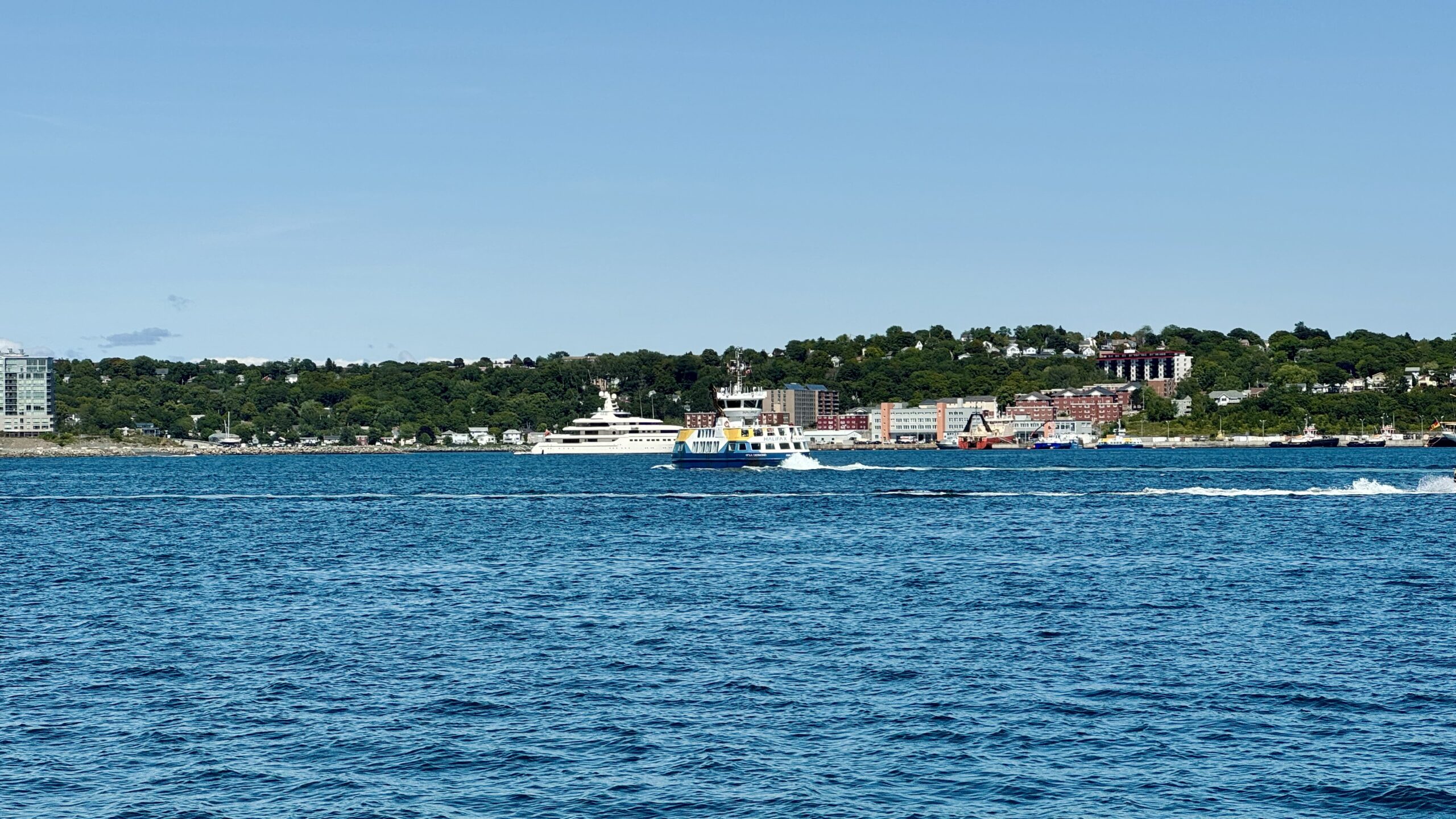
Punamu’kwati’jk, five o’clock, watching the fog clear off Kjipuktuk’s skyline across the water. Cranes over the harbour, more of them than I remember, and I lose count past fifteen. I’m on a half log, cut flat like a bench, right against the rocks, right against the ocean.
The fog had gotten on the ferry with me on the way over, climbing aboard slow the way it does, moving through everyone on deck like weather moving through a place that expects it. Then the foghorn went off into the city and for a second I didn’t know where I was. I watched the Angus L. Macdonald Bridge disappear into it, becoming everywhere and nowhere at once. Perched on this log, right at the lip of the ocean, something held me still that doesn’t usually hold still. Walking in Tiohtià:ke, this same pull always points me east. Out of the city, toward leaving. Here it just kept me in place.
The fog found me again the next day, on a bus.
Halifax to Charlottetown, the Maritime Bus, cheaper than I expected and lower-tech too. A gas station in Amherst with three-lettered parking spots standing in for what I’d pictured as a real transfer terminal. I watched the soil change from brown to red as we got close to the Confederation Bridge, and then we crossed it. On a bus you sit high enough to see the water on both sides, which you can’t from a car, and the water was fogged in the same way the harbour had been, visible for two or three metres and then just gone. Another version of the same disappearing.
Charlottetown gave me both of the things this region seems to hold at once, sometimes in the same hour. A Black server at the hotel restaurant, loud and warm with us over a meal, doing what our communities do when we meet in rooms like that. And, walking around later trying to find somewhere to eat, being gawked at, then followed through a Shoppers Drug Mart by a security guard I eventually had to confront. I’m not about to steal anything, I told him. I’m just Black. He kept following me anyway, and I thought about what it costs the Black folks I’ve met who live there—live this—full time, every day.
The next morning, Broadway and I gave our workshop.
Two hours on the history and structure of ballroom, then a voguing class. One attendee had come back specifically because they’d missed the first session we gave in February. They’d been practising in between. Watching them vogue, having clearly kept the thread going on their own, I understood something I already believed but hadn’t felt this concretely: that person is probably headed to Halifax eventually, once they’re out of school there, and if they are, we need a scene ready to receive them when they arrive.
That’s the thought that kept unspooling into our next day of workshops in Dieppe. I found out recently that a friend’s organization in Halifax is funnelling nonprofit money, thousands of dollars, directly toward building a ballroom scene. Deliberately outside any institutional structure, using the institution against itself. It’s exactly the kind of structural intervention I want to be doing. Standing in Place 1604 the morning after, in front of Dieppe’s city hall on Emancipation Day, waiting to screen Paris Is Burning before Broadway’s vogue class, I caught myself already halfway into a thought about a postdoc, and had to correct it mid-sentence. Not here, I thought. Not this bench, not this plaza. Somewhere in Atlantic Canada, doing this work with Black queer communities in some structural capacity, maybe.
The logic underneath it is one I already teach: build for the one person who otherwise has no access, and you build structures that lift everyone. I’ve been saying that for years about ballroom. It hadn’t occurred to me until this trip that it might also be the logic for a decision about where I live.
The water held me still here in a way it doesn’t at home. The same fog that disoriented me on a ferry found me again on a bus, and neither time did it feel like a warning. A security guard in Charlottetown made a different fact legible to my body, one no amount of thinking about postdocs will undo. Both are true about the same place at the same time, and I haven’t found the framework yet that holds them without one cancelling the other out.
Leave a Reply