
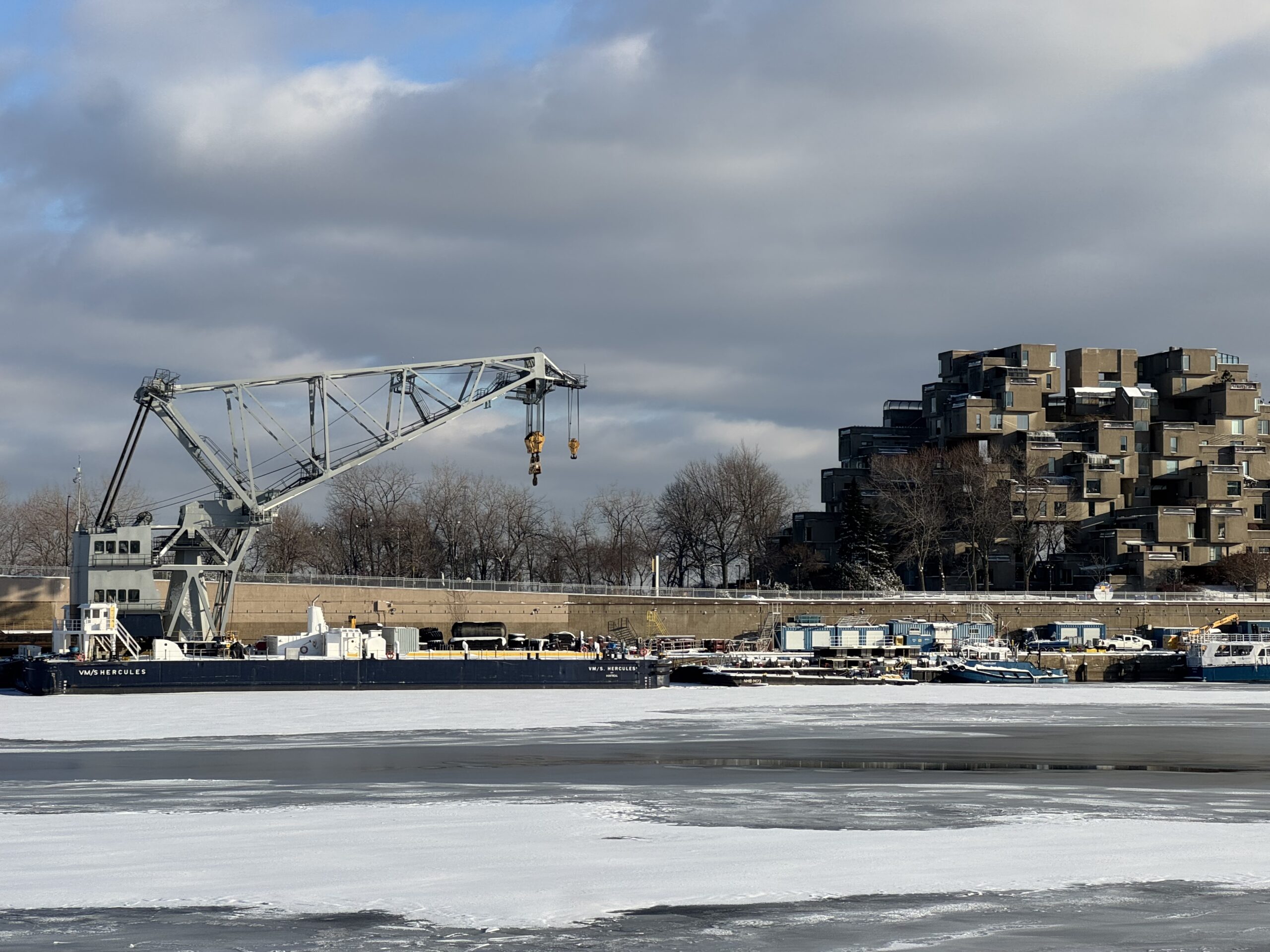
The sun is warm on my face at the port, and I don’t trust it.
Midwinter light has no business feeling this gentle.
The river is frozen hard enough to refuse reflection, to hold its surface without depth.
Ice tightens everything into place.
And still, the sun presses against my skin, insistent, intimate, as if it has selected me for a comfort it has not offered the water.
The warmth settles along my cheekbone, my forehead, the bridge of my nose.
It feels careful.
Conditional.
The kind of warmth that arrives without consequence.
Below me, the St. Lawrence stays sealed.
Nothing loosens.
Nothing yields.
The body receives what the structure does not.
I stand longer than I need to. The warmth encourages this. It invites cooperation. I find myself adjusting my posture to keep it where it is, then stopping mid-movement. The river does not respond. Frozen water thickens time, holds things mid-instruction.
The river has lived many lives. Long before it was drawn into colonial routes, it moved according to rhythms that did not answer to ledger or law. Those rhythms were narrowed, redirected, pressed into service.
The river was not born into circulation, but it was made to sustain it. Even frozen, that demand remains legible. I feel it in the way the streets pull away from the water, organized and expectant.
Montréal learned early how to organize violence without spectacle.
Enslavement here did not require plantations.
It required houses.
Parishes.
Courtrooms.
Contracts folded small enough to disappear into pockets.
The river anchored this order without needing to carry every body directly. It stabilized the circulation that made enslavement repeatable inland. Wealth accumulated. Authority settled. Black life moved through kitchens, sacristies, wills, and back rooms—measured, assigned, transferred at the scale of the household.
I leave the port and begin walking. The sun follows in fragments now, slipping between buildings, touching my face, then withdrawing. My hands stay numb inside my gloves. My feet register the cold through stone and pavement.
As the river slips out of sight, it does not recede. Its work continues elsewhere—through inheritance records, baptismal registers, domestic routines. Violence did not need the port to remain present. It lived closer than that.
Warmth keeps insisting. My thoughts turn to fire.
In 1734, fire tore through Montréal and forced exposure. It moved through homes and businesses, through the interiors where enslaved Black and Indigenous people laboured without legal standing. The fire did not invent violence. It illuminated what the city already contained.
Marie-Joseph Angélique was accused of setting that fire.
The archive does not offer certainty.
It offers procedure.
She was enslaved.
She was imprisoned.
She was interrogated.
She was tortured.
She was sentenced.
She was hanged.
Fire moved quickly.
Judgement did, too.
Walking now, the sun returns as the street opens. It warms my face without softening anything else. I let it stay. Heat has always been read carefully here—allowed when it behaves, named dangerous when it does not.
The records remain.
The scaffold remains in description.
The crowd remains as fact.
In New France, the work of execution was frequently assigned to enslaved Black men. Settlers refused the role. The state solved the problem by purchasing someone into it. One of them, Mathieu Léveillé, was held in bondage and forced to perform executions for years. The archive places him as the one who likely carried out Angélique’s hanging. It tells us something else, too: that the colony routinely conscripted Black life to enact its most visible violence.
This fact does not resolve anything.
It deepens the fracture.
The executioner’s body was also owned, unfree, positioned to absorb the consequence of an order that required intimacy rather than distance. The rope passed through Black hands—rough hemp against skin just as unfree—because the colony needed it to.
Angélique’s execution did not interrupt slavery in Montréal.
It clarified the terms.
It demonstrated consequence.
It absorbed the fire into governance.
Ice forms differently than fire spreads.
Slowly.
Quietly.
Layer by layer.
By the time I drift back up to Vieux-Montréal, the river is elsewhere, but its cold has stayed with me. I turn towards Place d’Armes without ceremony. The square does not announce itself as a site of death. It behaves like stone and space. People pass through. Traffic moves nearby.
This is likely where Angélique was hanged.
This knowledge reaches the body first. The chest tightens. The jaw sets. There is no shift in the square to mark this recognition. The sun touches my face once more, briefly, as if insisting on its neutrality. Nearby, a busker’s rendition of “My Heart Will Go On” bounces off the buildings, unembarrassed, continuous. The warmth does not belong to the place. It belongs to the moment, and the moment does not care where it happens.
Execution is cold work.
So is administration.
So is forgetting.
I keep walking.
The warmth thins. Cold resumes its full instruction.
By the time I reach home, the sun feels distant, almost unreal. But it stays the way certain facts stay—undeniable, insufficient, instructive. The river remains sealed. The square remains where it is. The archive remains incomplete and operative.
Nothing has been redeemed.
Nothing has been resolved.
What has happened is simpler and harder:
fire, ice, sun, and walking have entered the same field of attention, and my body has been asked to hold them together without explanation.
That is part of the afterlife too.
Leave a Reply