
May 9th. Sunny. I’m walking past the Winnipeg Police Service headquarters at 11 in the morning when I turn off Graham onto Fort Street and the timing is what it is. Two men coming from the gym, laughing, easy with each other and with the morning. They glance down at the man on the sidewalk as they pass, barely adjust their path, and keep moving. He’s Indigenous, wrapped in a Canadian Red Cross blanket, folded against the building at 11:15 a.m. The Red Cross blanket is the detail that stays with me. The disaster relief organization’s blanket, on a man on a sidewalk, on a weekday morning, in a city where urban Indigenous homelessness is not a crisis in the sense of something that arrived suddenly but a condition, the accumulated result of specific decisions made over a long time about whose life constitutes an emergency and whose constitutes a landscape. The two men are already half a block away, still laughing. They didn’t break their conversation.
Disappointment but not surprise. I knew before I turned the corner. The body knew before the mind finished the sentence.
I arrived on the afternoon of the 5th and went looking for the river almost immediately, dropping my bag at the hotel and walking out before I’d properly settled. I followed the Red River east, crossed the pedestrian bridge into Saint-Boniface with the Canadian Museum for Human Rights rising behind me, visible on the way over, visible on the way back, not demanding to be addressed.
In Saint-Boniface there’s a mural large enough that you see it before you understand what you’re seeing. Louis Riel at the centre, the Basilica behind him, Red River cart to his left, flowers below all of it in reds and yellows that don’t apologize. The body stopped before I decided to. I had no claim on this image and stood in front of it anyway because it was asking me to.
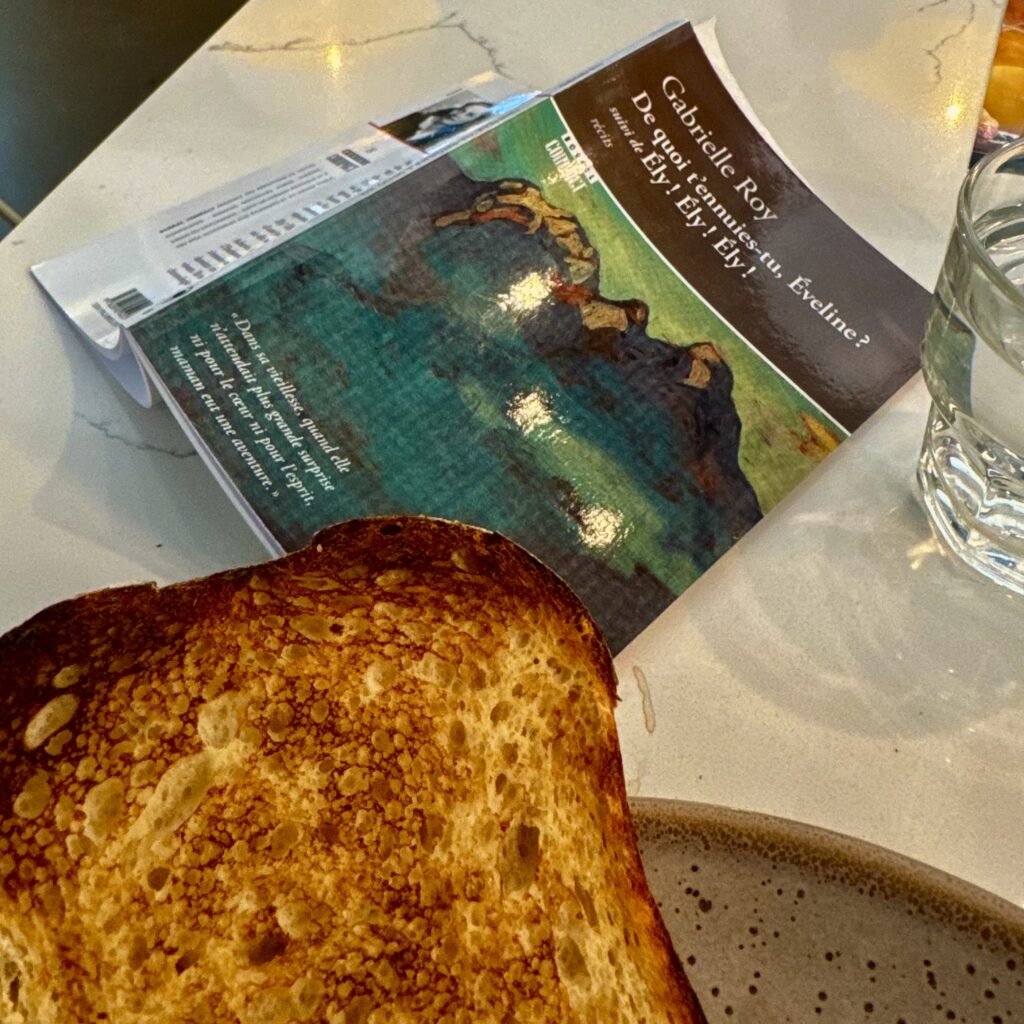
A few streets over I found a bookshop and was served in French without explanation required. I left with Gabrielle Roy, De quoi t’ennuies-tu, Éveline? suivi de Ély! Ély! Ély!, and opened her on a bench before I made it back to the water. She was doing something to me immediately, her descriptions of this land so precise and so felt that reading her while moving through it produced a particular disorientation, the prose arriving slightly ahead of the landscape, the landscape confirming it, the two things in a conversation I was overhearing.
The Forks is where the Red River meets the Assiniboine, the reason the whole city exists where it does, and I sat near the water that evening trying to be honest about my relation to it. This is not my river. I don’t mean that as a dismissal: this is the only honest position available to me. The Red River named a people who built their identity from unresolvable multiplicity, French and Indigenous and neither and both, named after a river valley that named them back, and I can hold that without claiming it. I read Roy at the water’s edge as the light changed, her sentences about the prairie moving through me alongside the current, both patient, both older than anything I was bringing to them.
I sat there unsettled in a way I didn’t immediately know what to do with.
The conference was the next morning. A labour union, its members doing work the state has largely abandoned, had flown me out to speak about decolonizing gender and the kind of care built outside institutional frameworks. There was something clarifying about that specific framing, being brought here by people who already understand that the official structures don’t hold, to talk about the communities that build their own. The room was practical and attentive in the way of people who work with their hands and their relations and don’t have patience for abstraction that doesn’t land somewhere. I tried to land somewhere. I think it did.
That night I went back to Roy. The hotel room, the flatness of the city pressing in through the window even in the dark, her sentences doing their patient work. She wrote about this land as someone who had been changed by it, who didn’t arrive with the landscape already interpreted but let it instruct her. I was trying to do something similar and was aware of how much further she had gone.
The following evening, I went to a drag show at Club 200. Someone I’d met at a ball in Tiohtià:ke, one conversation on the sidewalk in the afterglow of the function, had said if you’re ever in Winnipeg. I was. The room was warm and specific and full of a kind of attention that felt continuous with the Forks and the conference and Roy and the mural, different surfaces of the same thing: people making something real in a place that doesn’t always make it easy to. I stayed later than I meant to.
I carried Roy through all of it. On a bench, at a counter with coffee, back at the hotel. She kept describing the land with a care I was trying to learn from, the way she held the prairie’s scale without flinching, finding in its exposure not emptiness but a particular kind of honesty. Everything visible. Nothing apologizing for being what it is.
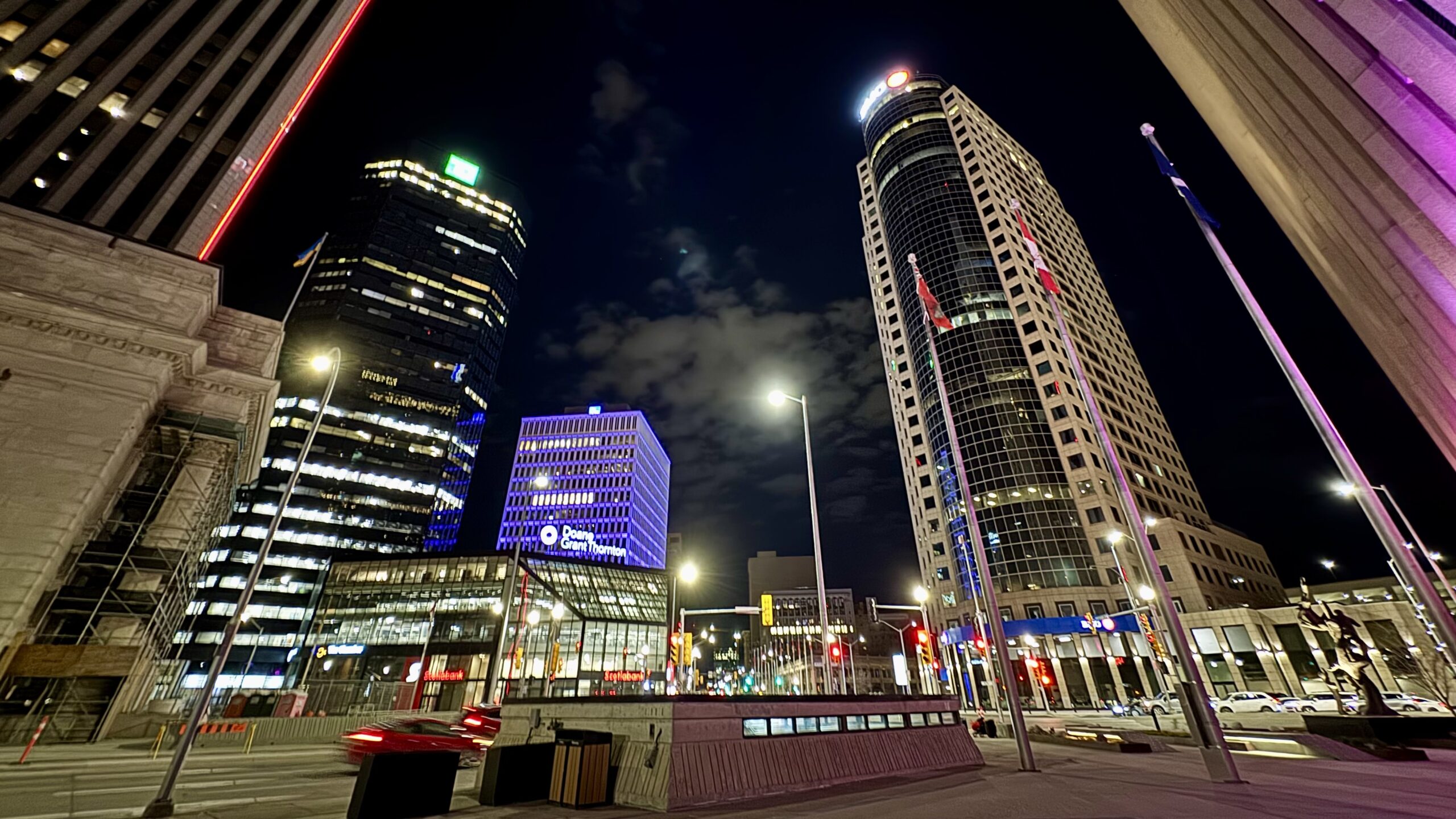
The Exchange District is right next to the Fairmont where I’ve been staying, neither of which I chose. I’ve walked through it almost every day since I arrived. The buildings are genuinely beautiful: ornate stonework, terracotta detail at rooflines, warehouse facades that speak to a moment of civic confidence, a city that built as if it expected to keep building. Many of the buildings now stand empty. I feel this as texture before I understand it as fact, the particular quality of a street where the architecture is present but the life isn’t quite, where you are aware of your own footsteps in a way that means something. There’s a gap between the ornamentation above and the sidewalk below and that gap is not accidental. Investment moved out of this city the way investment moves, quietly, structurally, with the consequences landing on specific bodies in specific places. What I keep returning to is not the emptiness of the buildings but the decision, ongoing and recursive, to leave them empty rather than house the people folded on the sidewalk beneath them. Anti-Indigeneity is not only ideology. It’s an allocation of resources, a determination of what counts as an emergency, a Red Cross blanket on a Fort Street sidewalk on a sunny morning while two men laugh their way past and the buildings above stand ornate and vacant. I walk through it and feel the logic before I can fully name it.
Anti-Blackness is operating here too, on its own terms, and I’m not going to collapse them. What I’ve been watching for four days is both, simultaneously, on people whose bodies this city has decided are not the ones worth protecting. The weight of already knowing and seeing it anyway is its own specific exhaustion.
I’m walking down Main toward Portage and asking myself whether I could actually live here. One of the positions I applied to was at the University of Manitoba. I never ended up visiting it. By the 9th, it doesn’t feel like the question it did on the 5th. The city has substituted a different one.
The mural and Fort Street and the empty Exchange and the river that isn’t mine and Club 200 and the conference and the man wrapped in the Red Cross blanket are all the same place. They don’t resolve into a verdict. They accumulate into something I’ll be sitting with for longer than the flight home.
I finished Roy this morning over breakfast. Her last pages, the land still doing its patient work on her, the sentences still making room for what the prairie keeps insisting on. I had been reading her as I moved through the territory she wrote about, and something about that had made the whole stay more porous, more available to being changed by what it actually was rather than what I had expected. I closed the book and walked out.
The wind at Portage and Main hits you before you’re ready for it. Nothing interrupts it for miles in any direction. That’s the thing about this place: everything arrives at full force, unchanged by whatever it passed through to get here.
I kept walking.
Leave a Reply