Statuses

  • Consequence as Weather

    Consequence as Weather

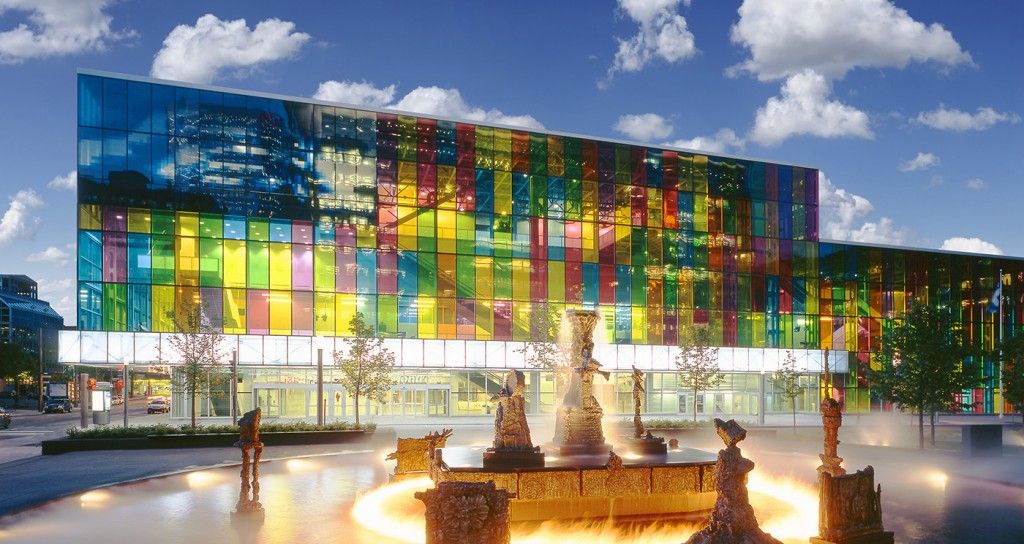
    The coffee shop near the Palais des congrès is already full of Liberal Party of Canada convention delegates when I join the line outside. Cop cars are parked down the street. Inside, every table has a staffer. Suits. Baseball caps. #LIB2026 lanyards. Louboutins under a table where someone’s set a Prada bag on the chair beside her. Laptop messenger bags open across tables the staff need to turn. Pins with Mark Carney’s face. Meticulously curled hair. Khakis. The particular self-assurance of people who’ve decided their presence anywhere is appropriate. Then one woman moving through the room with an umbrella from the Fairmont, the red of her dress the party colour, coordinated, intentional. She passes a barista without looking at her and something tightens in my chest that’s been tightening for days.

    I’m wearing a keffiyeh and I notice the moment they notice it. Something shifts in the room that nobody names. A delegate near the door clocks it and looks away with a speed that’s its own kind of statement. I’m used to being read in spaces like this, used to the particular attention that Black presence draws in rooms that have decided they’re for everyone. The keffiyeh adds a layer. They know it and I know they know it and we all sit with our coffees pretending the room isn’t doing what the room is doing.

    The REDress Project places empty red dresses in public spaces to hold the shape of the women who are gone, the ones this government decided this week, this specific week, don’t require sustained investigation or resources. The woman with the Fairmont umbrella didn’t choose red for that reason. The colour was assigned. Coordinated. By a party that also welcomed Marilyn Gladu across the floor, a woman whose votes against queer and trans people are part of the parliamentary record, and called it coalition. This is the party that marches in Pride parades. That points to marriage equality as proof of its character. I’m a queer person in this room and I’ve known for a long time that the shelter had conditions. My body doesn’t receive Gladu as shock. It receives her as confirmation, one more piece of evidence landing on top of everything already stored, every previous moment the walls showed how thin they were. That’s how it accumulates. Weight settling into the chest and the shoulders and the jaw, invisible from the outside, carried forward into every room where you’re told to be grateful for the protection. The woman in red moves through the coffee shop. The barista clears a table. None of them look up.

    This is my coffee shop. At the counter there’s a different kind of exchange available, the kind between people who’ve been showing up for each other across enough ordinary mornings that the terms are established. We don’t have to say much. I make a joke. He laughs in a way that’s also an exhale. We talk briefly about what it costs to serve people who treat you like infrastructure, who order without eye contact, who leave without acknowledgment. Nobody says Liberal Party. Nobody has to. The room keeps doing what it’s doing around us.

    Three tables away a delegate checks his phone. This government is complicit in a genocide and has spent considerable resources avoiding that word, and cut funding for investigations into missing and murdered Indigenous women, girls, and Two-Spirit people this week, and has used every available tool to avoid the connection between those two sentences. The funding, the votes, the abstentions, the phrasing carefully chosen to avoid the words that would require action. Somewhere a family is in rubble. Somewhere a child is being pulled from concrete. Somewhere a woman is missing and the file’s been defunded. Here we are, here I am, here they are, in Tiohtià:ke on a blustery Thursday morning. The woman in red passes the window on her way to the Palais. The Fairmont umbrella catches the light.

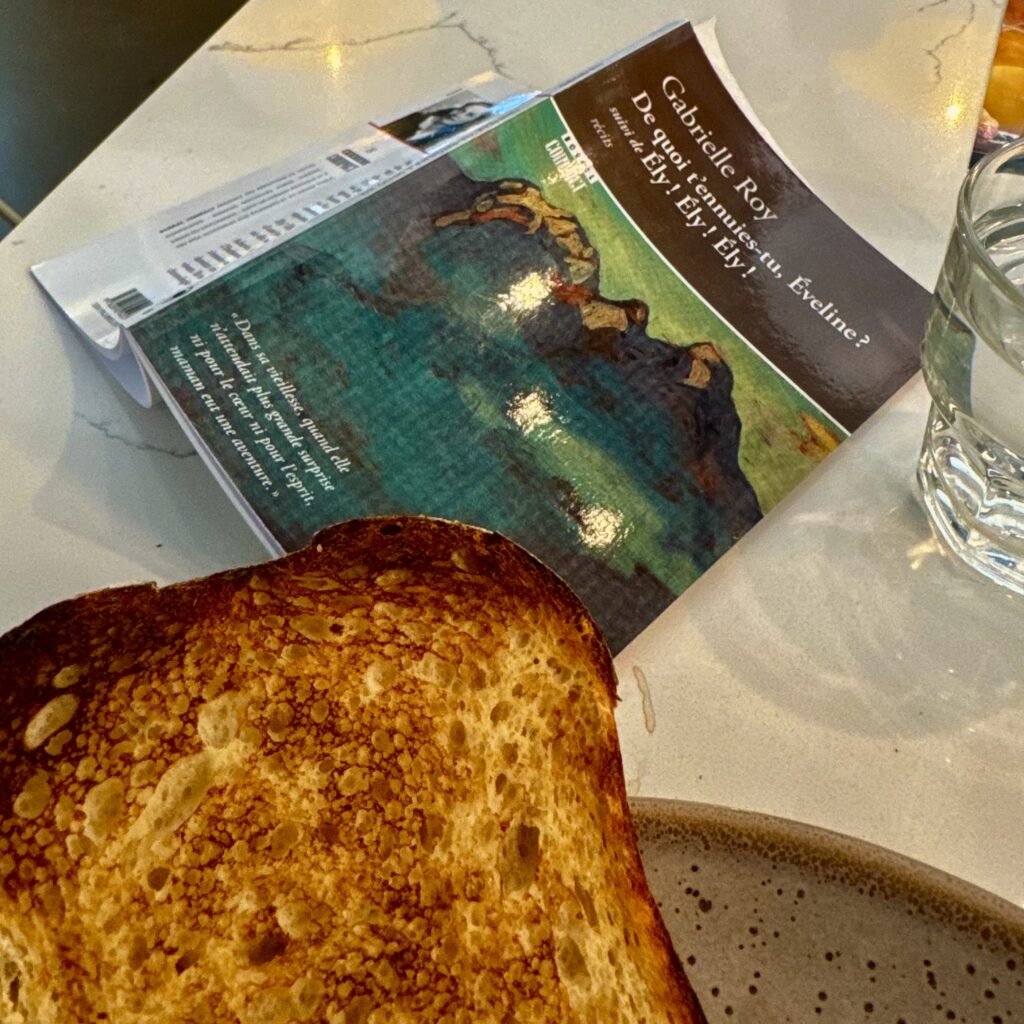
    I finish my coffee. Close my book. The room’s still full when I push through the door and turn south toward the Palais des congrès, toward the metro, past the cop cars still parked where I left them.

    Around the Palais the police are everywhere. The apparatus arranged in a perimeter around the people who command it, who fund it, who’ve always been the reason it exists in the form it does. The woman in red moves through that perimeter without breaking stride. I’ve never been the person that apparatus was arranged to protect. The people I love have never been that person. The people whose deaths we mark and carry forward, the ones the red was supposed to hold, whose files were defunded this week, the ones in rubble whose names this government will not say, have never been that person. The police are at the Palais des congrès because the people inside it put them there.

    What stays in my body is the knowledge that nothing I feel or say or write will reach these people in any way that costs them anything. They’ll leave the Palais and return to their lives and the decisions they make will continue to land on the same bodies they’ve always landed on and they’ll sleep. That’s what impunity actually is. The ability to move through the world without your actions ever returning to your body as consequence. I’ve spent my whole life in a body where consequence is the weather. Where what I do and how I move and what I wear and who I am carries risk in rooms like this one. They’ve spent their whole lives in the other kind of body. The kind the police are arranged to protect. The kind that gets to feel frustrated about service at a coffee shop without that frustration being a threat assessment. We’re in the same city on the same Thursday morning and we’re not in the same world.

    These systems don’t hold forever and the people inside them know it even when they perform certainty. I’ve watched enough of these rooms to recognize the particular discomfort of people who’ve learned to read threat and have started to feel it coming from directions they didn’t expect. It’s in the way the delegate clocked my keffiyeh and looked away. It’s in the way entitlement requires an audience that keeps agreeing to the premise, and that audience is getting smaller and louder about its refusal. The collapse of these systems will be disorderly and the people with the least protection will absorb the most of that disorder on the way down. That’s not a prediction. That’s the pattern, repeating. The keffiyeh. The barista who laughed in a way that was also an exhale. The agreement these people depend on is breaking and they can feel it.

    The most honest thing that happened this morning was a small pastry set beside a coffee without a word, between two people the room wasn’t watching. I’ve been thinking about that on the walk down here, about what it means that the thing that held the most required the least. The police were outside the coffee shop when I left. They’re all the way down the street and around the Palais des congrès, the same apparatus, just more of it, arranged in a perimeter around people who’ve never had to think about what a small thing costs or what it holds. I’m still thinking about the pastry.​​​​​​​​​​​​​​​​

    Fediverse Reactions
  • What the Credential Requires

    What the Credential Requires

    The process is specific. A recognized bachelor’s or master’s in social work. More than 350 hours of supervised fieldwork. Registration with a provincial regulatory body. Annual renewal. Professional liability insurance. Continuing education requirements that must be documented and submitted on schedules the regulatory bodies determine. In most provinces, certain activities are reserved exclusively for licensed practitioners, creating legal perimeters around forms of assessment and intervention that can only be practised by those the provincial order has recognized. The details differ by jurisdiction. The logic is the same across all of them.

    The stated mandate of professional regulatory bodies is the protection of the public. The mechanism for that protection is the control of professional practice. Those two things are presented as the same project.

    They are not the same project.

    To require that care be delivered through a licensed practitioner is to require that it be delivered through a person the institution has recognized, trained, insured, and made accountable to the institution’s own standards. The supervised fieldwork hours are not hours of learning how to be in relation with people. They are hours during which the institution evaluates whether the candidate’s practice can be named in its terms. Regulatory bodies define supervision as a formal, continuous process of reflection that integrates the values of the profession. The profession’s values. Not the community’s. Not the client’s. Registration is not a recognition of competence. It is an entry into a register. The register is a list of people whose practice can be found, audited, disciplined, and withdrawn.

    This is not bureaucracy failing to do what it promised. This is bureaucracy doing exactly what it was built to do.

    To require that care be standardized, documented, and reproducible is to require that it be made available on institutional terms. The institution sets those terms in relation to its own interests, which are not the same as the interests of the people most likely to need care. The session note is not a record of what happened between two people. It is a translation of that encounter into language an insurer can evaluate, a court can subpoena, and a regulatory body can review in the event of a complaint. Every translation involves loss. The losses here are not random. What falls out of the session note is precisely what made the session matter: the quality of the silence, the shift that happened that neither person could have predicted, the particular texture of someone’s survival. What remains is the presenting problem, the intervention modality, the plan. The care gets documented. The care does not survive the documentation intact.

    This conversion is the point. The credential is not incidental to it. The credential is the mechanism through which it happens.

    Licensed practitioners gain access to something specific: legitimacy within systems that were not built for the people most likely to need care. The ability to bill insurers. To work within institutions. To produce assessments that carry weight with courts, hospitals, employers, child protection services. That weight is deputized. It flows from the same institutions whose ongoing function includes the surveillance, regulation, and management of the communities those assessments are most often used against. To enter those institutions as a credentialed participant is to enter on their terms. The terms of participation are established before anyone arrives, regardless of what they intended when they applied.

    People still choose this. The choice is made, and the harms that follow from it belong to the people who enact them. The structure does not absorb individual accountability. What the structure does is make certain harms legible and defensible. It provides frameworks within which things can be done to clients that would, outside the professional context, be recognizable as violation. It provides language that converts those violations into documentation of professional practice. It provides discipline processes better designed to protect institutional authority than the person who was harmed. The credential is not incidental to this protection. It is how the protection works.

    The work that happened in this practice was real. Something moved between people in those rooms that was not reducible to the structure surrounding it. The quality of attention that accumulates in sustained therapeutic work, the particular thing that becomes possible when someone knows they will not have to start over next week, when the person across from them has been paying attention long enough to notice what has shifted and what has not. That is real in the way that relation is real. It happened, and the fact that it happened inside a structure organized to convert it into auditable service does not unmake it.

    What it does is make the contradiction sharp enough to become impossible to continue carrying.

    The practice is closing because continuing it would mean continuing to agree, in practice if not in belief, to what the credential requires. To keep routing genuine care through a structure whose function is to make it legible on institutional terms. To keep producing documentation that serves systems organized against the people sitting across from this desk.

    The care does not close with it. The obligation that came from being trusted with people’s survival does not dissolve when the annual registrations do. What those who were in those rooms carried here mattered, and it was received as mattering, fully, outside any framework the regulatory bodies provided for receiving it. That does not change. What ends is the agreement to deliver care through a mechanism that extracts something from it on the way, that requires it to pass through institutional translation before it can count as real.

    That extraction was always happening. This is what it cost.
  • Fool’s Spring

    Fool’s Spring

    The air is doing something it has no business doing in March.

    I notice it before I’m fully awake to noticing—something in the chest, a small release, the jaw unclenching in a way I didn’t realize it had been clenched. I’m already on the route when it registers. The cold that’s been structural for months, the kind that doesn’t ask permission and doesn’t negotiate, it’s just gone today. In its place there’s this softness, almost embarrassing in how good it feels, like the city decided to be generous without warning and didn’t tell me in advance so I could defend against it.

    People are outside. Not the usual bundled determination of Montréal winter movement, heads down, getting somewhere. Actually outside, taking up space, faces turned up. Someone’s dragged a chair onto the sidewalk in front of a café that has no business having outdoor seating yet. A man is standing on the corner doing nothing, just standing there, which you don’t see in February. A woman I pass makes eye contact and almost smiles and I almost smile back and we both look away like we almost said something too honest.

    The city’s doing the thing—I know the thing, I’ve watched it happen enough times to recognize it immediately—and I can’t do anything with that recognition because the body doesn’t care what I know. The shoulders drop anyway. The pace slows. Something lets go without asking.

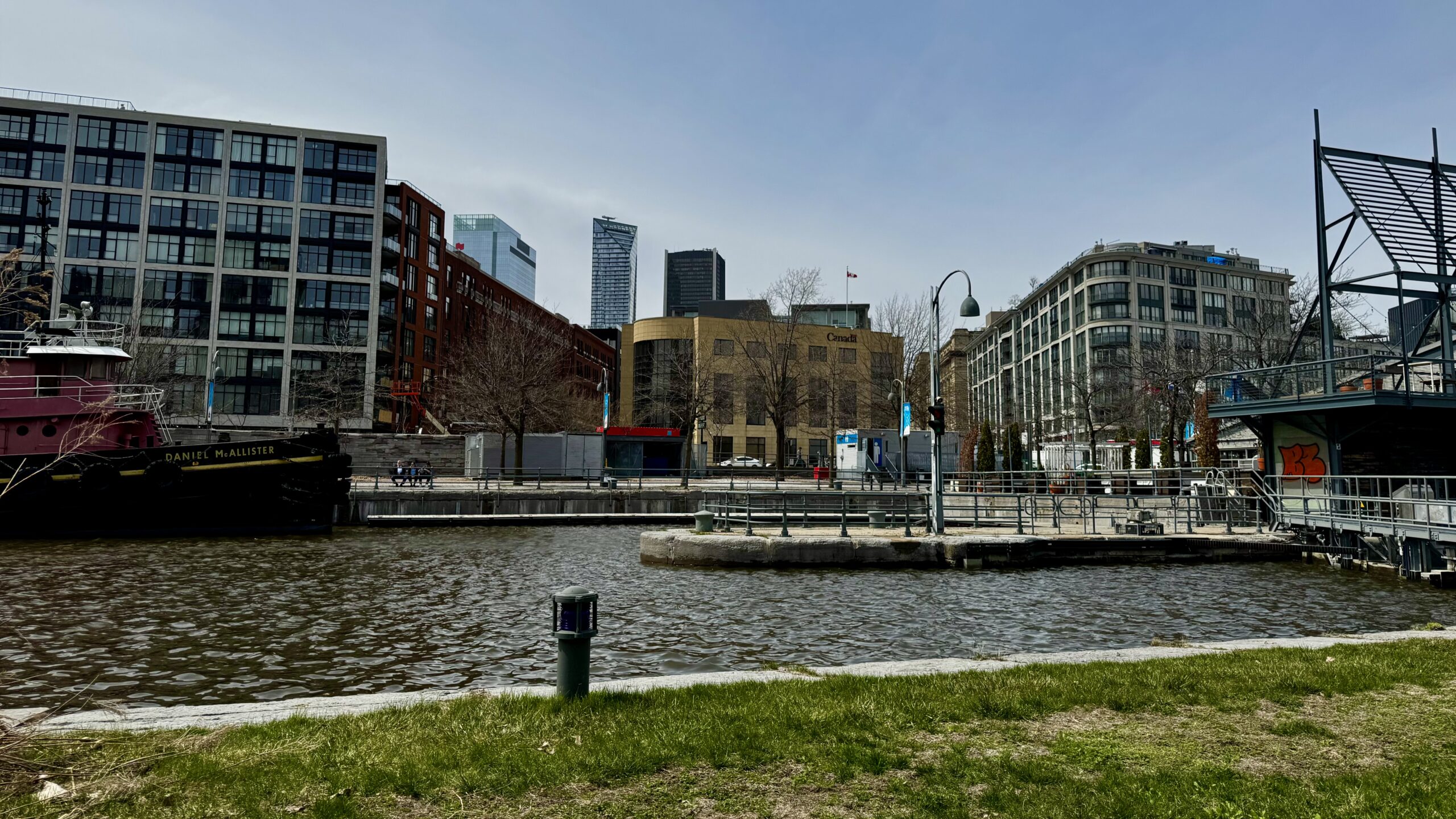
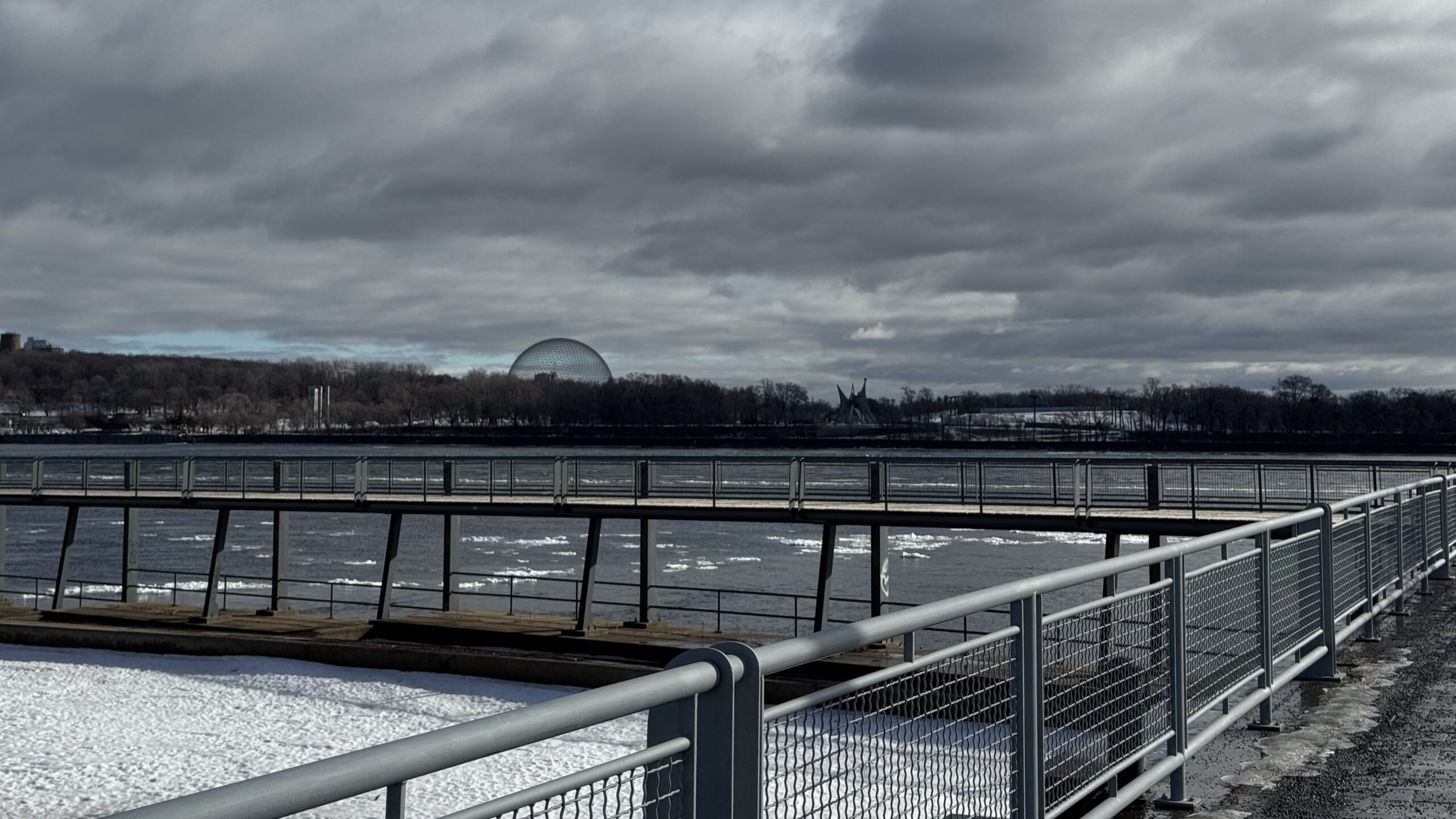
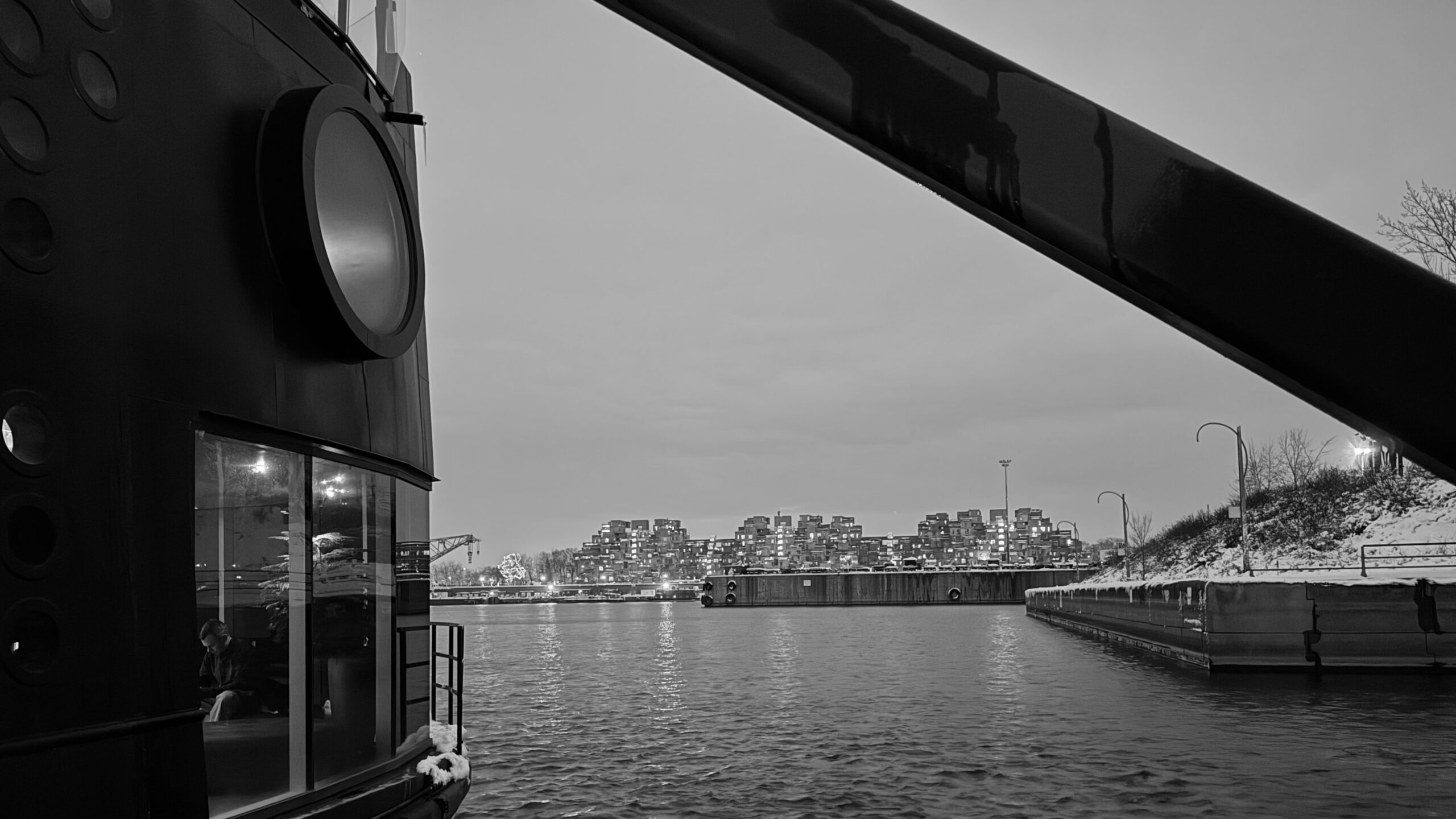
    I’ve been coming to this route since November, which means I’ve been here long enough to watch the river do everything it’s done this winter. Not every day, not with any intention exactly. Just when the body needed somewhere to put itself that didn’t require anything back. The Old Port in winter is good for that. Nobody’s performing anything. The tourists are gone, the terrasses are stacked and wrapped in plastic, and what’s left is the river and the cold and whoever else needed to be somewhere that wasn’t inside their own head.

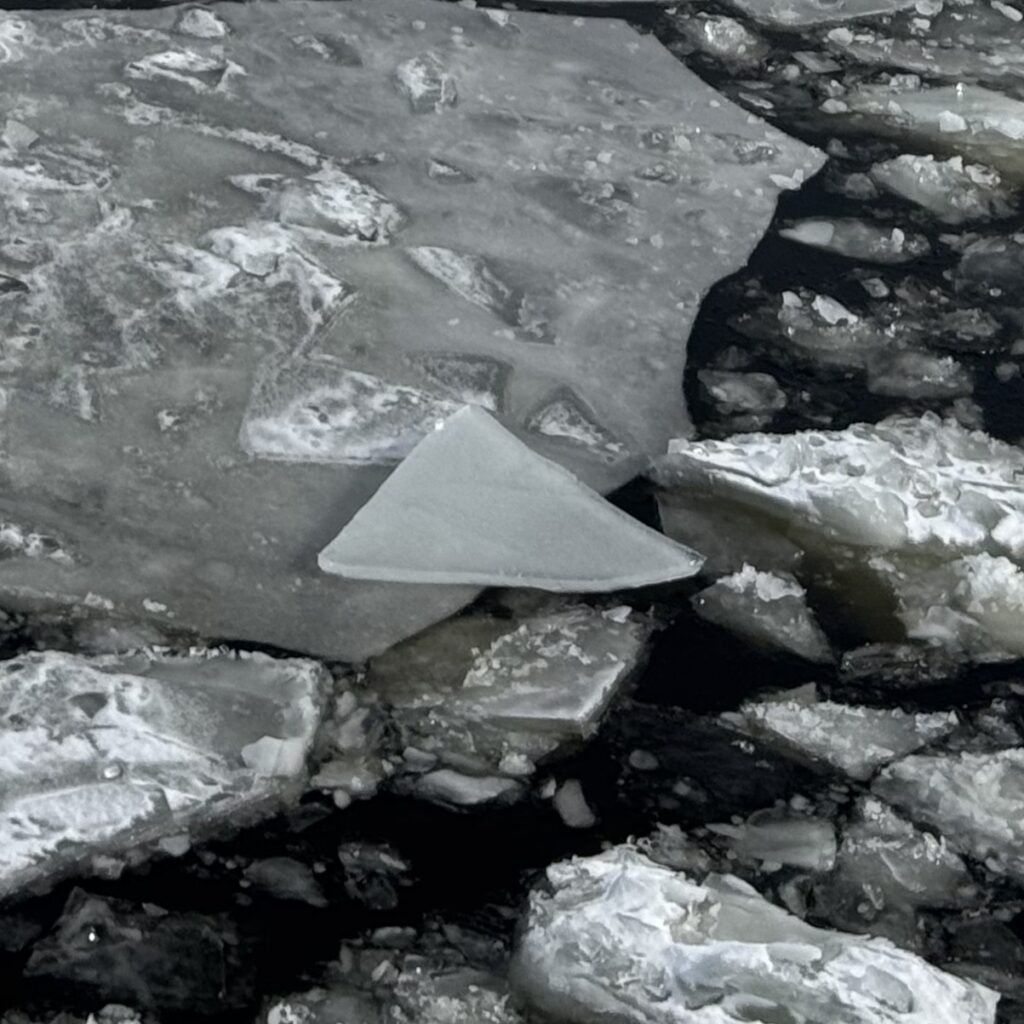
    I watched the freeze happen in pieces. First the edges, where the water slows against the bank and the cold gets a foothold. Then the surface thickening gradually, going from dark and moving to grey and uncertain to the flat white that means it’s held. There was a week in January where the ice looked almost translucent in the afternoon light — blue-green, the kind of colour that doesn’t seem like it belongs to winter. I stood there longer than made sense. I didn’t write about it. I just kept it. There was a morning in February where snow had covered everything overnight and the whole surface went illegible, no texture, no variation, flat white meeting flat white at the horizon. The river looked like it had stopped being a river. Like it was waiting for instructions. I remember thinking the cold that morning felt almost like clarity, which made no sense given that nothing was clear, but the body makes its own logic and I’d learned by then to let it.

    So when I come around the corner today and the river is moving—not fully open, there’s still ice out toward the middle, still that grey-white surface, but along the edges it’s dark water again, actual current—I stop without deciding to stop. I don’t know exactly what I’m registering. Just that it matters, the way some things matter in the body before the mind has caught up with why.

    What I understand now, that I didn’t know walking those winter mornings, is that I was memorising. It felt like the opposite—like emptying out, like just moving through cold air with nothing required of me. But the body was doing something the mind hadn’t signed off on yet. Storing details. Noting the specific quality of light on ice in January. Learning the weight of this particular stretch of waterfront at this particular time in my life. That’s what grief does before you’ve named it as grief: it makes you pay attention. It starts archiving without asking. It turns ordinary routes into records of something you’re not ready to call an ending yet. And then I look up, and the city is still here, doing what it does, and I feel it anyway.

    Montréal means it, though. That’s the part that’s always been hard to hold alongside everything else. When the warmth comes back and people spill out onto the sidewalks and strangers almost smile at each other, that’s real. There’s a genuine porousness to this place when the conditions allow it, a capacity for collective ease that I haven’t found anywhere else in quite the same register. I’ve loved this city through every version of myself. It taught me the pace of winter light and what care looks like when it’s built inside contradiction rather than despite it. The friends who showed up, the communities that held me, the particular way people here make room for each other in the margins of a place that isn’t always making room officially—that’s not nothing. That’s actually most of what I know about survival.

    And it’s all present today. I can feel it in how the city moves, the way the warmth loosens something collective and for a few hours everyone’s a little more available to each other. I’m not outside it. My chest opened on this walk the same as everyone else’s.

    But I’ve also lived here long enough to know the pattern. The warmth is real and then the policy conversation starts and the belonging turns conditional again. The city that holds you and then asks you to be less legible in certain rooms, to translate yourself into something more manageable, to accept that your safety is negotiable in the name of neutrality or order or whatever word is doing that work this season. The fool’s spring is the actual structure of what it’s been like to do Black queer abolitionist work here. The opening and then the slow close. The genuine warmth that never quite becomes something you can count on. You feel it every time. That’s not naivety. It’s just how it goes.

    What I didn’t expect today is that none of that would settle the question.

    I’ve been thinking of the leaving as something already decided, the walks a form of goodbye that was already underway, the compression becoming its own kind of instruction. And I still think that’s true. But today, in this light, with the river moving and the city briefly being the version of itself that I fell for, I don’t know. Not in a way that changes anything concrete. Just in the way that honest things are sometimes more complicated on good days than on hard ones. The hard days make the leaving feel obvious. The good days remind you what you’d actually be leaving. Neither one gets to be the whole truth.

    I keep walking. The warmth stays on my face. I let it.


    Somewhere in the middle of winter, I started reading job postings from small university towns.

    Not obsessively, not with a plan. Just tabs that stayed open longer than they should have, descriptions of places I’d never been that I kept returning to without quite knowing why. Towns I’d have to look up on a map. Departments small enough that you’d know everyone’s name by October. The kind of campus where the work would have to speak for itself because there’s no scene to situate it in, no institutional politics to navigate before you’ve even started.

    I told myself it was practical. The PhD is ending, the market is the market, you apply where there are positions. That’s true as far as it goes. But it doesn’t explain why those particular postings were the ones I kept returning to, or why imagining a smaller place felt less like settling and more like something the body was quietly asking for.

    I think my nervous system has started making cartographic decisions. The way this city lands on me now, the weight of it — some part of me has figured out that scale is something I can actually change. There’s a version of this work that happens somewhere I’m not already exhausted before I begin. I keep picturing a quality of morning more than a specific place. The kind where the first thing the body does is breathe. Where you can walk to work and the walk doesn’t cost anything, doesn’t pass three corners each carrying a different memory of who you were trying to be when you lived near there. Where the air is just air and the river, if there is one, doesn’t know your whole history.

    I know how that sounds. Like I think a different postal code is going to fix something that lives in the body and travels with it. I know the difference between changing your circumstances and outrunning yourself. But environment is not neutral, and it’s taken me years to trust that fully. Doing this work in a city where it’s legible but not exactly welcome, where every institutional conversation requires a translation tax, where you’ve spent years learning to make yourself understood in rooms architecturally designed not to understand you — that accumulates in the tissue. I’m not burned out in the generic sense. I’m tired in a specific and located way. Tired of the particular labour of being this person in this place at this moment in its politics. More rest isn’t going to fix that. Distance might.

    The teaching keeps coming up too. As something I actually want, in a way that’s become clearer the more depleted I’ve gotten here. Students who haven’t encountered this work before. A classroom where abolition isn’t the assumed vocabulary, where I’d have to find new ways in rather than spend energy defending the door. There’s a version of the work that gets lazy when it only ever talks to people who already agree, and I think I’ve been in that version for a while without fully admitting it.

    Small university towns have their own whiteness, their own particular loneliness for someone who looks like me. I’ve read enough from Black scholars at isolated institutions to know that the quiet I’m picturing can curdle — a different kind of exhaustion, the work of being the only one in the room following you into a different room in a different city. But there’s a difference between what I’ve been absorbing here and the difficulties I’d carry somewhere new. One feels like something the city does to me. The other would at least be mine to navigate on my own terms.

    I can go. That sentence is doing a lot of work. It’s a function of a passport, of citizenship, of options I didn’t earn so much as inherit through a specific geography of luck. Some of the people I love and do this work beside don’t have the same calculus available. The border that’s an inconvenience for me is a wall for others. There’s something uncomfortable about framing mobility as nervous system regulation when mobility itself is structural power. The leaving doesn’t stop being a privilege just because it’s also a need. That discomfort doesn’t get resolved by naming it. It just gets carried more honestly.

    The tabs stay open. The towns stay imagined, their particular quiet, the version of myself that might exist there. On the hard days that feels less like fantasy and more like information.


    I’m still walking this route. That’s the strange part.

    The body still knows every texture of this waterfront, every place where the pavement shifts or the wind comes off the water differently. I still stop at the same spots without deciding to. I still look for the light in the same places. Nothing about how I move through here has changed, and yet something is already gone. Not left exactly. Loosened. The way attention shifts before the body follows.

    I’ve been looking at this city too carefully for months. Too completely. Taking in details I never bothered with before — the particular colour of the light on Saint-Laurent in the early evening, the sound the métro makes pulling into Beaubien, the way snow sits differently on the mountain than anywhere else. It feels like love and it is love, but it’s also the beginning of an archive. You don’t memorise what you’re certain of keeping.

    The walks have been this. Every time I’ve come down to the river since November, I’ve been doing something I didn’t have language for until recently. Saying goodbye to a place I haven’t left yet, to a version of myself that is going to stay here even after I go. There’s grief in that and also something steadier than grief, something that doesn’t have a clean name. The body moving through familiar space one more time, not performing anything, just letting it register fully before the register closes.

    I’m still here. I’m already elsewhere. Both of those are true right now, on this same walk, in this same body, and I’ve stopped trying to figure out which one is more real.

    The warmth is still on my face when I turn back toward home.

    I didn’t ask for today. Didn’t need the city to do this right now, to be this version of itself while I’m in the middle of figuring out how to leave it. It would’ve been easier if March had just stayed March, stayed hard and grey and unconvincing. Instead it gave me this — the river moving, the strangers almost smiling, the chest opening before I could stop it. The kind of day that doesn’t argue with you. It just arrives and expects you to feel it.

    So I did. I let it in.

    I don’t know if I’m leaving. I know the tabs are open. I know the towns are still imagined, their particular quiet still hypothetical, the version of myself that exists there still unverified. I know Montréal is still the place that made me and that making doesn’t undo itself just because I’m tired.

    The river will freeze again next winter whether I’m here to watch it or not.

    The warmth will be gone in a few days. The cold will come back and close things over again. That’s fine. It got in while it could.

    The body knows the route either way.

  • Keeping Each Other Alive

    Keeping Each Other Alive

    Good morning.

    When I first heard the theme What’s at stake, I thought about crisis — the headlines, the smoke, that feeling that the world keeps ending. But when I let the question settle lower, into the ribs, it changed. It stopped shouting and began breathing.

    What’s at stake lives in how we breathe through the losing. How we keep each other alive — in body, in memory, in breath.

    We gather here in Tiohtià:ke, this island city colonially called Montréal, where the river holds its conversation with the sea. The Kanien’kehá:ka have called and cared for this place since before the measure of time, and still the river moves with their keeping.

    If you stand at its edge in the early morning, when mist lifts off the St. Lawrence like smoke from a slow fire, you can smell the ocean far away. The same current that laps these docks once brushed the shores of Ghana, of Trinidad, of Nova Scotia. This water has carried so much — salt, sorrow, survival. It remembers even when we do not.

    To live here is to live where rivers hold court with memory. And I’ve learned that the river always has something to say if you stand still long enough to listen.

    When I walk by that water, I feel it remembering me. The wind catches in my chest the way it must have caught in theirs — those who crossed, those who tended, those who waited on a different shore. The ocean and the river are not symbols to me; they are witnesses. They hold what language tries to bury — the tremor in a hand, the grit of a long-dried tear, the weight of a glance over a shoulder — everything we thought was gone, still moving.

    When I ask the river what’s at stake, it answers in layers: memory, sediment, and breath. Everything carried forward because someone refused to let it sink. The river teaches that what’s at stake is never abstract — it’s the remembering itself, the persistence of movement through loss.

    Christina Sharpe tells us that we live in the wake. I feel that every time I pass the port. The air itself carries residue — of ships, of chains, of prayers that were never written down. The wake is not simply history; it’s weather. And I’m still learning how to live inside that weather without drowning in it.

    The water keeps teaching: remember, and still move. Forgetting feels like stillness but pulls us under.

    Cole Arthur Riley writes that there are truths the body remembers even when the mind forgets. I know that truth. My shoulders tighten when I hear sirens. My breath catches at the sound of a crowd shifting tone. Our bodies are archives of every crossing, every warning, every survival.

    So when I ask what’s at stake here, in this body that remembers, I hear the pulse answer: the stakes are in the breath we keep taking, even when the air feels heavy. They’re in the trembling that refuses to disappear. Our bodies keep insisting that life itself is unfinished work.

    So take a breath. Feel the cold of this river air in your lungs. That chill has moved through centuries of breath — through Indigenous keepers of this land, through enslaved ancestors who built the port, through migrants who came seeking rest. Their breath mingles with ours. The body is the shoreline where past and present meet. Justice begins in the diaphragm before it ever reaches the law.

    Audre Lorde reminds us that caring for ourselves is a form of political warfare. I think of that every time I cook for someone grieving, every time I sit in silence with a friend who can’t find words. Care gathers what’s been shattered. It steadies the trembling hand. It chooses patience when anger wants to speak first.

    And I think — what’s at stake when we care for each other this way? It’s more than comfort. It’s the memory of our own worth. It’s the refusal to abandon tenderness in a world that keeps demanding hardness. Every gesture of care interrupts despair. Every act of care is a way back into the current.

    Our Jewish kin say in Pirkei Avot: it is not your duty to finish the work, neither are you free to desist from it. The river teaches the same thing. It keeps carving, returning, remaking. To care is to join that motion, to step into the current that refuses to stop.

    Philippe Néméh-Nombré reminds us that to be Black in Montréal is to live in the shadow of the ocean. Even this far inland, salt lingers in the snow. The Atlantic hums through the pipes and the bones of the city. I feel that hum when I ride the metro at night, when the doors open and cold air rushes in — the memory of tides still breathing through concrete.

    Every community that survives lives by a promise: to keep showing up, to tell the truth even when it trembles, to hold one another through the long dark. We break that promise sometimes, but we return to it, the way the tide returns to the shore.

    The Qur’an says, whoever saves one life, it is as if they have saved all of humankind. The Talmud says, whoever sustains a single life, it is as if they have sustained an entire world. Different tongues, one breath — both carrying the same rhythm of mercy.

    And the Qur’an also says, weigh with justice and do not fall short in the measure. The river whispers this, too. Justice is balance — the quiet work of holding one another steady in the current.

    Sometimes holiness is nothing more than breath shared between weary people. When the news is too loud, when grief hardens in the throat, the most radical act might be to exhale and know someone else is inhaling.

    I think of February on the St. Lawrence — ice shifting, breath visible, water moving anyway. That is prayer.

    The Qur’an tells of a moment when the Divine breath entered clay, and the clay remembered how to live. I think that breath has never stopped moving — through us, between us, through every mouth that still calls another name in love. Every breath, then, is borrowed holiness — an echo of that first divine exhale. Even when words fall away, breath keeps the prayer going.

    Cole Arthur Riley writes, it is holy to weep, holy to rest, holy to be held. Holiness gathers in warmth built between bodies, in hands extended across the ache.

    And when holiness feels far, I remember what’s at stake: not belief, but belonging. Not certainty, but the fragile thread that keeps us reaching for one another even when we can’t see the shore.

    There are days when my own body is scraped thin from carrying too much, for too long. When another name appears on the news. When the apology comes before the grief has cooled. When the word solidarity tastes hollow, when every meeting feels like a funeral with snacks. There are days when I want to disappear — not out of fear, but because the grief has nowhere left to go.

    And then there are days when grief turns to fire. When I want to shout until the sky opens. When I want the ground beneath boardrooms to tremble with the weight of what’s been silenced. When I am tired of sounding calm in a world that keeps burning. When exhaustion becomes anger, and anger becomes proof that something alive still refuses to die.

    Because forgetting is the luxury of the unaffected.

    And if you know what it is to be Black, to be queer, to be Indigenous, to be trans, to be displaced, to be criminalized, to be border-crossed or borderless, then you already know this truth: the world is not neutral.

    That’s when I feel what’s truly at stake — the world’s capacity for feeling itself. The part of us that still flinches at injustice instead of adjusting to it. That flinch is holy. That fury keeps faith with what should have been protected all along.

    And when the fire quiets, when the lungs remember how to fill again, there is the small miracle of return — the reaching for another hand, the weight shared, the breathing that steadies across two chests. Keeping each other alive means carrying the rage and the tenderness in turns, passing them back and forth until the tide shifts again.

    So what’s at stake moves through all of this — the fragile, luminous us. The breath between bodies. The hands that build the table. The memory that refuses to fade.

    We are descendants of those who crossed and those who tended. We are what the river carried and what the land still holds.

    The Torah says, I have set before you life and death… therefore choose life. To choose life, in our time, is to keep choosing each other — to cook, to listen, to repair, to rest, to stay. That might mean checking on someone who’s gone quiet. It might mean making food, or sitting still, or saying, I’ve got you. Or I’m sorry.

    When I ask one last time what’s at stake, I know now: it’s this. The persistence of care. The endurance of tenderness. The choice to live as if the river’s work is also ours.

    So when you leave this space — when the air outside stings your skin and the city feels heavy — remember the river. Remember its persistence. When you hear sirens, when you see a neighbour fading from view, when exhaustion tempts you toward indifference — stop. Take a breath. Keep each other alive.

    Our faiths, however we name them, meet in this place: in the river’s return, in the body’s remembering, in the breath that refuses to end with us. May we live like the river — carrying what has been lost without surrendering to it, meeting obstacle with movement, finding our way again and again toward one another. That is how we keep each other alive.

    So take this breath with me. One deep inhale. One long exhale.

    Let it carry the ache. Let it keep us soft. And let it be a way back to each other.