The air is doing something it has no business doing in March.
I notice it before I’m fully awake to noticing—something in the chest, a small release, the jaw unclenching in a way I didn’t realize it had been clenched. I’m already on the route when it registers. The cold that’s been structural for months, the kind that doesn’t ask permission and doesn’t negotiate, it’s just gone today. In its place there’s this softness, almost embarrassing in how good it feels, like the city decided to be generous without warning and didn’t tell me in advance so I could defend against it.
People are outside. Not the usual bundled determination of Montréal winter movement, heads down, getting somewhere. Actually outside, taking up space, faces turned up. Someone’s dragged a chair onto the sidewalk in front of a café that has no business having outdoor seating yet. A man is standing on the corner doing nothing, just standing there, which you don’t see in February. A woman I pass makes eye contact and almost smiles and I almost smile back and we both look away like we almost said something too honest.
The city’s doing the thing—I know the thing, I’ve watched it happen enough times to recognize it immediately—and I can’t do anything with that recognition because the body doesn’t care what I know. The shoulders drop anyway. The pace slows. Something lets go without asking.
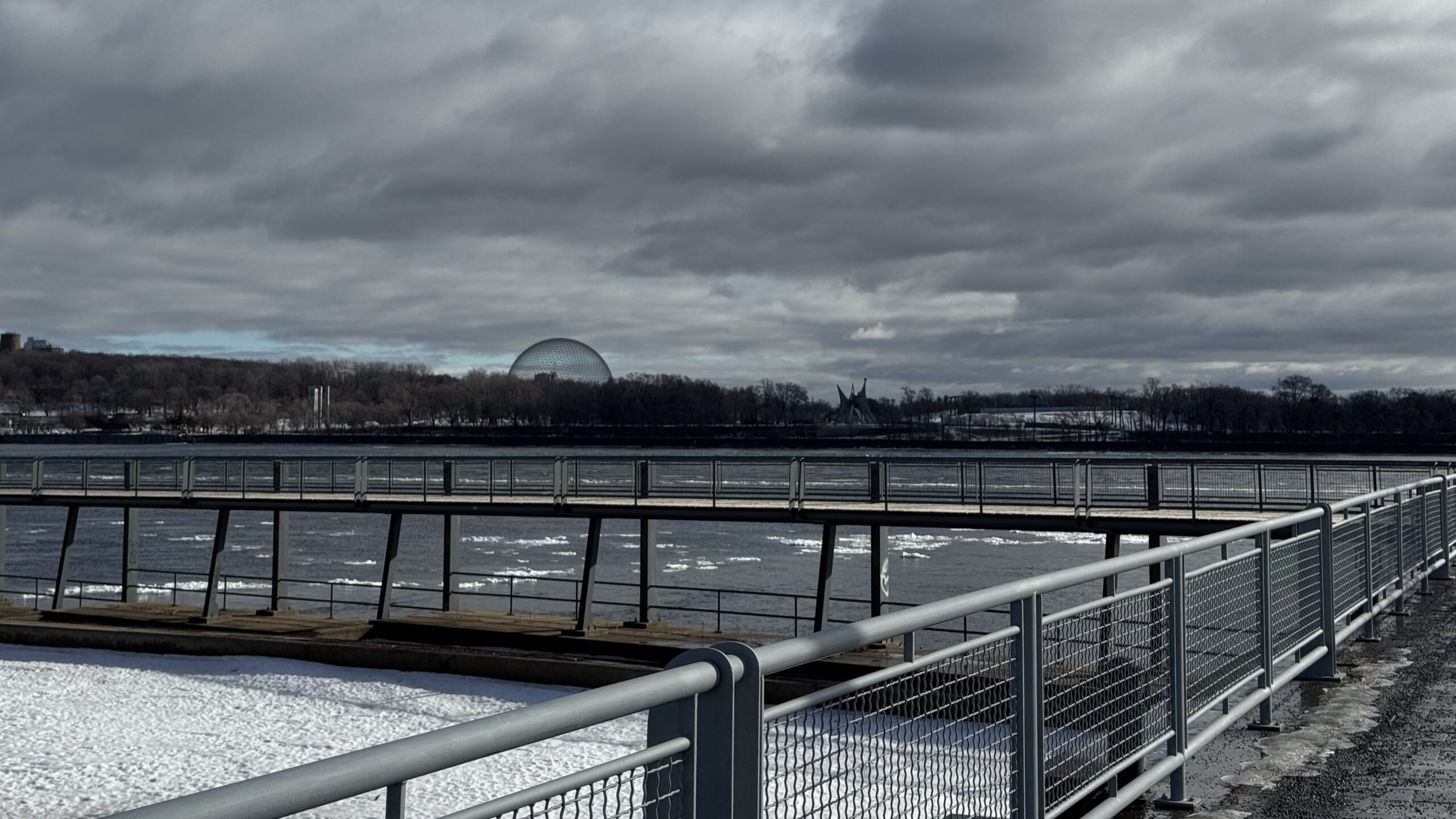
I’ve been coming to this route since November, which means I’ve been here long enough to watch the river do everything it’s done this winter. Not every day, not with any intention exactly. Just when the body needed somewhere to put itself that didn’t require anything back. The Old Port in winter is good for that. Nobody’s performing anything. The tourists are gone, the terrasses are stacked and wrapped in plastic, and what’s left is the river and the cold and whoever else needed to be somewhere that wasn’t inside their own head.
I watched the freeze happen in pieces. First the edges, where the water slows against the bank and the cold gets a foothold. Then the surface thickening gradually, going from dark and moving to grey and uncertain to the flat white that means it’s held. There was a week in January where the ice looked almost translucent in the afternoon light — blue-green, the kind of colour that doesn’t seem like it belongs to winter. I stood there longer than made sense. I didn’t write about it. I just kept it. There was a morning in February where snow had covered everything overnight and the whole surface went illegible, no texture, no variation, flat white meeting flat white at the horizon. The river looked like it had stopped being a river. Like it was waiting for instructions. I remember thinking the cold that morning felt almost like clarity, which made no sense given that nothing was clear, but the body makes its own logic and I’d learned by then to let it.
So when I come around the corner today and the river is moving—not fully open, there’s still ice out toward the middle, still that grey-white surface, but along the edges it’s dark water again, actual current—I stop without deciding to stop. I don’t know exactly what I’m registering. Just that it matters, the way some things matter in the body before the mind has caught up with why.
What I understand now, that I didn’t know walking those winter mornings, is that I was memorising. It felt like the opposite—like emptying out, like just moving through cold air with nothing required of me. But the body was doing something the mind hadn’t signed off on yet. Storing details. Noting the specific quality of light on ice in January. Learning the weight of this particular stretch of waterfront at this particular time in my life. That’s what grief does before you’ve named it as grief: it makes you pay attention. It starts archiving without asking. It turns ordinary routes into records of something you’re not ready to call an ending yet. And then I look up, and the city is still here, doing what it does, and I feel it anyway.
Montréal means it, though. That’s the part that’s always been hard to hold alongside everything else. When the warmth comes back and people spill out onto the sidewalks and strangers almost smile at each other, that’s real. There’s a genuine porousness to this place when the conditions allow it, a capacity for collective ease that I haven’t found anywhere else in quite the same register. I’ve loved this city through every version of myself. It taught me the pace of winter light and what care looks like when it’s built inside contradiction rather than despite it. The friends who showed up, the communities that held me, the particular way people here make room for each other in the margins of a place that isn’t always making room officially—that’s not nothing. That’s actually most of what I know about survival.
And it’s all present today. I can feel it in how the city moves, the way the warmth loosens something collective and for a few hours everyone’s a little more available to each other. I’m not outside it. My chest opened on this walk the same as everyone else’s.
But I’ve also lived here long enough to know the pattern. The warmth is real and then the policy conversation starts and the belonging turns conditional again. The city that holds you and then asks you to be less legible in certain rooms, to translate yourself into something more manageable, to accept that your safety is negotiable in the name of neutrality or order or whatever word is doing that work this season. The fool’s spring is the actual structure of what it’s been like to do Black queer abolitionist work here. The opening and then the slow close. The genuine warmth that never quite becomes something you can count on. You feel it every time. That’s not naivety. It’s just how it goes.
What I didn’t expect today is that none of that would settle the question.
I’ve been thinking of the leaving as something already decided, the walks a form of goodbye that was already underway, the compression becoming its own kind of instruction. And I still think that’s true. But today, in this light, with the river moving and the city briefly being the version of itself that I fell for, I don’t know. Not in a way that changes anything concrete. Just in the way that honest things are sometimes more complicated on good days than on hard ones. The hard days make the leaving feel obvious. The good days remind you what you’d actually be leaving. Neither one gets to be the whole truth.
I keep walking. The warmth stays on my face. I let it.
Somewhere in the middle of winter, I started reading job postings from small university towns.
Not obsessively, not with a plan. Just tabs that stayed open longer than they should have, descriptions of places I’d never been that I kept returning to without quite knowing why. Towns I’d have to look up on a map. Departments small enough that you’d know everyone’s name by October. The kind of campus where the work would have to speak for itself because there’s no scene to situate it in, no institutional politics to navigate before you’ve even started.
I told myself it was practical. The PhD is ending, the market is the market, you apply where there are positions. That’s true as far as it goes. But it doesn’t explain why those particular postings were the ones I kept returning to, or why imagining a smaller place felt less like settling and more like something the body was quietly asking for.
I think my nervous system has started making cartographic decisions. The way this city lands on me now, the weight of it — some part of me has figured out that scale is something I can actually change. There’s a version of this work that happens somewhere I’m not already exhausted before I begin. I keep picturing a quality of morning more than a specific place. The kind where the first thing the body does is breathe. Where you can walk to work and the walk doesn’t cost anything, doesn’t pass three corners each carrying a different memory of who you were trying to be when you lived near there. Where the air is just air and the river, if there is one, doesn’t know your whole history.
I know how that sounds. Like I think a different postal code is going to fix something that lives in the body and travels with it. I know the difference between changing your circumstances and outrunning yourself. But environment is not neutral, and it’s taken me years to trust that fully. Doing this work in a city where it’s legible but not exactly welcome, where every institutional conversation requires a translation tax, where you’ve spent years learning to make yourself understood in rooms architecturally designed not to understand you — that accumulates in the tissue. I’m not burned out in the generic sense. I’m tired in a specific and located way. Tired of the particular labour of being this person in this place at this moment in its politics. More rest isn’t going to fix that. Distance might.
The teaching keeps coming up too. As something I actually want, in a way that’s become clearer the more depleted I’ve gotten here. Students who haven’t encountered this work before. A classroom where abolition isn’t the assumed vocabulary, where I’d have to find new ways in rather than spend energy defending the door. There’s a version of the work that gets lazy when it only ever talks to people who already agree, and I think I’ve been in that version for a while without fully admitting it.
Small university towns have their own whiteness, their own particular loneliness for someone who looks like me. I’ve read enough from Black scholars at isolated institutions to know that the quiet I’m picturing can curdle — a different kind of exhaustion, the work of being the only one in the room following you into a different room in a different city. But there’s a difference between what I’ve been absorbing here and the difficulties I’d carry somewhere new. One feels like something the city does to me. The other would at least be mine to navigate on my own terms.
I can go. That sentence is doing a lot of work. It’s a function of a passport, of citizenship, of options I didn’t earn so much as inherit through a specific geography of luck. Some of the people I love and do this work beside don’t have the same calculus available. The border that’s an inconvenience for me is a wall for others. There’s something uncomfortable about framing mobility as nervous system regulation when mobility itself is structural power. The leaving doesn’t stop being a privilege just because it’s also a need. That discomfort doesn’t get resolved by naming it. It just gets carried more honestly.
The tabs stay open. The towns stay imagined, their particular quiet, the version of myself that might exist there. On the hard days that feels less like fantasy and more like information.
I’m still walking this route. That’s the strange part.
The body still knows every texture of this waterfront, every place where the pavement shifts or the wind comes off the water differently. I still stop at the same spots without deciding to. I still look for the light in the same places. Nothing about how I move through here has changed, and yet something is already gone. Not left exactly. Loosened. The way attention shifts before the body follows.
I’ve been looking at this city too carefully for months. Too completely. Taking in details I never bothered with before — the particular colour of the light on Saint-Laurent in the early evening, the sound the métro makes pulling into Beaubien, the way snow sits differently on the mountain than anywhere else. It feels like love and it is love, but it’s also the beginning of an archive. You don’t memorise what you’re certain of keeping.
The walks have been this. Every time I’ve come down to the river since November, I’ve been doing something I didn’t have language for until recently. Saying goodbye to a place I haven’t left yet, to a version of myself that is going to stay here even after I go. There’s grief in that and also something steadier than grief, something that doesn’t have a clean name. The body moving through familiar space one more time, not performing anything, just letting it register fully before the register closes.
I’m still here. I’m already elsewhere. Both of those are true right now, on this same walk, in this same body, and I’ve stopped trying to figure out which one is more real.
The warmth is still on my face when I turn back toward home.
I didn’t ask for today. Didn’t need the city to do this right now, to be this version of itself while I’m in the middle of figuring out how to leave it. It would’ve been easier if March had just stayed March, stayed hard and grey and unconvincing. Instead it gave me this — the river moving, the strangers almost smiling, the chest opening before I could stop it. The kind of day that doesn’t argue with you. It just arrives and expects you to feel it.
So I did. I let it in.
I don’t know if I’m leaving. I know the tabs are open. I know the towns are still imagined, their particular quiet still hypothetical, the version of myself that exists there still unverified. I know Montréal is still the place that made me and that making doesn’t undo itself just because I’m tired.
The river will freeze again next winter whether I’m here to watch it or not.
The warmth will be gone in a few days. The cold will come back and close things over again. That’s fine. It got in while it could.
The body knows the route either way.