
Category: Theory

  • Trophies

    Trophies

    Eight-thirty and I’ve been awake since six. The body has been doing this since I sent the dissertation in: waking itself before I decide to wake, some obscure bodily alarm I didn’t set going off in the dark. I ended up at a coffee shop I’d never tried before–less by choice and moreso because all my usual spots are all still closed–an oat milk moka slowly going cold in my hand. I don’t fully know why I came to sit here, under this ash tree at the edge of the Lachine Canal, except that the body has been leading and the mind has been following.

    The bike path is busy even now, this early. Commuters, runners, a construction worker setting out cones thirty meters from where I’m sitting. Birds are picking crumbs off the stone edge of the canal, and I can see an RTL bus from Longueuil crossing the Mill Street bridge above my right shoulder, moving through without stopping.

    The story broke a few days ago: officers from Station 39 in Montréal-Nord had been stopping Black men and men of Arab origin at rates that required formal explanation, issuing tickets on the basis of ethnicity, making racist remarks inside a unit culture that circulated them as ordinary. The investigation had started in March, already underway before anyone outside the unit knew to ask. Then, in the coverage, a detail: some of them had been ripping off locs during police interventions and keeping the pieces as trophies.

    Trophies.

    What I notice is which part of this incident dominated the headlines. The stops, the tickets, and the remarks are the texture of daily life for people in that neighbourhood: the unremarkable climate of being under a specific kind of management. It took the “trophies” to produce the press conference, the mayor calling it disturbing, the police chief holding the room with his own face as evidence that the institution has changed. Frank B. Wilderson writes that anti-Black violence circulates as atmosphere, the condition against which civil society confirms its own moral coherence. Scandals like this, almost predictable in their recurrence, are necessary precisely because the atmosphere is not. The trophy takes the heat so the remarks and the tickets and stops don’t have to. Then the reform response arrives on cue: body cameras, reassignments, oversight, the machinery that allows the atmosphere to be named without being changed.

    This logic doesn’t stop at the institution. A progressive journalist in this city who has covered SPVM violence for years and has built a sizeable following opened their Station 39 video with: “The SPVM is scalping people.” The image is vivid, which is the point, which is also the problem. Anti-Black violence is passing through a progressive media network as affective content, producing moral feeling in audiences who will likely never be stopped in Montréal-Nord on a humid Tuesday evening. The feeling confirms alignment: it circulates, metabolizes into outrage, and then the next story accumulates. I want to be clear about this: none of this requires bad faith. Civil society built the execution scaffold, and we mount it before we decide to. This is what Wilderson means by background affect: the Black body in pain as the ground condition that civil society, including its critics, requires in order to feel itself.

    Vincent Woodard writes about the consumption of Black bodies as inherited logic: the taking and keeping of the souvenir. Locs accumulate over months and years, the hair carrying its own time, and cutting them during an intervention is taking that time alongside the dignity and the agency and the flesh. What the officer does with the trophy and what the viewer does with the progressive journalist’s video share a structure. In both cases, the Black body is made available to someone who is not subject to it, received and held briefly, used to produce something — possession, feeling, the confirmation of one’s moral position — and then the Black body remains where it was: in Montréal-Nord, subject to the next ticket, the next racist remark, the next unjustified stop. The trophy is the version that made the condition legible. The underlying assumption was already there before the scissors, before the camera, in every interaction that didn’t make anyone’s feed.

    Saidiya Hartman says gratuitous violence doesn’t require justification. It enacts a prior condition. The analysis is not a shield against it. I have been studying this for four years. The dissertation on my committee’s desks right now is over a hundred pages about how communities care for themselves when institutions won’t, and I am sitting here under this ash tree at eight-thirty in the morning with a chest that weighs more than it did yesterday. The knowing doesn’t stop the landing.

    A duck comes down the canal with a few others trailing. The water here is built, cut through Kanien’kehá:ka territory in the 1820s to make commerce legible, to route water according to a particular purpose, to bend it to the capitalist’s will. There is still life in it. Their attempts at control failed, as they always do. Water finds a way.

    Christina Sharpe writes about residence time, the measure of how long an element stays in water. Sodium for 260 million years. The water doesn’t release what entered it. This canal connects to the St. Lawrence connects to the Atlantic, and the Atlantic received—and the Atlantic holds. Holds the bodies, holds the names that were never written down, holds the ones whose lives were rendered unremarkable long before the Station 39 officers kept their trophies. The surface in front of me has always been holding something it won’t disclose, and I have been sitting beside it long enough that I stopped checking.

    I was starting to gather myself to go when I realized it was raining. Had been raining for a little while, actually. There was no forecast for it, so I hadn’t brought an umbrella. The ash tree had been holding it off without asking—the canopy dense enough to keep me dry—while the canal surface in front of me was already pocked with it, thousands of small entries. I hadn’t noticed because I was protected. I don’t know how long I’d been sitting inside this weather I couldn’t feel.

    Fediverse Reactions
  • Période de questions

    Période de questions

    June 10th. Twenty to six, and I’ve just arrived at Centre Saint-Pierre for RÉZO’s annual general meeting. The long tables usually here have been folded and pushed against the right-hand wall. Plastic and metal chairs in rows facing a screen. Fluorescent light. I find a seat and the shaking starts, low and steady. There is one woman in the room. No Black people.

    By ten to six I can read who is staff and who is board. I take out my notebook. The body does what it does in rooms like this — holds itself a certain way, stays within a shape the space expects, files everything it notices without letting that noticing show. Fourteen days before, I had published a piece about this organization and sent it directly to its executive director and board. Two days after that, the executive director confirmed receipt and told me it had been received by everyone I had intended, that there would be more reflections soon. I had also published the piece publicly on LinkedIn, where the organization was named and tagged, visible to the funders and sector partners and researchers who follow it. Tonight is the annual general meeting. I have yet to receive a written response. I came because the meeting is public and the community this organization built a program for, and then let go of, deserves someone in the room when its year is accounted for.

    Before the meeting opens, the executive director tests the sound. He opens a laptop, opens YouTube, types musique into the search bar. The algorithm returns Aya Nakamura first. There is a pause before he clicks. Copines loads. No sound.

    He works through the settings. A young Black tech enters the room — the only other Black person who has come through the door, and he has come to work. He locates the problem, works on it. While they’re at it, the video ends and Tyla’s Water starts automatically, one Black woman’s voice following the other’s into the same silence, neither one selected, neither one heard. A few minutes later, the tech fixes the system. He leaves.

    Rodrigo, the board’s president, opens by announcing he won’t be running for re-election. The territorial acknowledgement that follows is Concordia University’s, read verbatim. A text written for another institution’s rooms, carried into this one without the labour of being re-situated.

    At twenty past six, Kevin arrives. He is the only Black member of the board, and the only Black person who entered this room as a member tonight. The meeting has been running for fifteen minutes. The opening, the acknowledgement, the beginning of the financial report — already done.

    The financial audit is presented by a Black woman, external to the organization, hired for this function. The working sound system carries her voice across the room — this is what it was fixed for, this is the first voice it produces — as she presents a surplus of about twenty-four thousand dollars for the year and accounts for the organization’s finances with the precision of someone engaged for a single purpose. She finishes. She leaves.

    The tech came to work. The accountant came to work. The two voices surfaced by the algorithm came to test whether the room could carry sound. I came as a community member and was not spoken to once — not by staff, not by board — for the hour and forty minutes I was there. There were looks, several of them, across the whole evening. The particular flicker of recognition from people who know exactly who you are and what you sent them fourteen days ago, who saw it posted publicly on LinkedIn with the organization named. Their recognition went nowhere. It registered me and moved on, and kept registering me and moving on, each time it happened, across the whole meeting, the room processing my presence the way it processed the two voices the algorithm returned: surfaced, used, set aside.

    The budget for the coming year: a dedicated line of eighty-two thousand dollars for the chemsex project, in partnership with the Direction régionale de santé publique. A grant received six months ago that would have funded more chemsex workers had conditions not changed. Seven positions cut at the end of March. A new funding source for a program that cannot yet be named. The precarity of project financing acknowledged as the sector’s structural reality — and it is, I want to be precise about that, the instability is real and organizations across this city are living inside it. No dedicated funding line for Kominote.

    Then the annual report, not yet published, available in two weeks. In the rundown of services, I hear the word Kominote spoken aloud in an institutional setting for the first time in two years.

    Six meetings this past year. Eight people per meeting.

    I sit with that for a moment. Two years of institutional silence, two annual reports in which the program and the person who built it didn’t exist on any page, and now the name said aloud, in this room, while I am in this room, unaddressed. He can say the name — that isn’t what the pause is about. The pause is about what comes after it, which is: nothing else. Convive, the Spanish-language group, gets its registrations and activities and long descriptions. The chemsex project gets its staff trainings, in active development. Kominote gets one breath and the meeting moves on. HoT, the group for trans men and trans masculine people, is mentioned as also continuing this year. I didn’t catch the details. I was still inside the hearing of the name.

    The board section is thorough. The person presenting lists membership requirements carefully: there must be at least one person living with HIV. That requirement exists. There is no requirement about racialized members. There is no requirement about Black members. The 2020 report I wrote for this organization — the one it called un point tournant dans l’histoire de notre organisme — required a board composition of minimum 33% racialized members, including at least one Black person, as a governance requirement. Because the presentation tonight was detailed and specific, the absence is not ambiguity. Six years. It was never made a rule.

    The institution counted the sessions it did not sustain. It listed the requirements that were never written.

    After the services section, the moderator asks if there are questions or comments.

    The room tightens as people look around at each other, avoiding my gaze. A collectively held quality, bodies readied, the expectation of confrontation. Everyone in that room knows the piece exists. The executive director confirmed its receipt and forwarded it to every person with authority here. The tension has a specific shape: the room is waiting for me to make myself a scene.

    I say nothing.

    This is not retreat. The argument is already on the record, made carefully and in full, using the organization’s own documents as evidence, delivered to the people who could act on it. What a raised hand would produce is a different kind of record: the one where I become the disruption to be managed, the affect to be addressed while the substance waits. I have watched this organization manage that particular sequence before. At SMASH, their annual conference, in 2025, I pressed a white presenter on why a session built on photographs of Black people contained no analysis of what being Black meant for the people in those photographs, for the statistics being shown, for the rates of criminalization and healthcare exclusion the data was already documenting. What the institution managed afterward was my affect. Not the presentation. The following year’s SMASH program contained no Black-specific health content. The word does not appear in the document.

    So I stay quiet, and the room’s readiness for a fight moves through the agenda and dissipates. Two silences in one room tonight. The voices that were loaded and never played. The voice that declined to perform. Both of them the post’s.

    The meeting ends at quarter to eight. I close my notebook and go.


    Here is what I knew sitting in that room that the room did not say.

    RÉZO is not an organization that lost its federal funding and had to make impossible choices. The original Advance program — five years of federal money coordinated nationally by the Community-Based Research Centre, with RÉZO as the Montréal partner — funded Kominote, and it ended. That ending was real. But a second cycle followed. Advance 2.0 runs from 2022 to 2027 with the same partners, RÉZO still the Montréal coordinator. Federal money is flowing now. I was sitting in a room where the organization’s 2026-27 budget was being presented, and that budget exists inside an active federal funding relationship. The sector-wide precarity is real and I am not dismissing it. What it does not explain is where the cuts specifically landed — because that determination is institutional, made inside the precarity, and the record shows what it produced.

    SMASH is what RÉZO built with those resources. The conference was created in 2019 as the francophone pillar of the Advance alliance and confirmed at the AGM tonight as continuing alliance programming. Which means the specific federal funding stream that once sustained a support group built by and for Black GBTQ men now sustains the conference where I was managed for naming anti-Blackness in one of its rooms — the conference that answered that naming by removing Blackness from its program the following year. RÉZO runs an independent budget and workplan, and the choices about what to build within the mandate belong to them. The redirection is RÉZO’s redirection. The same mandate. The same federal relationship. Different choices about what gets architecture.

    HoT makes the choice legible. I was sitting in a room where HoT was mentioned as continuing in 2025-26 — the group for trans men and trans masculine people that, like Kominote, was an Advance-era program that lost its footing when the first grant ended. The most recent annual report shows HoT on its fourth cohort, named and described, with documented plans to expand. Kominote appears nowhere in that report, or the one before it. Both programs apparently ran this past year. The report in two weeks will show what each looked like. But the 2024-2025 record already answers the question the funding cliff raises: when two programs fall off the same cliff and the organization rebuilds one with institutional architecture and leaves the other to run on whatever labour held it together outside any documented support structure, the cliff stops being the explanation. What remains is the choice.

    Which brings me to the six sessions. Eight people each time. Running in 2025-26 after two years of documentary absence, with no funding line, no named partnership, no dedicated position. Steve Bastien built Kominote and ran it through its first years. His name disappears from the 2024-2025 annual report alongside the program — gone in the same transition, without acknowledgment, the way the internal anti-racism committee also went: there in 2022-2023 as a named organizational priority, absent from the next two reports without explanation or account of dissolution, as though it had simply stopped being something worth noting. Whether Steve was the one who held those six sessions in 2025-26, or whether the community found another way to sustain what the institution had dropped, is not on any record I have access to. What is on the record is that the institution will count those sessions as its own in the report published in two weeks. The labour that made them possible will not appear in it.


    I want to add something I didn’t say in the last piece. The 2020 report specified a campaign against racism in LGBTQ+ spaces, with its form to be determined by a consultative committee made up exclusively of racialized people. The campaign that launched in 2022 was real. It said what needed saying. I wrote that before and I meant it. What I didn’t write: it was produced through a professional advertising relationship with Upperkut, with community members as consultants to production rather than governing committee. Participants from Kominote — people who had described, in sessions built on trust, what it felt like to be reduced to the surface of their bodies in spaces that were supposed to hold them — had those descriptions worked into campaign content and distributed on the apps where those reductions happen. The apparatus that named the consumption reproduced it in the act of naming. Both things are true and I have stopped needing them to resolve.

    And the extraction has operated twice, not once. The 2020 report produced institutional currency — the turning point language, the sector legitimacy, the funder credibility of an organization that had commissioned rigorous community research and named what it found. That currency was spent. Then the BLM statement, published six days after George Floyd’s murder, naming Kominote specifically, naming the structural obligations the moment required — that statement is still live on the organization’s website. Still in circulation, still producing legitimacy, still available as evidence that the organization understands structural racism and is committed to addressing it. The structural transformation it named is not documented as implemented in any annual report. The commitment is retained. The obligation is not met. Tonight: Kominote’s name spoken once after two years of silence, six sessions counted, next ones unfunded, the page still live with Dates à venir! The naming costs nothing. Each naming produces another small increment of the same currency the turning point produced in 2020, and the obligation that would have required actual redistribution remains, as it has remained, unnamed.

    I have been in relation to this organization since 2017. That summer I was a young outreach worker doing harm reduction in communities the state had largely abandoned, learning two things simultaneously: what care looks like when it actually reaches people, and what an institution looks like when it houses harm without naming it. I had no full language for what I was reading then. The body read it anyway, developed its grammar for it — the low shaking that started tonight before the meeting opened, settled across the ninety minutes into something steadier, the room’s recognition of me without address becoming just another thing the body metabolized and kept.

    What nine years of that grammar has produced is this understanding, which I want to state plainly.

    The anti-Blackness I have been describing does not work by exclusion. Not the door closed, not the service refused, not the hostility you can locate and confront. That form is real and it is not this form. This form welcomes you in. It hires you. It commissions your knowledge and calls what you produce a turning point. It launches the program your community asked for. It funds the program while the funding architecture compels it to. It builds a campaign from your community’s testimony and receives the coverage. It keeps the commitment on its website. It confirms receipt of the analysis that names all of this and says there will be reflections soon.

    And through all of it, it does not change its structure. The governance requirement is never written. The training is never documented. The program is not rebuilt when the resources return — or it runs on absorbed and unrecorded labour, and the institution counts the sessions it didn’t fund. The money moves toward the conference. The accountability infrastructure disappears from the record. The meeting that was going to happen, happens.

    What makes this form distinctive is that it cannot operate without us. It needs the needs assessment, the community’s attendance, the testimony, the turning point, the Black voice the algorithm surfaced into the search bar, the Black tech at the sound board, the Black accountant at the podium, the Black member in the plastic chair not speaking during the période de questions. We are not incidental to what this institution presents itself as. We are the input. The welcome is not the opposite of the extraction. The welcome is how the extraction works. We are brought in so that what we carry can be used, and the structure that would make our presence binding rather than useful is the one thing that is never built.

    The body knew this in 2017. The language has caught up.


    The piece went out on May 27th. Receipt confirmed May 29th. More reflections soon. The AGM was June 10th. No written response has arrived in the fourteen days between. The budget presented that night was the budget. The board requirements listed in detail were the requirements. Nothing in the fourteen days of looking into it produced an amendment to either. The deferral was named, and the AGM is what came after it.

    I don’t know where this lands. The annual report arrives in two weeks and I will read it the way I read all of them — alongside everything else this organization has published about itself, because its own documents have always been the evidence. Something is in motion. I am not in a hurry. The work doesn’t depend on the institution answering. It depends on staying in relation to the people the institution was supposed to be answering to, which is what required being in that room, and what will require being in the rooms that come after it.

    One Black woman’s voice returned by algorithm as the answer to a search for music, clicked into the silence, not heard. Another arriving automatically behind her, also not heard. Neither one reached for, both of them used, the apparatus moving on when they didn’t produce sound, the shaking in my body settling across the evening into something steadier, the body done warning and simply present.

    I closed my notebook. I got up from the plastic chair. I went.

    Fediverse Reactions
  • Les inscriptions sont fermées pour le moment

    Les inscriptions sont fermées pour le moment

    The conversation is over. My friend and I are sitting in the particular stillness that follows something hard, the kind where the next thing hasn’t become possible yet. I know how to be here. I’ve learned, over years of this kind of work, how to stay inside difficulty without flinching toward resolution, and that knowing didn’t go anywhere when I closed my practice. That was partly the point. The practice closed so that this could happen differently, in the register of friendship rather than the session note, the billing code, the annual registration, the showing up that doesn’t require an intake form.

    Which means I also know what comes next. I know how to locate a resource, how to identify which organizations are genuinely adapted and which ones will make someone feel worse for having tried. For this friend, this need, I reach for RÉZO, Montréal’s primary sexual health organization for GBQ men, before I’ve finished the thought. The body already moving toward the answer while the mind is still formulating the question. Something that becomes reflex when you’ve been inside a community long enough, when you’ve given enough of yourself to a particular ecosystem of care to know where things live inside it.

    I open the site. The navigation has changed. The page has moved, nested now under a sub-sub-section I have to locate before I can locate what I came for. I find it.

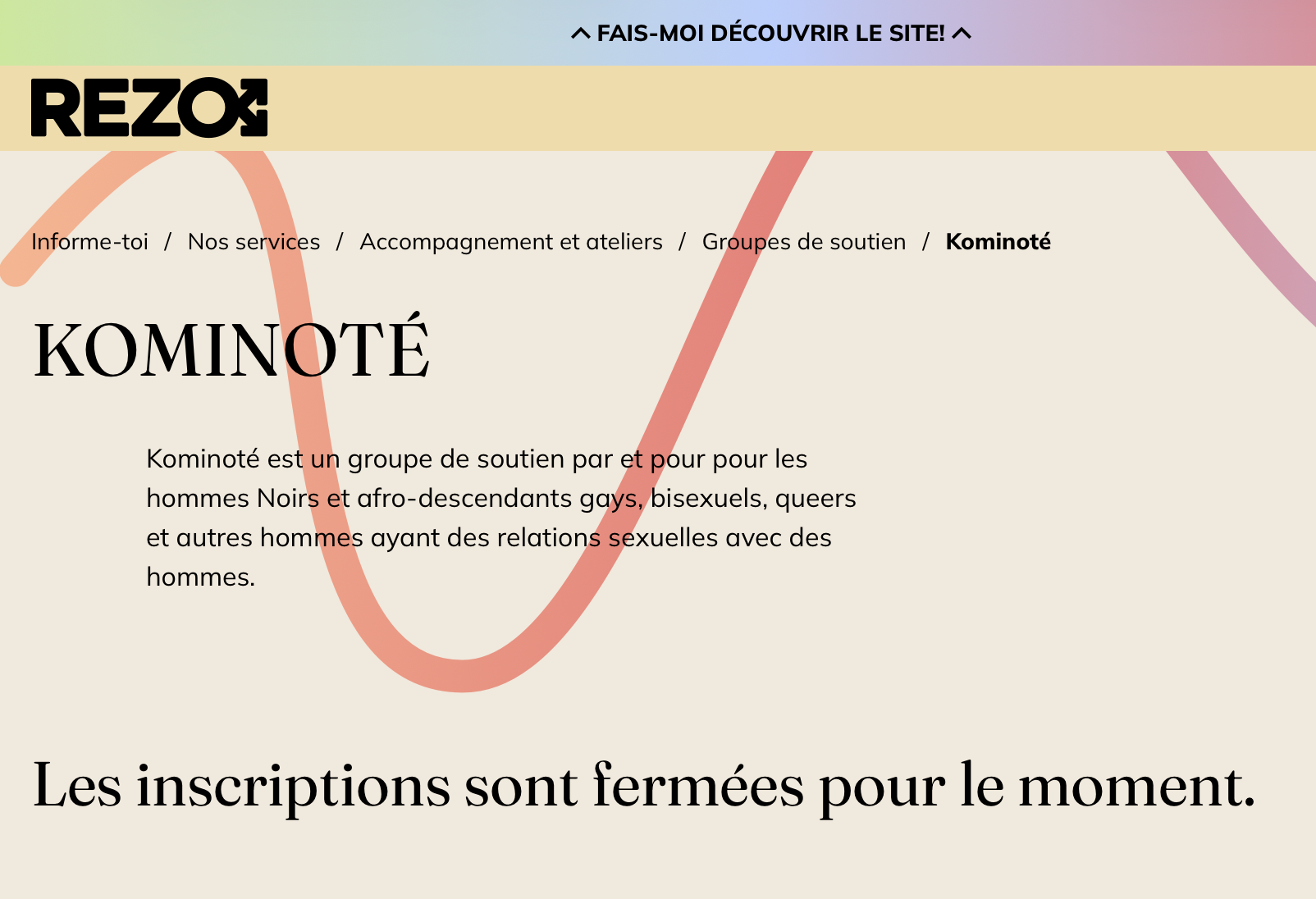
    Les inscriptions sont fermées pour le moment.

    My body receives this before I do. Something settles low in the chest: not sharp, the specific weight of something already known arriving as confirmation. The body has a grammar for this particular texture of disappointment, has developed it over years and in relation to this specific institution. I stay on the page longer than I need to. Dates à venir. I close the tab.

    My friend is still there in the way people stay with you after a difficult conversation. Still needing something. I sit with the quality of not having it to give, which is different from not knowing it existed, different from not having tried.

    I’ve known RÉZO since 2017. That summer, I was an outreach worker for their sex worker program, young, newly arrived in this kind of work, learning what it meant to move through communities the state had abandoned and then appointed institutions to monitor. The work itself was real. I was doing harm reduction with people who had built their own forms of survival inside that precarity, and something in me recognized that, was drawn toward it, was learning from it. That part I kept.

    There was a supervisor. His relationship to Black men’s bodies was legible to me that summer before I had full structural language for it. The institution had chosen not to have language for it either, which is its own kind of position. What surrounds that kind of behaviour inside a professional context is often more instructive than the behaviour itself. The silences. The way certain things circulate without being named, without anyone being required to account for them. The particular atmosphere of an organization that’s decided its progressive commitments are self-evident and therefore require no examination. I was a young Black worker inside that atmosphere, doing real work, learning two things simultaneously: what genuine care looked like when it reached people the state had abandoned, and what an institution looked like when it housed harm without naming it. You learn things from what an organization doesn’t say. I filed that knowledge somewhere and kept working.

    Training, supervised hours, three provincial registrations, insurance, continuing education requirements, documentation, all of it building toward a practice and toward a growing clarity about what the credential required in exchange for the legitimacy it conferred. It asked me to convert genuine care into something auditable, to route what happened between me and the people who trusted me through frameworks designed to make it legible to institutions rather than useful to people. I stayed inside that structure long enough to do real work and also long enough to understand what it was costing. I closed the practice deliberately in order to hold this differently. In the register of community, of friendship, of care that doesn’t require the state’s recognition to be real. I believed the infrastructure for that kind of work existed. That belief is what I was carrying when I opened the tab.


    In 2020 RÉZO hired me to lead a community needs assessment. The question was precise: why were Black queer and trans people structurally absent from the organization’s users, and what would it actually take to change that. I consulted 38 people, 21 in individual interviews and 17 through an online survey, with trans and non-binary participants deliberately over-recruited because the existing research on Black MSM health had excluded them as a matter of course. The consultation ran mid-COVID, which meant planned group discussions were cancelled, interviews moved to screens, and anonymity was compromised for participants who weren’t out because payment required a name attached to a cheque. These constraints are named openly in the report because that kind of transparency is part of what makes a document trustworthy rather than authoritative.

    What the community described was specific. They talked about walking into RÉZO and feeling immediately that the space had been built around someone else, that the staff’s frame of reference didn’t include the particular ways anti-Blackness and homophobia operated together in their lives, that being Black and queer in Montréal’s LGBTQ+ spaces meant being hyperlegible in some registers and invisible in others. They described the sexual fetishization of Black men as a documented harm operating not at the margins of those spaces but at their centre. They described needing something built from the ground up around their actual experience, not retrofitted from programming that had been designed around a different community’s needs entirely.

    The report that came from that process wasn’t a set of suggestions. It required a Board composition of minimum 33% racialized members including at least one Black person and at least one Indigenous person. It required anonymous CVs as standard hiring practice. It required mandatory anti-racism training built into onboarding for all staff and volunteers, with documentation, on a schedule the organization would be held to rather than one it could determine for itself. It required a dedicated support group animated by and for Black community members. A public awareness campaign against the sexual fetishization of Black men inside LGBTQ+ spaces, because the community had named that fetishization specifically and the report took them seriously. The specificity was deliberate. The consultation had been thorough. The report matched it.

    The document landed. RÉZO received it, the document they’d hired me to produce, and called it “un point-tournant dans l’histoire de notre organisme.” The report is still linked on the Kominote page. Still available to download. The organization’s own words about what this moment represented are still on the record, attached to the page of a program that’s no longer running, below a banner that reads: Les inscriptions sont fermées pour le moment.

    Kominote launched in 2021. Discussion groups, individual consultations, thematic workshops covering sexual health, discrimination, mental health, the specific experience of navigating LGBTQ+ spaces that hadn’t been built with Black queer people in mind. An awareness campaign against the sexual fetishization of Black men. RÉZO had asked what the community needed and they’d said, and then they’d come when something genuinely responsive was offered. The community showed up. Twelve people across twenty-five sessions in the program’s second year. Individual consultations running in parallel. People moving from one-on-one support into the group because the group was what they’d been looking for. They didn’t need to be convinced.

    Then political appetite shifted. Funding dried up. RÉZO’s own 2024-2025 annual report opens by acknowledging a reduction of sexual health funding. This is real. RÉZO has undergone significant restructuring in recent years, losing substantial staffing capacity across multiple intervention teams. People lost their jobs. Programs lost capacity. Communities lost services that had been built over years. The organization has been navigating a genuine crisis, not a managed inconvenience, and that context belongs in any honest account of what happened next. It does not, however, determine where the cuts landed. That determination is institutional. The funding landscape is genuinely difficult, and it does not explain what happened next. The Chemsex/PnP project expanded during this same period. It received more than 267 hours of individual accompaniment in 2024-2025, two support groups, multiple staff, detailed coverage across several pages of the annual report. Convive, the Spanish-language group for Hispanic GBQ men, is described in the same document as essential and thriving, 182 members, 12 meetings. Funding pressure is distributed unevenly and the distribution is legible if you read the annual reports alongside the Kominote page. Neither the 2023-2024 nor the 2024-2025 report mentions Kominote. Two consecutive years of institutional silence. In that same 2022-2023 report, the last one to mention Kominote, Chemsex/PnP appears for the first time: a new program still in development, four meetings held.

    The page stays up. The report stays linked. Les inscriptions sont fermées pour le moment. Dates à venir. The organization keeps the political currency produced by the consultation, the report, the community’s attendance, and sheds the obligation that currency was supposed to carry. This isn’t neglect and it isn’t bureaucratic failure. Neglect would be passive. What this is, is the active maintenance of a progressive reputation built on work the institution is no longer doing, for a community that came to everything Kominote offered and was not sustained. The box is ticked. The community member looking for a group session finds a banner. RÉZO gets to keep the turning point. The community gets dates à venir.

    The summer of 2017 is where this grammar comes from. Not a case being built but a way of reading being learned, through the body, before the language caught up. Black presence instrumentalized to produce legitimacy, to signal progressiveness, to access funding, and then the institution withdrawing once the currency has been extracted, leaving the community that produced it without the infrastructure their presence was used to justify. The needs assessment the institution commissioned and praised and didn’t implement. The program the community filled and the institution didn’t sustain. This isn’t a pattern of failure. This is a pattern of extraction, and it’s been operating at RÉZO for as long as I’ve known the organization.


    HoT and Kominote were built under the same federal project funding, the first phase of the Avancer alliance, which ran from 2018 to 2022. HoT followed a needs assessment, produced a guide for trans men and transmasculine people having relationships with men, and became a program. The community it was built for came to it. Kominote did the same. Federal project funding is always time-limited. When that first phase ended, both programs hit the same cliff and RÉZO had to decide what to sustain.

    The 2024-2025 annual report describes HoT as being in its fourth cohort, nine people enrolled, with plans to rebuild the group for 2025-2026. Its registrations are also currently fermées pour le moment. The difference is that HoT exists in the report: named, accounted for, assigned a future. Kominote doesn’t appear in either the 2023-2024 or the 2024-2025 annual report. Not to note a pause. Not to signal a rebuild. Not once. Two programs, the same funding origin, the same cliff, the same direction of travel while Chemsex/PnP expanded, while Convive grew, while the annual report filled pages with statistics about what the organization chose to sustain. A community’s needs don’t contract because a program’s enrollment does. The pattern isn’t about one program or one community. It’s about which communities RÉZO decided, in practice rather than in stated values, to keep building toward when the federal money ran out.

    Architectural decisions are decisions. Convive has its own dedicated portal in RÉZO’s primary navigation, built into the site at the same architectural level as the main sections. The site exists in three languages, structured partly around this portal. Where something lives in a navigation structure communicates institutional priority as clearly as anything in an annual report. Kominote sits under a sub-sub-page of the services section, below a banner that by now you know.

    This isn’t a critique of Convive or the community it serves. The contrast isn’t between those communities. It’s between what the institution decided to sustain and what it decided not to, and what that pattern communicates about where Black queer people actually sit in RÉZO’s hierarchy of commitments, as opposed to its stated one.


    In 2022 I presented Kominote’s findings at SMASH. Black queer and trans community members had said what they needed, I had documented it, and I brought it to the conference of the organization that had commissioned the work and called it a turning point. That’s the before.

    SMASH 2025. A presenter had used photographs of Black people throughout their slides on sex work and health access without once analyzing what being Black meant for the people in those images, for the statistics being presented, for the disproportionate rates of criminalization and healthcare exclusion the data was already showing. I asked, in the room, why racialization had been absent from a presentation that had used Black bodies as its visual evidence. The answer was that there hadn’t been time to get into everything. I said that was a choice, and that the choice didn’t align with the use of those images. The presenter, a white woman, became upset. A white man well known in the space went to her and said, “en tout cas y’était ben énervé,” offering her comfort by reducing what I had said to a matter of my affect. Not the presentation. Not the question. My affect. A Black trans friend who had been at the conference with me heard it and told me. I addressed him directly and in public. What followed was the organizers moving to calm me down — not to address the comment, not to address what any of it meant in a space organized, ostensibly, around the health and dignity of the communities whose images had just been used as backdrop. The angry Black body was the disruption. Everything that had produced the anger was not.

    RÉZO didn’t address what happened in any way the community would recognize as meaningful. Nothing reached the people who had been in that room. Nothing suggested the institution understood what the afternoon had revealed about the space it had built.

    SMASH 2026. No sessions on Black people. Multiple sessions on chemsex and PnP, across different framings and angles. The conference that couldn’t hold a question about anti-Blackness in 2025 found no place for Black-specific health content in the following year’s program. The 2026 program is the institution’s answer to the 2025 question, more complete than anything said in the aftermath of that afternoon, more honest about institutional priority than any statement of values on the website.

    I’ve been carrying what I know about this institution since a summer in 2017. The specific and accumulated kind of knowledge that builds when a body is right about something before the mind has language for it, that builds through years of acquiring the language only to watch it change nothing. I know what it means when an institution commissions a report, calls it a turning point, and files the turning point. I know what it means when a community fills a program and the program isn’t sustained. The body kept the record across all of it. So did I. The difference between those two things has gotten smaller over the years.

    My friend is still there. Still in the particular aftermath of a hard conversation, still needing something that should exist, that did exist, that was built specifically for them and for people like them by a process that asked the community what it needed and received an answer and turned that answer into a program and called the whole thing a turning point in the organization’s history. The report that produced Kominote is still on RÉZO’s website. Still linked from the page with the closed registrations. Still available to download. It describes, in the organization’s own commissioned language, exactly what RÉZO was asked to become and exactly what it hasn’t become. The turning point is still there. The program it turned toward is not.I don’t know what my friend will find when they look for support next. I know what I found when I looked for them. The report and the page are both still there, sitting on the same server, attached to the same organization, available to anyone who knows where to look. The evidence isn’t mine. It belongs to RÉZO. They hired me to write it, they praised it, they linked it, and they left it there, attached to the absence it was supposed to prevent. That is the record. It doesn’t require my anger to be legible. It is legible on its own.