
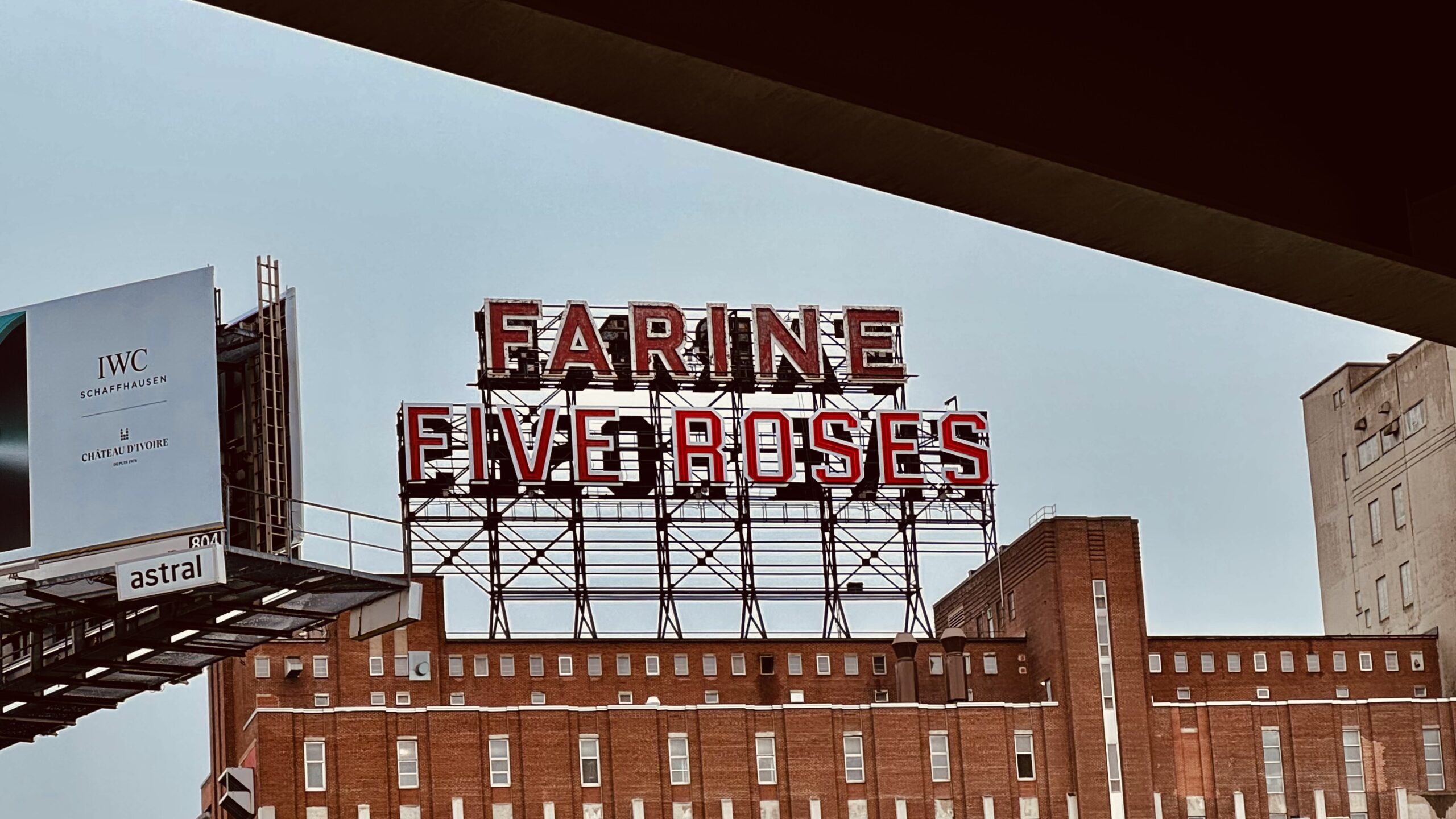
Under the Bonaventure Expressway. The Five Roses sign at an angle I hadn’t expected from here. REM trains to my right, sliding past without sound from where I’m sitting. Water. I’m always near water these days, and I’m starting to think that’s not incidental.
A bus passes overhead and the whole structure hums. Rain making texture over the basin, fine and persistent, the kind that doesn’t announce itself. Black railings, rusted, graffiti-covered, dripping. Lines of water just waiting to fall. Sand. One of those public workout structures no one is using at this time on a Saturday morning. A group of runners in high visibility spandex and shorts run down the bike path. The city in every direction, and Griffintown beyond it, for rent signs on every building.
I’ve been coming to this city as someone who’s leaving. I didn’t notice until I sat down.
I developed a habit, somewhere in the last year, of waiting for the role that already speaks my language. The one where the job posting uses words close enough to mine that I can step in without translation. I projected myself so completely into those futures that when the doors didn’t open, I had to grieve whole lives I had never lived. And then came the questions, quieter and more damaging than the disappointment itself: I thought I was made for this. I didn’t even get an interview. What do I do with that?
Yesterday, I applied for more jobs than I had in all of last year. Something loosened. I sat with the grief and then I just started applying. Not waiting for the role that already recognizes me. Apply, and release. The worth of the work is established in other rooms, by other accountabilities. A search committee is not the final word on any of it.
I’m finishing a PhD in fields being actively criminalized south of the border, at a political moment that has shifted so much since I started that some days it’s hard to remember what the urgency was supposed to look like from the outside. When I began there was appetite. Now the appetite has moved, or curdled, or gone underground, and I’m here with a dissertation about fugitive care and speculative health and Black queer survival, graduating into a structure that is rapidly deciding this work is a liability.
And yet. The peer review. The publications. The editor’s face at the ball. The collaboration still coming. Something has expanded inside the work that I didn’t plan for. The quality of attention is different than it was three years ago. I can feel it when I write, the way a sentence finds its own weight now, the way I trust the observation to carry more than it used to. I didn’t manufacture that. It accumulated through drift, through coming back to the same water in different weather, through learning to let the body lead and follow after it with language.
I can’t be expected to always produce from what I carry in my body. That wouldn’t be research. That would be extraction.
I also deserve care.
I also deserve care.
Not to break the fourth wall or anything, but I keep thinking about these posts. How they might eventually compile into something. A monograph, maybe, or the evidence of one: a methodology demonstrated rather than argued, drift as a way of knowing, the fragment as form. What I’ve been building out here, in public, might already be the work. Not preparation for the work. The thing itself, accumulating. That feels important to say out loud, even just to myself, under the expressway, in the rain. And then an Amtrak train rolls backward across the bridge over Wellington, toward Gare centrale, and I think about Avery Gordon, about haunting, about what it means to walk grounds that announce their own history on interpretive signs beside empty lots.
This is one of the birthplaces of industrialization in Canada, the signs say, and the land they mark is largely vacant. The apartments going up in Griffintown are full of people who arrived after whatever the land remembers. Irish famine migrants came through here in 1847 carrying typhus, tens of thousands of them, and the ones who didn’t survive were buried in mass graves not far from where I’m standing. The Black Rock near the water marks some of them. The neighbourhood that bore their labour and their dying was eventually abandoned, then razed, then rebranded as a market for luxury condos with exposed brick and river views. The exposed brick is original. I’m walking through it, making my own record, adding my body to the account.
The running club has crossed to the other side of the canal. I don’t know when that happened.
I want to stay in this city. I have wanted to stay. But I know what it means to be this particular person at this particular moment in this city’s politics, and that knowing sits in my chest differently than the wanting does. They are both true. They do not resolve each other.
I don’t have a job. I’m tired. I said that in my previous post and it was real and it needed saying.
And also: I’m not stuck. I have a place to stay, for a few months or longer if needed, with a friend I love. The flexibility I’ve been reading as precarity is also, just barely, freedom. The frantic searching, the plans that keep changing because they always do because that’s the nature of these structures, maybe that’s what has been keeping me half out the door. Engaging with the city as someone already in transit. Already gone.
I think receiving the news by the canal on that day unbraced something in me. The body did the work and the mind caught up later, slow and a little embarrassed. Maybe this is the same thing. Maybe I need to let myself unbrace again: to be here, in Tiohtià:ke, under concrete, watching water. To hold the basin, the railings, the grey of the sky, without requiring any of it to resolve.
Maybe when I stop the frantic searching, direction makes itself clear. It has before. I have evidence of that. I can use it.
Pacing and waiting and unbracing at the Peel Basin. The rain drips and the texture changes. A REM train speeds back toward the mountain. The water waits.
Maybe that’s enough. Maybe that was always enough.
Leave a Reply