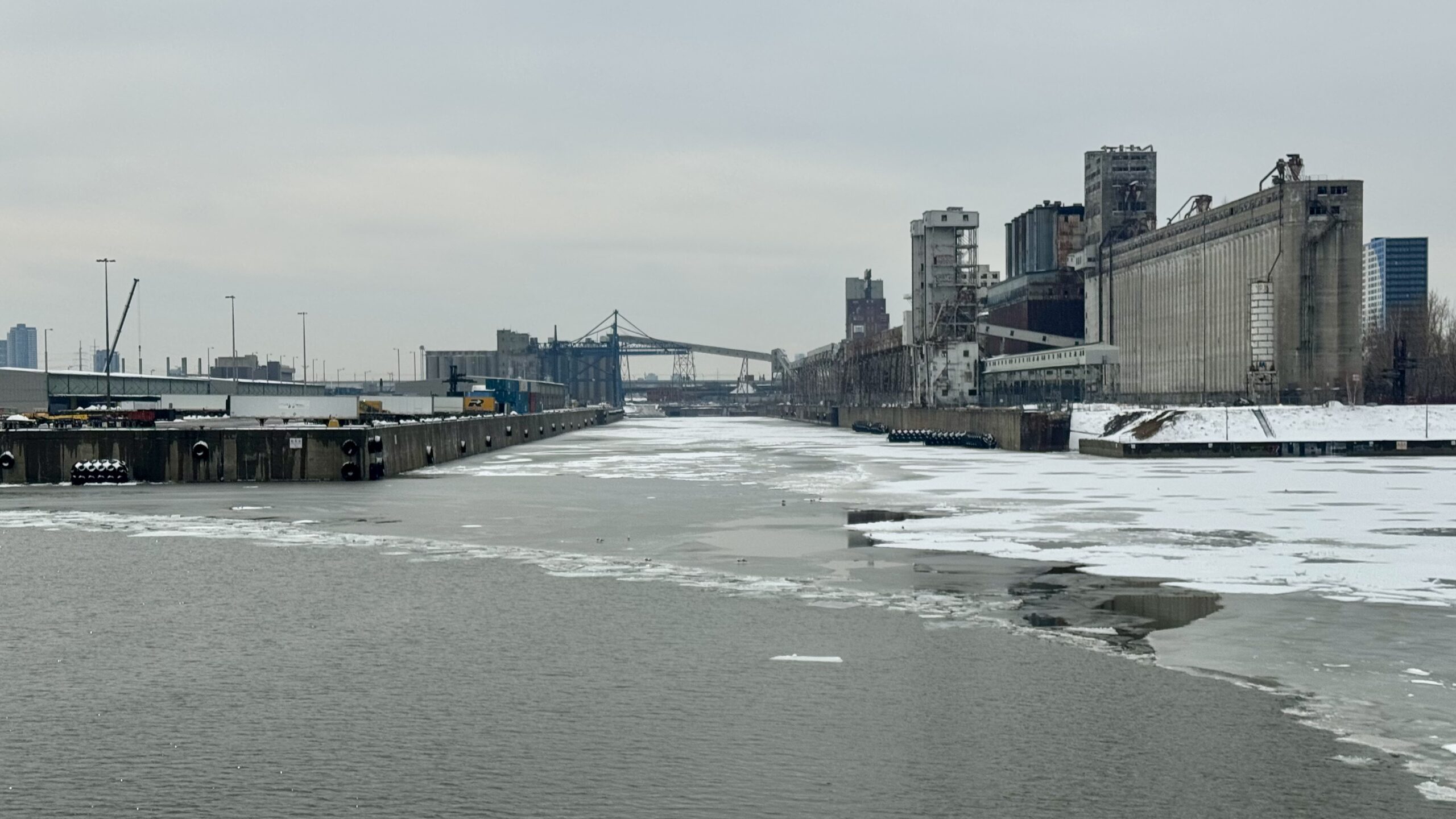
The ice is sweating. Moisture gathering at the surface, at the precise line where the ice meets the water it’s in the process of becoming. I’m watching it from the bench on the pier, the same bench, the same eastward orientation I keep returning to without quite deciding to. Gulls have settled at that line and they don’t move. They know something about thresholds. They sit exactly where the transformation is occurring and they stay.
The St. Lawrence in late March. The ice still holds toward the middle, grey-white and flat. At the edges it’s releasing, the surface doing its slow work, and the water that was held all winter is beginning to find its way back into current. I’ve been sitting here long enough to watch it happen. I haven’t moved either.
There’s a specific quality of attention this place produces in me. I come here when the body has been holding too much and needs to set it down somewhere that can receive it without asking what it is. The body keeps returning to this exact spot, this exact orientation, facing east, the city at its back, and at some point the repetition itself becomes information.
I put the city at my back when I sat down. I know what’s there. I know this city the way you know something you’ve loved through several versions of itself and several versions of yourself — its pace, its particular generosity, the specific texture of its contradictions, the way care gets built here inside difficulty. I’ve walked these streets through enough seasons to have accumulated a real knowledge of this place. That’s most of what I know about how to survive.
The most enslaved people in what is now called Canada lived here. In these streets. In these buildings’ predecessors. They moved through this geography, were bought and sold in it, built what became the city now sitting behind my left shoulder. Montréal, Québec City, the towns along this river — the institution put down roots here, made its records here, established itself in French and in English and in the silences between the two. The history is documented and specific and present. It’s in the soil the city was built on. It’s in the financial foundations of institutions that are still standing. The place holds this whether I acknowledge it or not. What I try to do is be someone who doesn’t pretend otherwise while I’m standing here — who doesn’t let the beauty of the water or the particular way the light falls on the ice in March do the work of making the ground feel neutral.
Follow the St. Lawrence east and you reach the Atlantic. The Atlantic is the route of the trade. The trade is the origin of my lineage. The river in front of me, moving in the direction it has always moved, is carrying water toward the ocean that carried my ancestors. The body standing at the edge of this pier and the current visible at the edge of this ice are not separate things. There’s a line from here to there that is literal — longitude, current, the specific direction water moves when the land finally releases it into the sea. I keep facing east. I keep coming back to this exact orientation. The body keeps choosing it. The eastward pull runs deeper than this lifetime’s accumulation of difficult days and necessary walks. The ancestors are in the direction the water goes. Facing east, here, at this river, is a form of relation.
Ancestral presence feels like a quality of attention, a pressure in the chest that arrives when you’re standing somewhere that holds more than it shows, a recognition that moves through the body before the mind has assembled the full sentence. I’ve felt it here before. I feel it today. Something in the body responds to this geography in a way it doesn’t respond to other geographies, and I’ve learned to follow that response without demanding it become more legible than it is. I’m not the first Black person to stand at this water. I’m not the first to face east from a shore on this river and feel the weight of what the water knows. There’s an accumulation in a place like this — of the people who came before, of what they survived and didn’t survive, of the specific grief of those who were brought here and those who were born here into conditions not of their making. That accumulation sits in the body alongside everything else, indistinguishable sometimes from ordinary grief, sometimes from the particular tiredness of carrying one’s own history through a world that keeps asking you to set it down. I stay with it. I’ve stopped asking it to become more coherent than it is. Some knowledge arrives in sensation and lives there, and the staying is the practice.
The gulls haven’t moved from the line where the ice sweats. I keep returning to what they seem to understand about that specific location — the threshold between states, the place where one thing is becoming another and the process is incomplete and you can see both at once if you look closely enough. The grief of knowing what the water knows is structural. It predates you and will outlast you. It lives in the body as inheritance rather than as event. The grief of standing at a river that runs toward the place your people were taken from, in a city built in part by their labour and their captivity, in a body that carries the record of all of it — that grief has no clean edges. It doesn’t arrive in a single moment and it doesn’t resolve in one either. It moves the way the ice moves. A slow release at the surface, the held thing finding its way back to motion, not all at once but gradually, at the line between what was solid and what is becoming current again. The holding is structural, which means the release is too: slow, incremental, happening at the edge where the conditions finally allow it. This is one of the few places where the grief the body carries and the geography underfoot are in direct relation. Where the river is already doing the work of holding the history, because it runs through the same history on its way to the sea.
There’s a practice in returning. Each time the body is slightly different — more tired, or more clear, or carrying a different weight — and the place receives that version without distinction. What accumulates is a relational knowledge, built through repeated presence, through being changed by a place over time and being willing to notice the change. I know this stretch of the St. Lawrence in winter. I know what the ice looks like at different stages of forming and releasing. I know the quality of the cold here and how the wind comes off the water and where the light lands in the late afternoon. That knowledge was built through return, and it means something that it was built at this geography. The body knew to come here today. It knew the turn toward the water before the thought to turn had fully articulated itself. This is what happens when a practice has been sustained long enough that the body has internalized its logic. The walks have their own intelligence. The route has its own memory. And underneath that memory, older routes: the ancestors returning to water, finding their way to shorelines for their own reasons, carrying their own knowledge of what the water holds. Some of those routes were interrupted. Some were destroyed deliberately, the paths erased along with the people who made them, the knowledge scattered in the violence of what was done. The practice of return is partly an attempt to hold what was held, to keep a thread from breaking entirely, to maintain a relation to geography that was never supposed to be maintained. I have this river. This body. This bench facing east. I’ve stopped waiting for more before taking it seriously.
The ice is still sweating when I finally stand up. The gulls have shifted slightly but they haven’t left the line. The water at the edge is darker now than when I arrived, more current visible, the release progressing through the afternoon. I stand there for a moment before turning back toward the city, facing east with the cold on my face, feeling the specific quality of attention this place produces and letting it finish what it was doing before I interrupt it with movement. The river will keep doing this after I’m gone from the pier. The ice will keep its slow release toward the edges, the sweating at the line, the water finding its way back into current. The St. Lawrence will keep running east the way it has always run, carrying whatever the city gives it, moving toward the Atlantic with the patience of something that has been doing this longer than anyone alive can remember. The ocean it runs into will keep holding the history it holds. The salt will stay salt.
At the end of everything, it all returns to that. The ocean that carried my ancestors. The river that runs into it. The body standing here, made of water and what water holds, at the edge of a geography that is mine and not mine, claimed and unclaimed, loved and not yet finished being grieved. The ice sweating slowly back into motion. The gulls at the threshold. The city at my back, built on what it was built on, holding what it holds.
The water already knows all of it. I come here to remember that I do too.