Category: Academic

  • Eastward

    Eastward

    The ice is gone.

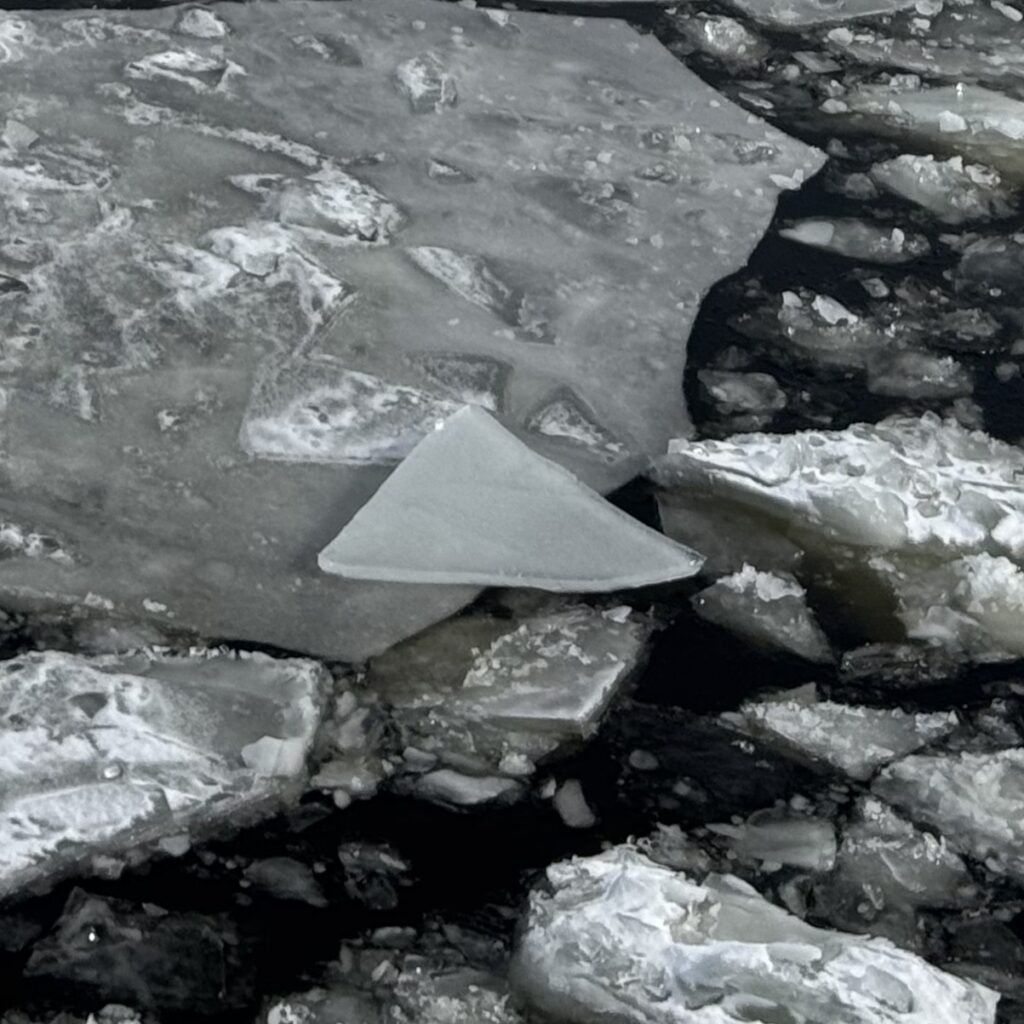
    I notice this before I’ve settled fully onto the bench, the oat milk moka still warm between my hands, the pines along the boardwalk doing their slow work in the wind. Habitat 67 sits in my peripheral vision the way it always does. The Jacques-Cartier Bridge. The amusement park still closed for the season, rides standing idle behind the fence. This is the same bench, the same eastward orientation I keep returning to without quite deciding to. The Grand Quai in late April looks like a different river than the one I’ve been sitting with all winter, and in some ways it is. What I’m looking at now is water that has finished its holding. The ice that was here, the particular piece I wrote about once, the one that had taken the shape of a perfect triangle and pointed east the day I submitted my application, is gone. The river took it. That’s what rivers do across a season, with what they’re given.

    I came back because the body knew to, before the rest of me had a reason.

    Yesterday the city was warm.

    I had finished a book on a terrasse on rue Saint-Paul, the last page coming the way last pages do when you’ve been living inside something long enough — not with surprise but with a recognition that the shape had completed itself. I sat with the last sentence for a moment before closing it, the way you sit with the last note of something before the room starts being a room again. Espresso. A crepe. The sun was doing what it had no business doing in the last days of April and rue Saint-Paul was receiving it without question, the old stone of the buildings holding the warmth differently than the glass towers do, softer, like the city remembering an older version of itself. People moved slowly. Faces turned up. I had nowhere to be and the body knew it and settled accordingly, shoulders dropping to a place they haven’t reached in months, the jaw unclenching, the particular luxury of a Tuesday that belongs entirely to itself.

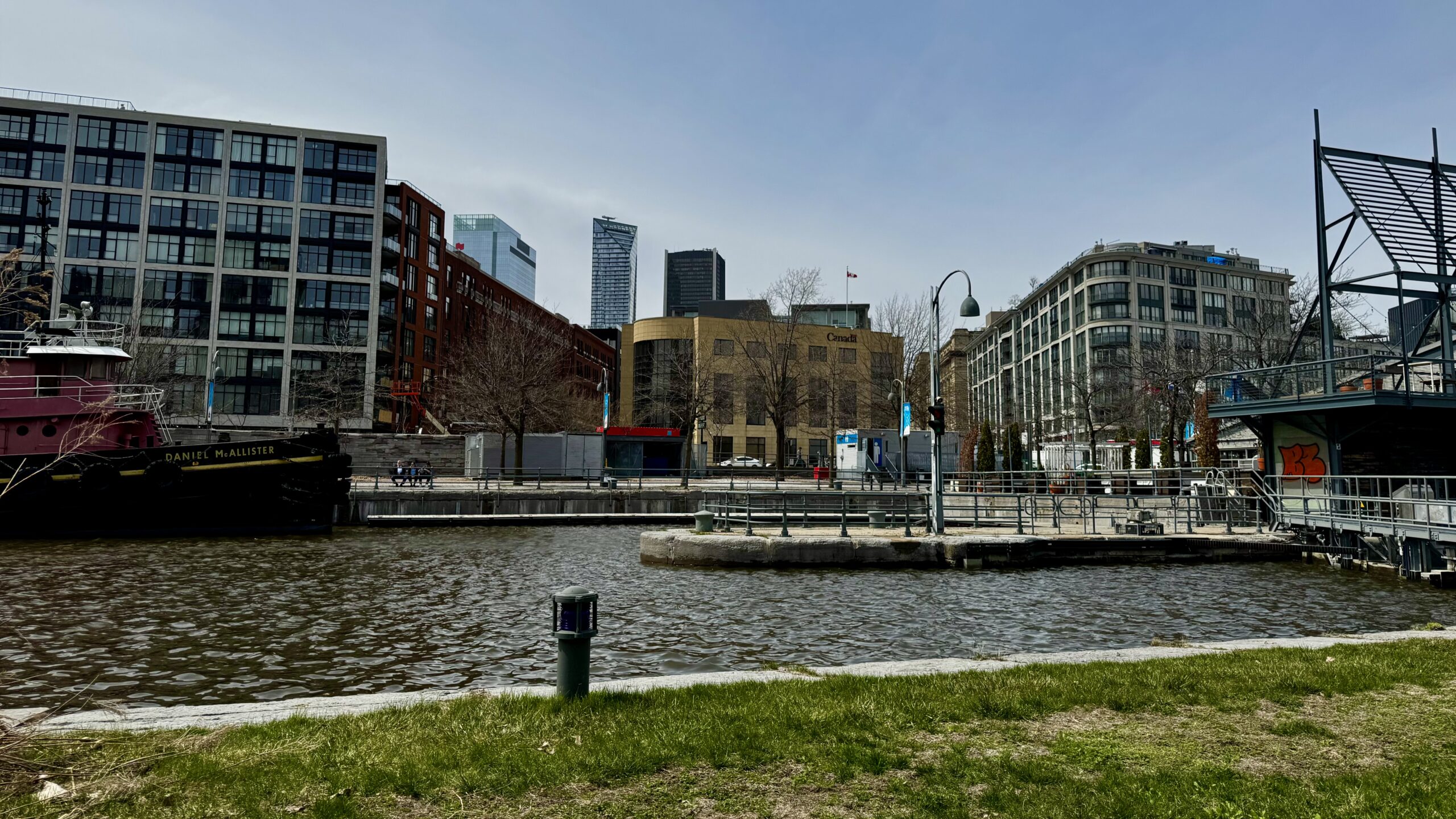
    I walked to the Lachine Canal after. The streets through the old port were still carrying the warmth, the light coming off the cobblestones at the angle it only reaches in spring, low and honeyed, the kind of light that makes the familiar look briefly precious. The Daniel McAllister was sitting in the locks the way it always sits, red and massive and indifferent to what the afternoon was doing around it. I found a patch of grass near the water, soft from the recent thaw, and lay down with my backpack as a pillow and let the sun press into my face and chest and the fronts of my hands. The body settled into the ground. The canal moved beside me with the particular quietness of still-cold water in a warm month. Somewhere across the water a bird was doing something persistent. I closed my eyes.

    The body was already somewhere it recognized. Water, the eastward pull, the quality of attention that arrives in me when I’ve been near this city’s waterways long enough to stop performing being near them. I didn’t know I had brought anything. I thought I was lying in the sun on a warm day with a finished book and nowhere to be. The email came into that. I stared at the water for a long time after. Not thinking. Not yet. The canal kept moving the way it had been moving before the email arrived, indifferent to the reordering that had just occurred inside my chest. The sun was still doing what it had been doing. The Daniel McAllister hadn’t moved. I lay there with the phone face down on the grass beside me and let the body do what it needed to do with the information before I asked it to do anything else.

    Not even an interview.

    I knew it before I opened the email. Had known something was coming since morning in the way you know certain things through the body before they arrive as language — a low settling, a particular quality of stillness that isn’t peace. I had been waiting eight weeks. The waiting had lived in my shoulders, in the bracing I’ve been writing about for months, the compression that doesn’t shift with rest or movement. And then the day had been so good. The book finished, the sun, the terrasse, the city briefly being the version of itself that makes you forget you know better. I think now that the body had been preparing the whole time, had been carrying the knowledge forward through the morning and into the afternoon, had found the water and lain down beside it because it knew what was coming and wanted to be somewhere it could receive it.

    Four days before this, I was at a ball.

    The editor of a collection on queering research methods was in the city — they had already read the chapter I submitted, the one that takes ballroom as its methodological site, had held the manuscript in their hands and followed the argument through — and it happened, the way things sometimes happen in this work, that there was a function that weekend. Le National was filling up as they arrived, the air carrying that particular charge a ballroom space holds before the first category is called, sweat and cologne and anticipation and the low thrum of a sound system that knows what it’s there for. This is my place. The place where my body remembers things about itself it forgets in other rooms.

    The commentator was electric that night. It’s the girls I see, it’s the girls I know, it’s the girls I LOVE! — the chant landing and lifting and landing again, the whole room carrying it forward without being asked, the way a room becomes a body when the conditions are right. For Bizarre and Face the effects came out, light and smoke and the particular theatre of a category that understands spectacle as argument, and the walkers moved through it like they had built the universe the effects were gesturing toward, because they had. Then the commentator called for the DJ to cut the beat. Someone deserved their flowers. The praise came slowly and specifically, the way real recognition does when it isn’t performed but meant. I turned to them and said: imagine what a moment like that does for your self image.

    They were watching the room the way you watch something you’ve read about but hadn’t yet felt in the body. And I was watching them watch it, and I was also just there, inside the thing my chapter is about, the thing I have been trying to describe in academic language for years, and for a few unrepeatable hours the distance between the researcher and the researched was not a methodological problem I was managing but simply gone. They saw the work in its own element. Saw what the work knows that the chapter can only point toward.

    The hiring committee reviewed my file and moved on without making contact.


    These are not the same kind of not-being-chosen and my body knows the difference. It also knows the longer record. The tissue that received the email yesterday has received other decisions, earlier ones, ones that arrived before I had language for what it meant to be assessed and found not quite right for the available position. The committee doesn’t know that. The file doesn’t carry it. But the body holds the full archive anyway, and what lands on it now lands on everything already stored there — every room that looked at what I was and made its calculation, every process that moved forward without me, every form of not-being-selected that taught me, before I had words for any of it, that my belonging somewhere was conditional on someone else’s decision. The hiring committee is not the first institution to review my file and conclude I wasn’t what they were looking for. The body has been here before.

    What I know is that my work circulates. It reaches into rooms before I do. The professor who was hired for the anti-colonial social work position I applied for once asked me to lecture in one of their courses, on anti-Blackness, because of the strength of what I had built. The editor came to the ball. The work is not invisible. What it is, is illegible to the institutions that would need to legibly credential it in order to shelter it. There is a difference between being seen and being chosen, and I have been living inside that difference long enough to name its specific texture — the way it sits in the chest distinct from ordinary disappointment, distinct from failure. This is not failure. It is something more precise and in some ways more exhausting than failure, because it requires knowing the value of what you’re holding while watching the institution decide it doesn’t know what to do with you.

    I have to pay my bills. I don’t have a job. In a few months the PhD will be finished and the structure it provided — the funding, the timeline, the container — will be gone, and the practice is already closed, and the position didn’t come, and I am sitting at the bottom of every scaffold at once. I know the work has value because I have watched it have value, repeatedly, in rooms that received it on its own terms. I am also scared in a way that doesn’t care what I know.

    A triangular piece of ice, pointing eastward, on the surface of the Saint Lawrence in late February.
    A triangular piece of ice, pointing eastward, on the surface of the Saint Lawrence in late February.

    I came back to the Grand Quai this morning because this is where I picked it up.

    Eight weeks ago there was ice here. A piece that had taken the shape of a perfect triangle, pointing east, and I had stood at this water and let that mean something on the day I submitted the application. I know what I felt standing here, the particular quality of a sign you don’t go looking for, the way the body receives it before the mind has decided whether to believe in that kind of thing. I let it mean something. I carried it forward through eight weeks of waiting, through the compression and the bracing and the not-knowing, and I brought the weight of it with me to the canal yesterday and it was still there when the email arrived.

    The ice is gone now. The river took it back sometime in the weeks I was waiting, dissolved it into current the way it dissolves everything it’s given across a season. I’m looking at open water. The same eastward orientation, the same bench, Habitat 67 still on the opposite shore, the boardwalk’s pines still swaying slowly in the wind. The place hasn’t changed. What it was holding is gone.

    I’ve been watching this stretch of water long enough to know what it looks like when it’s finished holding something. This is what it looks like.


    So I put it down.

    Not the work. Not the knowing. Not the particular exhaustion of being this person in this work at this moment. Those travel with me. What I’m putting down is the version of the future I had been carrying in my chest since January: the particular mornings I had been imagining, the quality of quiet in a small town, the body that might exist there, less braced, more available to itself. The version of myself that had a title and a campus and a room where the work could happen on its own terms. I had given that version a lot of grace. I had let it become specific. I had let myself want it.

    The ancestors came from the direction this water runs. The shard of ice that pointed east is already out there somewhere, dissolved into the Atlantic, returned to the water that carried my people. I’m not the first one to sit at this river and give something to the current. I won’t be the last.

    The trucks are still beeping in the distance. The pines are doing their slow work in the wind. Habitat 67 and Île-Sainte-Hélène and the Jacques-Cartier Bridge still sit in my peripheral vision, the amusement park still closed, the rides standing idle. The oat milk moka has gone cold in my hands. The sky is the particular grey of a day that isn’t going to change its mind.

    I’m still here. I’m still undone. The water already knows what to do with what I’ve brought it.

    Fediverse Reactions
  • When Institutions Demand Our Labour but Not Our Voices

    When Institutions Demand Our Labour but Not Our Voices

    There is a particular kind of exhaustion that comes from being invited into a space only to realize that your presence was the priority, not your voice. The expectation was that you would show up, fill the quota, sit on the panel, make the institution look good—without challenging its structure, without demanding more than what was already decided.

    I have been in these spaces too many times to count. I have watched institutions that claim to care about Black voices, queer voices, abolitionist voices drain the life out of people who enter them believing, against all odds, that they might be able to create change from within. Universities, funding bodies, social work organizations, community initiatives—they all know how to position themselves as inclusive. They know the language of equity and representation. They know how to craft the right optics. But when we speak, when we name the contradictions, when we refuse to be flattened into their diversity statements, they make it clear: our labour is welcome, but our voices are not.

    It is never just one moment. It is a pattern. A structure. A way that institutions operate to extract what they need from Black thinkers, activists, and community workers while maintaining control over the spaces they claim to open up for us.

    The Many Forms of Institutional Extraction

    In universities, it looks like being invited to speak on “diversity and inclusion” panels, but never being asked to lead research that critiques the institution itself. It looks like racialized scholars being pushed into unpaid emotional labour—mentoring students, chairing equity committees, doing the messy relational work of care—while white colleagues focus on their research without the added burden of proving their value. It looks like funders celebrating Black scholarship in their marketing materials but only financing projects that do not threaten their power.

    In social work and community organizations, it looks like Black and Indigenous practitioners being called on to educate white professionals on anti-racism while working within systems that refuse to meaningfully change. It looks like organizations that parade their commitment to decolonization, trauma-informed care, and community leadership, while maintaining the same hierarchical, settler-colonial structures that prevent Black and Indigenous workers from exercising real decision-making power. They want our knowledge, our cultural competency, our ability to reach the communities they claim to serve. But when we ask for autonomy, self-determination, or actual redistribution of power, they ghost.

    Even in ballroom and grassroots spaces, the pattern repeats itself. I have seen corporations, brands, and even queer organizations tokenize ballroom culture while offering nothing in return. They will sponsor a ball for optics but never fund the survival of the community. They will parade ballroom as a symbol of queer liberation, yet ignore the material conditions of Black queer and trans people beyond the performance. Major brands will put ballroom performers in ad campaigns, yet pay them a fraction of what they give white queer influencers. They will co-opt our language while refusing to invest in the spaces that sustain us. They want the spectacle, not the politics. They want the culture, not the care. They will use the language of “house” and “family,” but their investment stops the moment the cameras turn off.

    The Cost of Being Seen But Not Heard

    The cost of this is not just burnout, alienation, or frustration—though it is all of those things. It is the weight of being asked to perform expertise without being given the tools to enact it. It is being invited into a room only to realize that your presence is symbolic, not transformative. It is the slow realization that these institutions were never designed to hold us fully, only to extract what is useful before discarding the rest.

    This is how institutions make us question our own instincts—by making us believe that if we just advocate harder, just soften our words, just play the game a little longer, we might be able to shift something. But that shift never comes. Instead, we exhaust ourselves in a system that only rewards our presence when it is convenient, and punishes us when it is not.

    For a long time, I thought the answer was to demand more from these institutions—to advocate, to push back, to make them understand that inclusion without power is meaningless. But I have learned that institutions are not built to listen. They are built to extract. They are built to absorb critique without transformation. And so the question is not how we make them see us, but how we decide where to place our energy.

    Choosing Refusal Over Extraction

    Refusal is a skill. It is an act of survival. It is learning to recognize the spaces where our work will be extracted and discarded and choosing, instead, to build elsewhere. It is understanding that we are not bridges to institutional legitimacy—we are architects of something entirely different. It is naming the harm without softening it, without waiting for an invitation to be palatable. It is leaving the table when the meal was never meant to sustain us.

    I no longer waste my time trying to be heard in places that have already decided what they are willing to hear. Institutions will always seek our labour, but we get to decide where we give our energy. Our work belongs to us—not to the systems that refuse to listen.

  • Urgent Call for Dalhousie to Divest from Companies Complicit in Israeli Occupation

    Urgent Call for Dalhousie to Divest from Companies Complicit in Israeli Occupation

    Dear Members of the Dalhousie University Board of Governors,

    As a current doctoral student at Dalhousie University, I feel compelled to speak out on an issue that goes to the very heart of our shared values as an academic institution. The university’s investments in companies complicit in the illegal Israeli occupation of Palestine contradict its commitments to equity, justice, and human dignity. This is not just a financial matter—it is a moral crisis. Dalhousie’s continued financial ties to these companies make it complicit in ongoing violence that the United Nations has clearly identified as having genocidal intent.

    The recent report  by UN Special Rapporteur Francesca Albanese provides chilling details about the systematic destruction of Palestinian life in Gaza. The report describes the forced displacement, mass killings, and deliberate targeting of civilians as actions that amount to genocide. This is not a distant issue; it is one that our university directly engages with through its investments in companies that profit from illegal settlements, home demolitions, and militarized violence. These financial choices have real, devastating consequences for millions of Palestinians.

    Dalhousie’s history shows us what happens when institutions prioritize profit over people. The Lord Dalhousie Panel Report laid bare the university’s deep entanglements with anti-Black racism, slavery, and colonial exploitation. While efforts have been made to address that legacy, the university’s investments in companies enabling the destruction of Palestine perpetuate the same systems of violence. These decisions undermine everything Dalhousie claims to stand for.

    As a student at this university, I had felt proud to be part of a community that values equity and reconciliation. But those values must be reflected in our actions, and over the three years I have spent at Dal to date, what I have seen is a lot of lip service to equity and social justice without doing the very difficult work needed to actively undermine the legitimacy of the systems that reinforce oppression. Let me be clear: investing in companies complicit in genocide is antithetical to everything our community profess to believe. We cannot look away while lives are being destroyed, communities erased, and an entire people subjected to state-organized oppression. Neutrality in the face of such violence is complicity.

    My work as a scholar focuses on how systemic violence fractures communities, identities, and lives. I know deeply how interconnected these struggles are. The settler-colonial violence Palestinians and Lebanese populations face today is not unlike the legacies of anti-Blackness and Indigenous dispossession that continue to shape Canada and Nova Scotia. These systems of oppression are linked, and our response to one reflects our commitments to all.

    Dalhousie has an opportunity to lead—not with words, but with action. Divestment is not a radical demand; it is a necessary step toward aligning the university’s financial practices with its values. By divesting, Dalhousie can affirm its commitment to justice and human dignity, standing in solidarity with those resisting systemic violence. This is not just about Palestine—it is about Dalhousie’s role in shaping a more just world.

    I urge you to act now. Divest from all companies complicit in the illegal Israeli occupation. To delay is to allow our resources to continue funding violence and destruction. The choice before you is clear: to perpetuate harm or to stand on the side of justice.

    This is a defining moment for our university. Let Dalhousie be remembered as an institution that chose accountability and courage in the face of genocide. Let it be a leader in the fight for equity, dignity, and human rights.

    In solidarity,

    Vincent Mousseau, MSc RSW
    PhD Student
    Faculty of Health, Dalhousie University